Full article about Schist silence in Nisa’s three-parish plateau
Cork bark, stone crosses and chilli-warm Nisa cheese under an Alentejo hush
Hide article Read full article
A hush over the montado
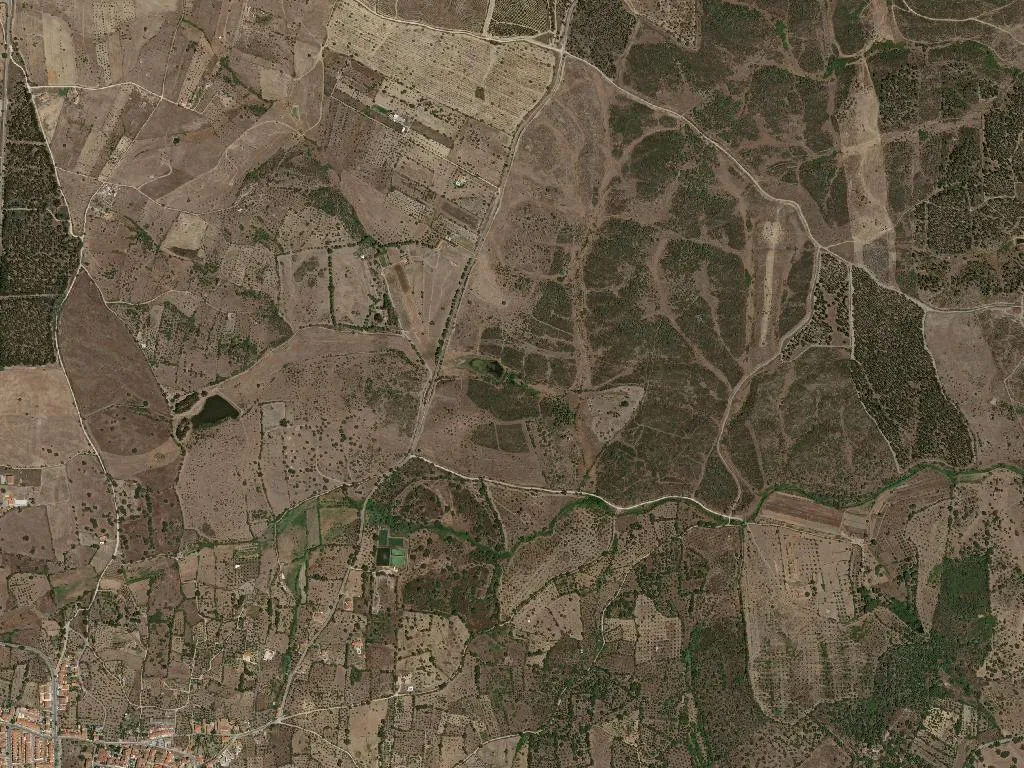
The afternoon is so still you can hear holm-oak leaves rasp softly in the breeze. At only 241 m above sea level, the plateau rolls away in a quiet mosaic of cork trunks—their bark recently stripped to raw copper—and olive groves that tilt at irregular angles against a rinsed-out Alentejo sky. In the hamlets of Espírito Santo, Nossa Senhora da Graça and São Simão, schist walls drink in the sun while white limestone quoins flash back the light like blind mirrors. With barely two inhabitants per square kilometre, space itself seems to exhale.
Stone, faith and memory
The three parish churches that give the municipality its cumbersome name serve as triangulation points in a landscape that repeats itself, wave after wave, to the horizon. Inside Graça’s single-nave interior, a 17th-century wooden Madonna brought back by pilgrims has had her painted fingers burnished smooth by centuries of candle smoke. Countryside stone crosses mark abandoned pilgrimage routes; in deserted farmyards, granite walls slump under acid-yellow lichen. Step into São Simão without closing the door and your footfall drifts longer than you expect, as if the stone itself were replaying every whispered Credo since the Reconquista.
Taste of schist and sheep
At the cooperative, North-Alentejo olive oil sluices gold from the press, leaving a rasp of green fruit on the tongue. Yet the defining flavour here is Nisa DOP cheese: aged on rough-sawn timber, its rind freckled with noble mould, its interior butter-yellow and chilli-warm. Tolosa, the milder “mixed” cousin, carries the memory of a vanished local estate rather than the Basque city it evokes. In tascas, clay bowls arrive steaming with açorda—coriander-garlic broth soaked into yesterday’s bread and crowned with a poached egg that breaks into a sunset swirl. Local reds, grown on fractured schist, carry the same mineral tang you taste when you lick a sun-heated stone.
Trails among mills and dry streams
The Trilho dos Moinhos snakes between São Simão and Espírito Santo, following a winter torrent that in spring throws up wild orchids between the pebbles. Windmills stand sail-less, stone skeletons etched against the fading light. Under the cork canopy, last year’s leaf-litter crackles; somewhere a boar roots with the sound of wet tarpaulin being dragged across earth. In deeper valleys, black vultures ride slow thermals, wing-tips splayed like burnt paper.
Between schist and silence
Part of the Naturtejo Geopark, the plateau is an open book of Palaeozoic drama: folded schist, thrust faults that rip the land like torn fabric, boulders polished by 300 million years of weather. Inside the interpretation centre, fossils and tectonic maps translate the story; outside, on the Georota de Nisa, geology becomes weight and texture—the cold rasp of slate in the shade of a cork oak that was already mature when Wellington’s troops marched through. Local slate miners once called it “the singing stone”: split at noon in August it gives a dry click indistinguishable from the cicadas’ electric drone.
Slant light
Come late afternoon, oblique sun sets São Simão’s walls ablaze—lime wash cycling through rose, apricot, copper, each tone lasting seconds. A single church bell sends one low note across the valley, the vibration hanging longer than the sound itself. Wood-smoke from holm-oak drifts straight upward in the motionless air, and you learn the Alentejo art of waiting without impatience.