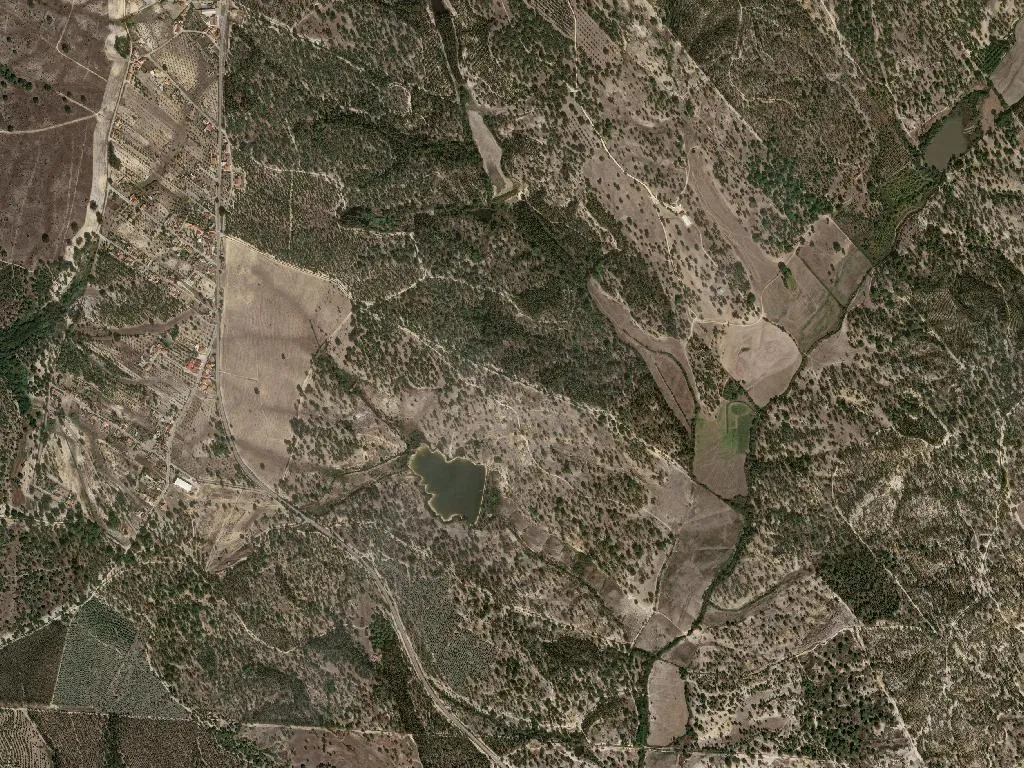
Full article about Foros de Arrão: Where Sheep Outnumber Souls
Merino bells echo across wheat-stubble plains outside Ponte de Sor’s quietest parish.
Hide article Read full article
Where the asphalt surrenders to sheep bells
The Alentejo sun lands on the tarmac of the N244 like a physical blow. By mid-morning the road surface is already sticky, and the only sensible place to be is beneath the 400-year-old olive trees of Herdade da Casa Nova, whose trunks are wide enough to park a tractor against. From this wavering shade the land rolls away in a blond sheet of wheat stubble and cork oak savannah, interrupted only by the bell of São João Baptista calling 450 Merino ewes to the milking parlour at Queijaria Monte da Azinheira.
Foros de Arrão, a parish swallowed inside Ponte de Sor’s 82 km², numbers 811 souls. That works out at roughly one person for every ten football pitches; walk five minutes in any direction and you have the horizon to yourself. The settlements – Foros itself, Vale do Arneiro, Vale de Açor – sit so lightly on the land that locals still measure journeys in time, not kilometres: quarter of an hour to Café Central for a bica, half an hour to the only butcher who still slaughters on site.
The taste of thyme in curds
Tolosa’s Mestiço cheese carries the region’s Protected Geographical Indication for a reason. The blend of black Merino ewe and Serrana goat milk is coagulated with lamb rennet at exactly 36°C, hand-pressed into oak moulds, then left to breathe on pine shelves for sixty days. Rosa Maria Pereira, who runs Monte da Azinheira with her cousin Zé Natário, can read the pasture in each wedge: wild thyme, hill rosemary, rockrose – the maquis scrub that forces animals to graze slowly, concentrating flavour.
Shepherding here is less a romantic backdrop than a stubborn economic fact. Twelve full-time pastors remain; José Manuel Cardoso, 58, is one. He knows every water point along the Sor river and every cork oak that throws shade at 3 p.m. in August. The average age of his neighbours is 65; children account for fewer than nine per cent of the population. Keeping the January Tolosa Cheese Fair alive – held every year since 2003 – is therefore not folkloric decoration; it is a survival strategy.
A horizon measured in mountain silhouettes
Stand on Foros de Arrão’s main street – in truth a single ribbon of patched asphalt – and the eye slides 40 km north until it collides with the Serra de São Mamede. Nothing rises higher than a haystack in between. At dusk the plain turns the colour of old sovereigns and the temperature drops from a brutal 38°C to a breathable 25°C; the air smells of olive-wood smoke and dry straw.
There are seven places to stay, all of them conversions of stone farmhouses or barns. Monte da Charca still keeps its original dovecote; guests wake to António Rosa’s rooster and, at night, see the Milky Way at magnitude 6.5 – dark-sky readings better than those recorded in many official reserves. The nearest supermarket is an 18-km round trip to Ponte de Sor, so dinner tends to be whatever came out of the garden that afternoon: tomatoes the size of cricket balls, lamb scented with marjoram, a slice of Mestiço that has been coaxed, not rushed, into being.
Silence here is conditional: larks at dawn, 11 species of bat at dusk, the soft percussion of sheep pads on dirt. It is the sound of a landscape that has learned to live with absences – and to charge what remains with flavour.