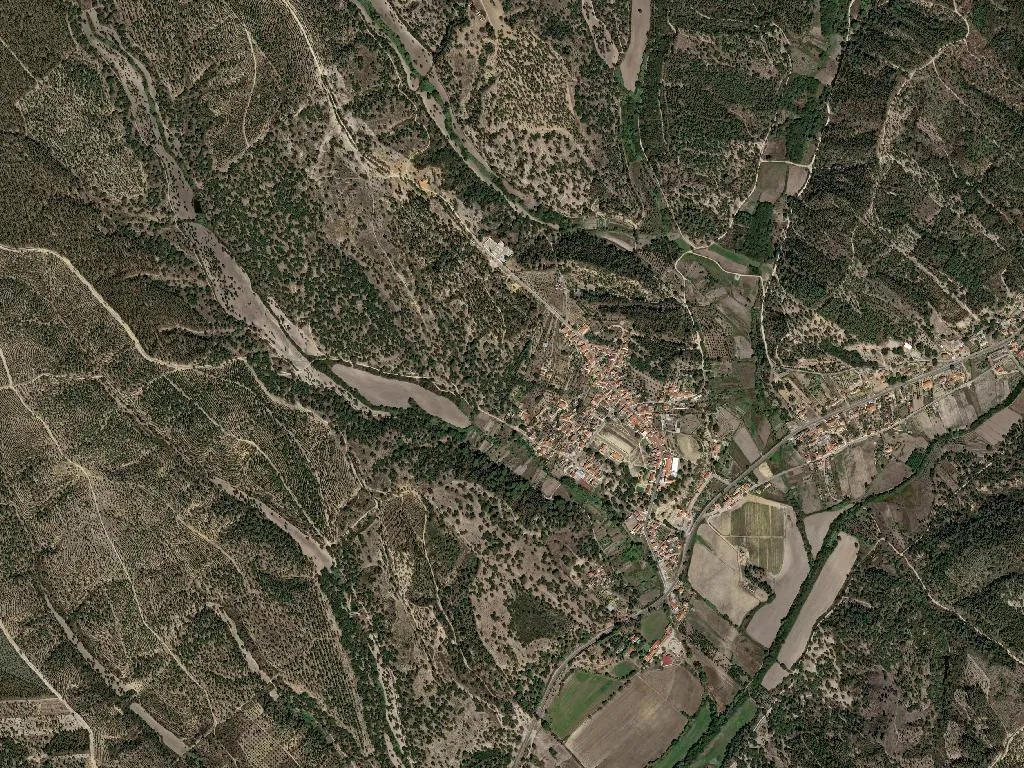
Full article about Longomel: Sardine Crackle in Cork-Scented Silence
Tiny hamlets, ankle-deep stream, storks on telegraph poles—Longomel feeds you petingas and silence.
Hide article Read full article
The sizzle of small fry
The crackle of petingas—tiny sardines—hitting the pan slices through the afternoon hush. It is the signature sound of Longomel, drifting from low kitchen doors where olive oil shivers and women flip the fish until the edges bronze. Five hamlets—Sete Sobreiras, Rosmaninhal, Longomel itself, Escusa and Vale do Arco—share 47 km² of cork-dotted plains and hold, between them, fewer inhabitants than a single London Underground carriage. At 192 m above sea-level the air is thin enough to carry the clap of storks’ wings as they patrol the sluggish Longomel stream.
How water shaped the land
That stream, barely ankle-deep by August, once persuaded villagers to plant rice in the lower fields; today it is coots and mallards that paddle between the reeds. Storks rule the skyline, their nests—dinner-plate platforms welded to telegraph poles—like miniature Eiffel towers strung along the valley. Scholars argue the name Longomel derives from the Latin longum mel, “long honey”; locals side with the honey story for the same reason they still claim Uncle Joaquim nearly signed for Sporting—nobody can prove otherwise.
Stone, lime and a creak of faith
The parish church is white-washed, cool inside, its door hinge squeaking like a reluctant confession. No gilded altarpieces, no baroque theatrics: just a single cedar pew polished by three generations of knees and a bandstand where an accordion once squeezed out Vira waltzes on feast day. The village fountain still spills water colder than lager; the Rosmaninhal water-mill has been locked so long that swallows have forgotten the way in.
Migas, spare ribs and Tolosa cheese
You eat well here because hunger is taken personally. Kale-and-bean soup is thick enough to hold a fork upright; migas—breadcrumbed comfort—are an excuse to decant half a litre of local olive oil; fried spare ribs come with a rim of fat that seeps deliciously into rough bread. Tolosa DOP cheese is sliced by eye, weighed in the palm, gone in two bites. And those petingas are the real thing—silver-skinned, not the anaemic supermarket “baby sardine” fillets flown in from elsewhere.
August fever, perennial Sunday
On the first weekend of August Longomel’s population quadruples. Grandchildren who emigrated to France or Luxembourg pitch tents between olive trees, the bar runs out of Super Bock, and the dance marquee thumps until the priest taps the band leader on the shoulder. The other eleven months feel like one long Sunday: you open the shutters and silence walks straight in.
Learning to live with quiet
Losing a quarter of the village in a decade leaves gaps you can walk through—empty doorways, rusted gates, a football pitch where the grass grows taller than the goalposts. There are 321 residents over 65 and only 76 children under ten. Yet someone has converted a barn into a five-room guesthouse, another keeps hives labelled “Stork Honey” as a joke, and Dona Albertina, 84, swears the trick is “never moving to the Algarve”. Birdwatchers now appear with Swarovski scopes, cyclists follow the new irrigation tracks, and insomniacs pay good money to be woken by a rooster that can’t tell time.
The last light settles on stubble fields. A stork lifts off, wings labouring, the slow beat echoing like a metronome until the bird slips behind a eucalyptus line. What remains is the smell of warm earth, a haze of dust, and the certainty that tomorrow will taste much like today—which, in Longomel, is less a threat than a benediction.