Full article about Lufrei: feel 900-year granite chill near Amarante
Trace Romanesque chisel marks and Baroque gilt in this Tâmega-side hamlet outside Porto
Hide article Read full article
The granite that remembers
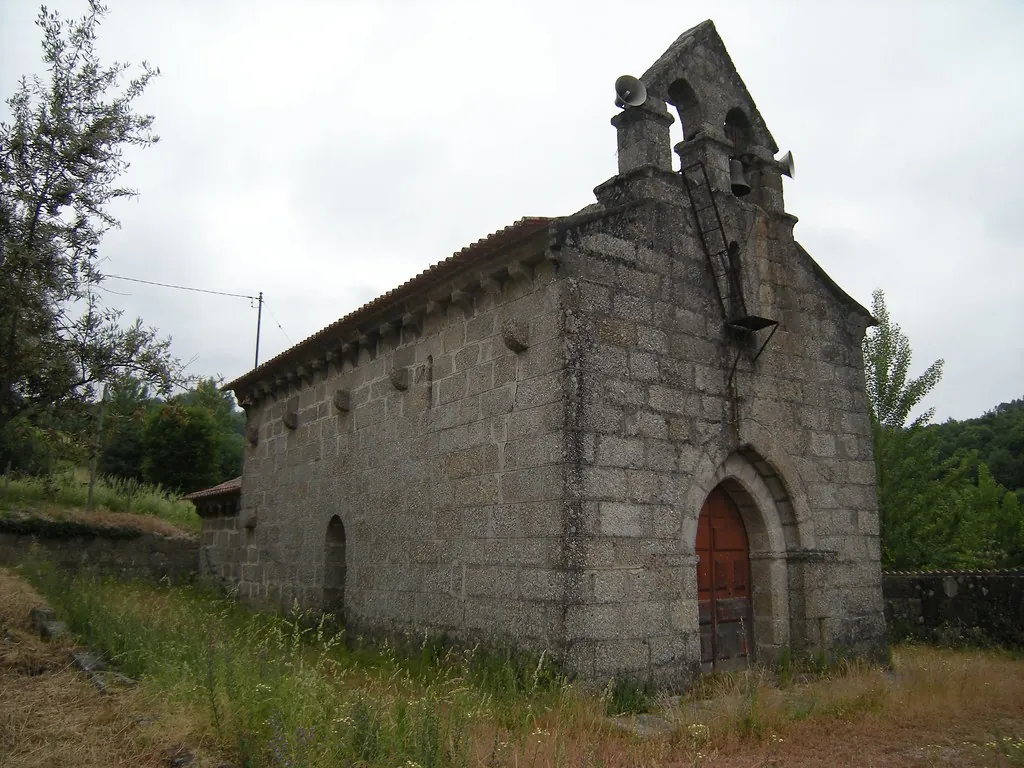
Even when the morning sun has warmed the square, the façade of Lufrei’s church still carries last night’s chill. Lay your palm against the blocks that were hewn nine centuries ago and you feel the rasp of the chisel marks, the velvet of moss packed into every joint, the damp that granite never quite surrenders. Around you, silence is broken only by a cockerel somewhere behind the chestnut trees and the faint, steady breath of the Tâmega, rolling invisible beyond the maize fields.
A Romanesque bridgehead
The parish arranges itself around a Romanesque core consecrated in the twelfth century, when the Benedictine Mosteiro do Divino Salvado ruled both bank and belief on this side of the river. The monastery was extinguished in 1434, but its church survived – spare, almost block-house solid, its triumphal arch ringed by concentric archivolts, its capitals carved with scrolling vines and strict geometry, nothing superfluous. Listed since 2010 on the Rota do Românico (route 3, “Eastern Sousa Valley”), it sits 3.2 km from Amarante’s postcard centre, far enough that you can stand alone in the nave and hear your own footfall ricochet off stone polished by 900 years of shoes.
Eighty metres away, the eighteenth-century Capela do Divino Salvador answers with gilded carpentry of 1743, a Baroque burst of devotion at domestic scale. Between the two buildings you can read the entire stratigraphy of rural faith: austerity, wealth, Counter-Reformation, all layered without erasing what went before.
When the French looked across the water
On 18 April 1809 General Soult’s corps tried to storm the bridge at Amarante. From Lufrei’s higher ground Portuguese militia watched every movement. The parish priest noted in the baptismal ledger a week later: “Today I baptised João, son of José Pinheiro, godfather a soldier of the 2nd Line Regiment who has taken refuge here with comrades.” The same maize terraces that now supply the Minho’s cattle once shook to cannon wheels, though no blue plaque announces the fact. Memory survives only in family anecdotes and in the names of small fields – “Pólvora”, “Mata-dos-Franceses” – that no map bothers to print.
Beef, honey and green wine on the Minho table
Lufrei’s cooking is anchored in two protected products: Carne Maronesa, from the auburn-coated mountain cattle bred on the Marão slopes, and Mel das Terras Altas do Minho, an altitude honey scented with heather and wild lavender. At O Tâmega – the parish’s single restaurant – Thursday market lunches bring a clay pot of lamb and Maronesa shin simmered with smoked paprika, followed by the region’s emphatic sarrabulho rice, a dish António Fernandes has served since 1987. For pudding, cornbread broas are still baked by Dona Fernanda in Vilar’s communal wood-oven on Saturday mornings, sweetened with honey from José Augusto Pinto’s eight hives up in Carvalhal.
The 645 ha of parish vineyard – mostly Loureiro and Azal – supply eighteen quintas. Armando Costa bottles his own: the cellar door is simply the front porch, open 09.00-12.00, and the price always includes ten minutes of conversation about the 2023 harvest. There are no tasting lounges, no souvenir corkscrews.
Hay-meadows and chestnut woods
Unsignposted paths link the village to outlying chapels and to the narrow irrigated meadows where hay is still cut by scythe. Between dry-stone walls you walk under chestnut coppices counted by the town hall in 2019 – Sequeiros alone has 42 veteran trees. Ask for directions to the thirteenth-century Capela de São Sebastião and the reply is conversational: “Take the earth road to the water-mill, then climb the lane to the right.” At 220 m the view opens east across the Tâmega to the first ramparts of the Marão, the ridge that seals off the coast from the Trás-os-Montes hinterland.
With 1,594 residents Lufrei is denser than most of Amarante’s upland parishes, yet the landscape feels uncluttered. The 2021 census counted 344 over-65s and only 177 children; the primary school closed its doors in 2018. Still, on 15 August the parish council stages its annual feast for Nossa Senhora da Assunção – a night of grilled Maronesa steaks, honey cake and dancing on the churchyard flagstones.
Late afternoon, when low sun ignites the Romanesque capitals and wood-smoke begins to rise from the chimneys, Lufrei shows itself for what it is: a place where the stone outlasts the hands that cut it, and where the cold granite of morning still stores, in every moss-filled joint, the warmth of the twelfth-century chisels that shaped it.