Full article about Vila Garcia, Aboim e Chapa: gold-leaf echoes above the Olo
13th-century bridge, baroque gold retable, cobalt azulejos—three hamlets stitched to a river.
Hide article Read full article
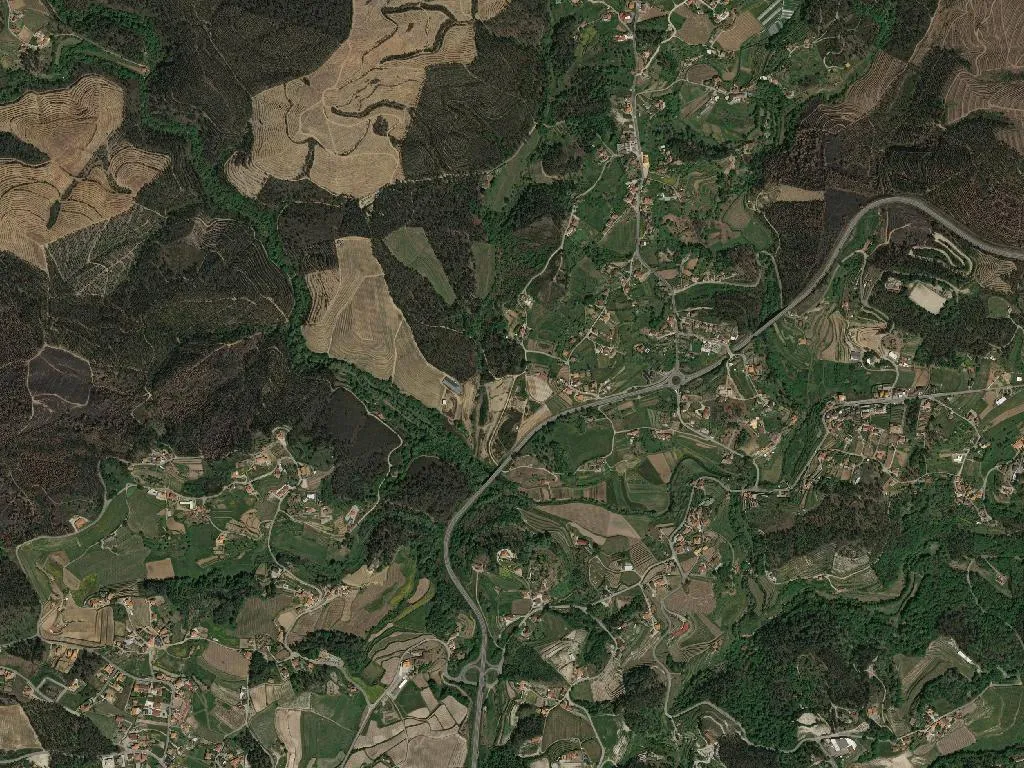
Footsteps ricochet off the granite ribs of Vila Garcia’s medieval bridge, each echo swallowed a second later by the Olo’s low murmur. Between blocks polished since the 13th century, water folds over itself in glassy tiers, releasing a cool breath that rises even in August. Mid-stream, poplars sieve the morning light into shifting gold bars that flick across the surface. This is the founding soundtrack of the civil parish forged in 2013 from three hamlets—Vila Garcia, Aboim and Chapa—where 1 663 souls still order their days by the river that once powered watermills and now irrigates smallholdings on 12 sq km of northern Porto district.
Three names, one slope
Administrators simply acknowledged what geography had long decreed. The union stitches together a tilted amphitheatre that drops from 400 m on the Serra do Marão rim to the Olo’s narrow floodplain. Vila Garcia, first mentioned in 1227, lends its toponym—probably a land-owning Garcia who fortified the ford. Aboim carries a Visigothic fingerprint: the patronymic Abon, carried south by Suebi settlers, fossilised in granite. Chapa, population 47, may echo the iron sheets worked in early smithies; today it is silent except for cowbells and the occasional trail bike.
Gold-leaf and tin-glaze
The parish church of São Pedro stands plain-faced in naked stone, its 1550s façade the very definition of restraint. Push the door and the interior detonates: a single 18 m retable sheathed in 18-carat gold leaf catches candlelight and flings it back at the polychrome saints. Manueline survivors—an ogee window here, a rope-moulded portal there—peek through the baroque overlay, granted protected status in 1977. Five kilometres away, the chapel of São Sebastião in Aboim reverses the scale: whitewashed walls, a barrel ceiling, and 1740s azulejos that narrate the saint’s martyrdom in cobalt comic-strip panels. The only soundtrack is a neighbour’s cockerel asserting ownership of the lane.
Smokehouse mornings
January air is thick with oak tannin. In open-sided barns, linguíça and salpicão hang like burgundy stalactites, curing slowly over smouldering logs. Pig-killing day is still a calendar marker: families gather before dawn, the animal dispatched with a .22, the work apportioned—one team stripping leaf fat for torresmos, another mincing shoulder for morcela. By noon the first sausages are in the smoker; by evening the table carries roast kid scented with mountain thyme and a clay pot of chanfana—goat braised in red wine until the meat slides from the bone in glossy shards. Cornbread, crust an inch thick, is torn and dunked; the local vinho verde, Loureiro-based, slices through the fat with lime-peel acidity. Dessert is cavacas, brittle domes that shatter into vanilla-scented sugar.
Water and cliff
The Olo Trail unspools 12 km along the river’s right bank, a permissive path that once gave priests, millers and smugglers right of way. Meadows grazed by long-horn Barrosã cattle are stitched together by loose-stone walls; above them, 40 m schist cliffs serve as natural balconies. Irrigated plots glow emerald even in July—an unintended legacy of the Fridão dam, finished 1986, whose reservoir tempered night frosts. Wild boar dig for bulbs along the banks; short-toed eagles circle overhead, waiting for the next grass-fire flush.
Saints, reels and reel-to-reel
On 29 June the parish repopulates. Emigrants fly in from Paris, Newark and Geneva for São Pedro’s romaria. The procession leaves Vila Garcia at nine, picks up residents of Aboim under the railway arch, and reaches Chapa by eleven, brass band in tow. After Mass the square becomes an open-air kitchen: kid goats rotate on makeshift spits, the fat hissing onto vine cuttings. In May girls build flower-decked altars to the “Maios”, singing quatrains that beg the maize to grow taller than the reaper. The abandoned Tâmega line station—closed when the last narrow-gauge train rattled through in 1990—still carries its original tin sign, a prop that caught the eye of director Paulo Rocha, who shot sequences of “O Rio do Ouro” here in 1998, using locals as extras.
Dusk settles. The river keeps its 800-year appointment with the granite piers; the smokehouse issues its final wisp; the bell of São Pedro tolls six times—not to announce the hour, but to confirm that, for one more day, nothing has shifted out of place.