Full article about Gestaçô: Douro Gorge Meets Minho Sky
Ridge-top hamlet where bees lace heather honey and accordions echo off Marão peaks.
Hide article Read full article
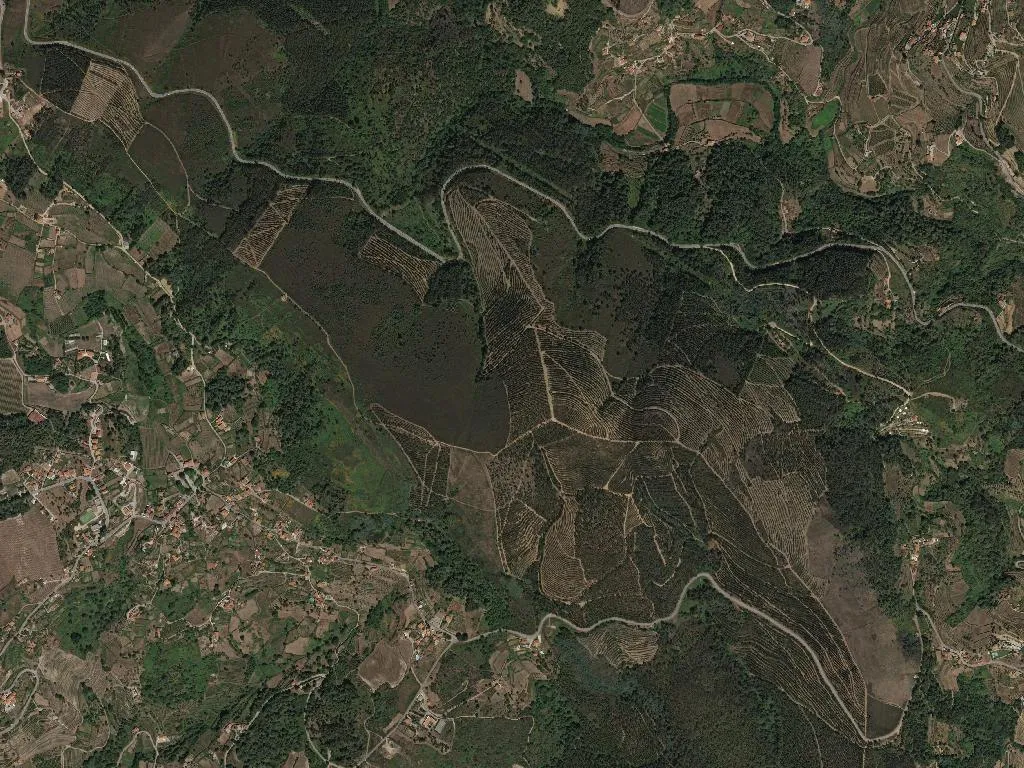
The tarmac corkscrews upward, each hair-pin lifting you farther from the Douro’s glinting slate of water. At 670 m the air thins and cools, carrying the metallic scent of wet granite. You have crossed an invisible frontier: behind you the river valley, ahead the stubbled uplands that announce the Minho highlands. Gestaçô balances on this ridge – 1,013 souls spread across fourteen square kilometres of slope, pine and rush meadow.
Between sky and valley
Altitude dictates the daily script. Dawn arrives muffled in river fog that erases stone houses until, around ten, the sun burns the curtain away. Then the view snaps into focus: south, the Douro’s carved gorge; north, the saw-tooth of the Marão. Neither fully Douro nor entirely mountain, the parish earns its living from forest, pocket-sized meadows where sheep and goats graze, and from bees that work the heather, broom and scattered sweet-chestnut.
The honey is entitled Mel das Terras Altas do Minho DOP – a dark, resinous nectar with a liquorice tail that lingers on the palate. Most keepers run fewer than thirty hives; labels are handwritten, lids clipped with a clothes peg. Expect a jar left on the kitchen table of whichever modest guest-house you’ve booked – the local welcome tax.
Highland devotions
The first Sunday in May belongs to Nossa Senhora do Pé da Cruz. Sardines blacken over cane grills in the primary-school yard, and Carlos – the publican who has squeezed the same accordion since he was fifteen – strikes up a vira. The bigger date, São Bartolomeu, falls on 24 August, but the parish council nudges it to the nearest weekend so Porto émigrés can drive home. Saturday night means butterflied lamb and open-air dancing; Sunday, a procession down Rua Direita and Rua de Cima, pausing opposite the stone house where Padre Amândio, the village’s only national celebrity, was born in 1898.
Walking a vertical map
The rural lane M513 climbs 200 m in less than 2 km – a gradient that finished off many a Renault 4 still clinging to life here. Paths link hamlets whose names read like contour lines – Outeiro do Cabeço, Vale da Ribeira, Recouto da Lage. On Rua de Baixo, Dulce tends fifteen terraced vegetable steps her grandfather built from field-stone; the runner beans she sells to O Castanheiro restaurant in Figueiró five miles down the hill.
The weight of winter
With barely seventy inhabitants per square kilometre, silence has room to breathe. When Atlantic weather systems stall, temperatures sink below zero and fog parks for days. Chimneys exhale the only movement; wood-smoke drifts sideways at this height. Gestaçô does not court visitors in winter, and that refusal is part of its integrity. The place functions, rather than performs: cattle come home at dusk, bells chiming a slow metallic rhythm through the pines. Evening ends when the mountain says so, not when your phone screen glows midnight.