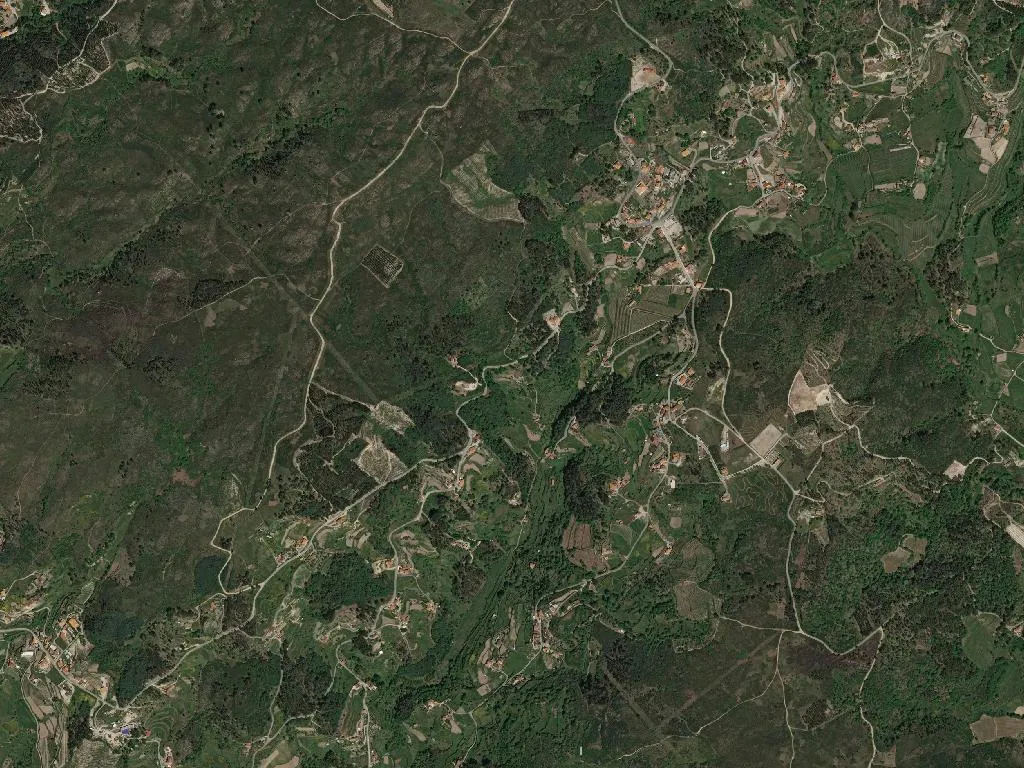
Full article about Grilo, Baião: Bronze bells & burnished-honey hamlet
Oak-heath hives, 240-year bell, August diaspora feast—tiny Grilo above the Douro
Hide article Read full article
The Bronze that Measures the Day
The bell of Nossa Senhora da Conceição still keeps the hours in Grilo. At seven, at twelve, and once more at seven it swings, a 240-year-old heartbeat cast by the Oleiro family, bell-founders who carried their moulds south from Fundão. When an easterly blows, the note drifts as far as the first great bend of the Douro; when the wind flips west it dies in the Tâmega gorge above Crestuma lock.
A Census of Absence
Officially 472 people live here; in late August the number swells. That is when the diaspora clocks in for the feast of Nossa Senhora de Ao Pé da Cruz: mechanics from Barreiro where their parents emigrated in the 1970s, receptionists from Porto's shopping malls, toddlers who have never seen a beehive. The procession climbs Rua do Calvário at nine sharp, passes the house where Canon Américo—Grilo's only chapter-member at the Sé do Porto—was born, and halts on the very terrace where, in 1962, the porch collapsed onto the bandstand during open-air mass. No one was scratched; parish credit books record it as intervention, not luck.
Honey the Colour of Burnished Oak
High-mineral soils and a cloak of oak-heath give the local honey its mahogany tone. Fifteen beekeepers list Grilo as their address, yet only three hold DOP Mel das Terras Altas do Minho status: Armando Silva on Canada da Serra, the Lima brothers in the hamlet of Santo António, and Idalina Matos, who inherited forty hives in 1998 after a May storm flattened the cork trees of Póvoa. Call before ten; afterwards she is out draping frost-net over her alqueiras—on 14 May 2017 the mercury dropped to –4 °C, a date beekeepers here speak of like a battle.
The Road that Turned Coaches
The EM534 climbs 280 m in just 3.4 km. Locals still call it Caminho do Torno because wagon drivers once had to swing wide at Patameira to save their axles. Tarmac stops at the 1893 stone cross; beyond that the surface reverts to loose schist. Half-way up, a detour leads to São Bartolomeu, a chapel first raised in 1627, rebuilt in 1926 after lightning split the founder's tomb. Inside, an 18th-century gilded frame shelters a reliquary no bigger than a cigarette case: fragments of the apostle's bone. Albano, the sacristan, will meet you on Wednesdays or Sundays—provided you telephone first; he does not climb the hill for curiosity.
Night Sky at 425 Metres
Grilo offers one place to sleep: Casa do Rio Frio, an eighteenth-century farmhouse in Calvos whose granite sink could bathe a sheep and whose hearth swallows three oak trunks at once. Postcode 4640-011 exists on maps, yet there is no letterbox; the postman comes by motorbike, Monday to Friday, after the downhill run to the river and back up. On windless nights between 15 July and 15 August the Milky Way spills across the terrace like a dropped tray of sugar, unobstructed by a single streetlamp.