Full article about Loivos da Ribeira & Tresouras: Where Bell Meets River
Stone-walled vineyards and wild-flower honey cling to the Tâmega’s right bank in Baião.
Hide article Read full article
The Bell’s Echo
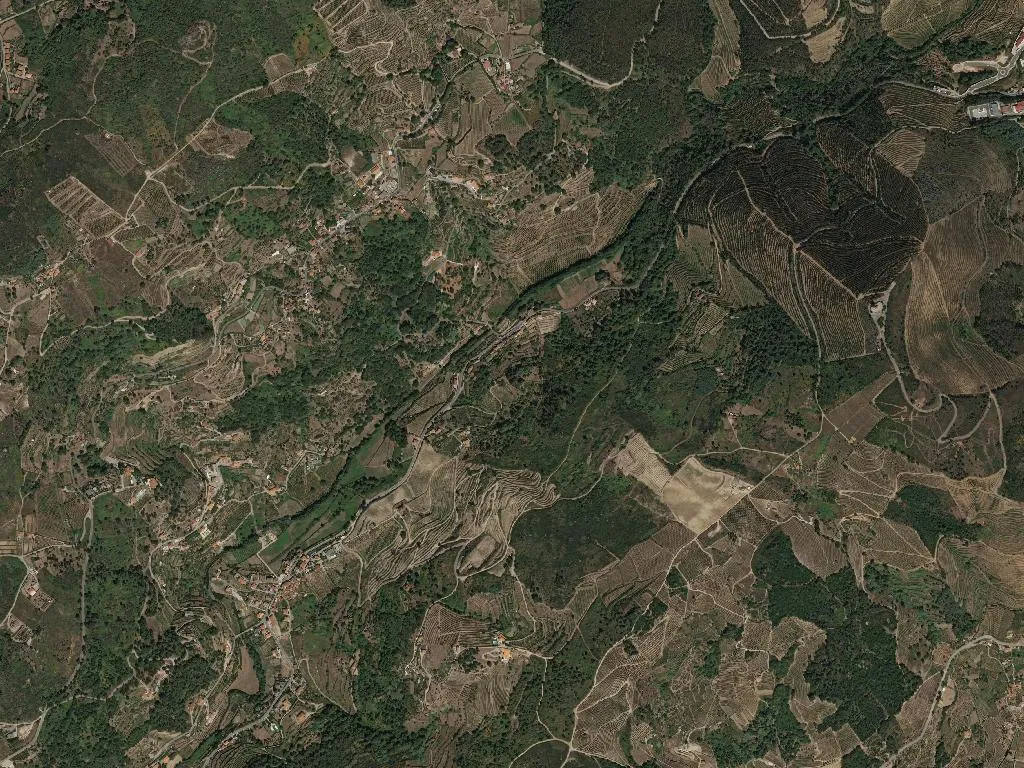
The chapel bell lands three flat notes across the Tâmega valley. Sound skitters over the stone terraces of old-vine parcels, ricochets off slate wine-cellars, then dissolves where the river bends, its water still khaki after the dawn rain. On the north-facing slope that climbs from the right bank to 242 m, Loivos da Ribeira and Tresouras have shared a single civil parish since 2013 – two hamlets stitched together by the same geometry of dry-stone walls, the same calendar ruled by the grape harvest and by Nossa Senhora de ao Pé da Cruz, whose mid-September feast still anchors rural life across these 717 hectares of tilted ground.
Seventy souls per square kilometre translates as scattered houses along dirt lanes, vegetable plots of sweetcorn grown for backyard hens, smoke-blackened charcuterie dangling from low kitchen ceilings. Of the 700 residents, 175 are over 65; only 65 are under 15. The arithmetic is familiar throughout the upper Douro: silent outward drift, shuttered primary schools, fields slipping back to gorse when arms are missing to work them.
Terraces, Must and Honey
Every slope is stepped. Centenarian pergola-trained vines alternate with modern vertical plantings, their taught wires slicing straight diagonals across the hill. Twisted olive trees mark property lines – the same micro-plots parcelled and re-parcelled for generations. Higher up, where gradient outruns profit, broom, heather and rock-rose take over; there, 200 beehives find their forage. The resulting Mel do Douro DOP – certified since 1996 – is a high-altitude wild-flower honey harvested by the Loivos cooperative, selling 15–20 tonnes a year direct to shops in Arcos de Valdevez and Braga.
Invisible yet omnipresent, the Tâmega governs orientation: every road dives toward it, every rivulet drains to its mountain-caged bed. The right-bank terraces catch the afternoon sun – a gold that ignites the vines in October and warms granite door-sills until dusk.
Feast Days and Return Tickets
August belongs to São Bartolomeu: procession, brass band and a makeshift dancefloor of boards laid on the football pitch, drawing construction workers home from France and Switzerland. September is reserved for Our Lady at the Foot of the Cross, a devotion first recorded in 1758. Her original chapel stood at the junction of the old mule tracks to Amarante and Marco de Canaveses, demolished when the EN15 was widened in the 1960s; the stone cross that gave her cult its name still leans in the hillside grass. During these two weekends the churchyard overflows, voices multiply, the everyday hush is broken by laughter and the burble of decorated tractors. Then the valley exhales: a trailer of manure rattles uphill, a dog barks at the postwoman, white wood-smoke rises straight into frost-skinned mornings.
Five guesthouses – modest villas and family quintas – accommodate travellers who want Douro proximity without the river-cruise hubbub of Régua or Pinhão. Here the landscape keeps its working edges: collapsed walls awaiting rebuild, earth tracks ribboning between vineyards, silence sliced only by wind or the distant cry of a short-toed eagle.
When the sun drops and raking light turns the terraces into a staircase of gold and violet shade, the Tâmega valley inhales. The scent of wet schist fuses with hearth smoke. Somewhere a hinge squeals. The chapel bell will not speak again until tomorrow.