Full article about Refontoura: Where Vineyards Breathe Woodsmoke
Above the Sousa valley, granite lanes climb to Refontoura's ramada vines, Sunday rojões and 80-cent
Hide article Read full article
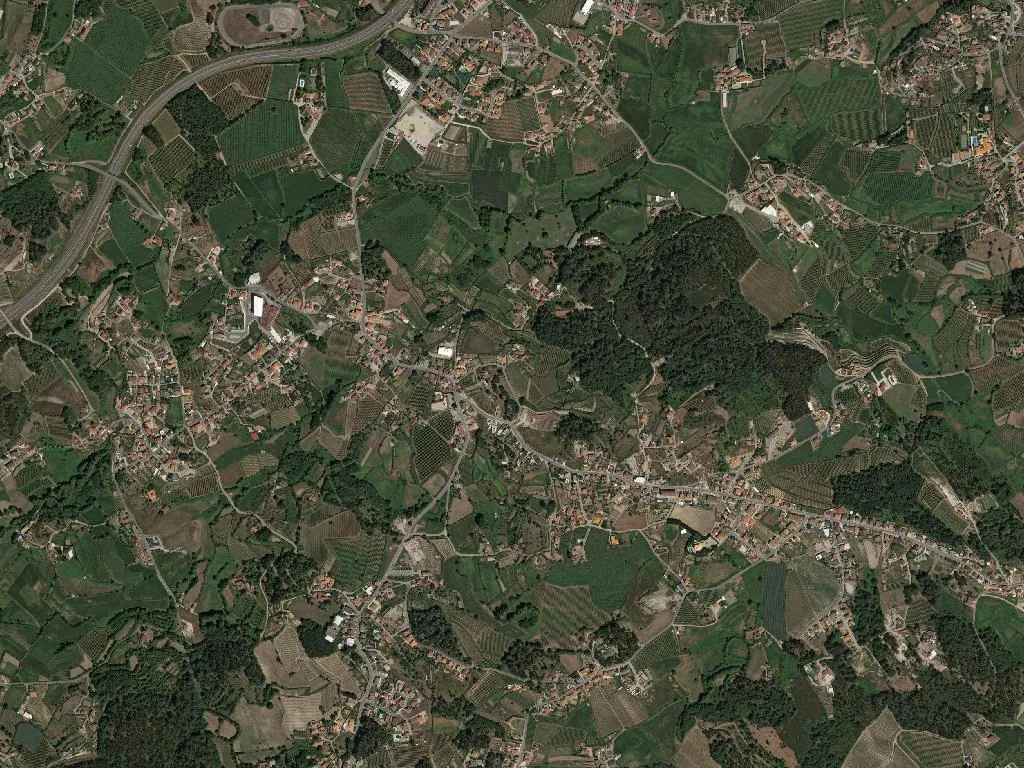
The lane corkscrews up from the N206, granite walls squeezing the tarmac until it gives way to schist terraces stitched with Loureiro vines. At 301 m above the Sousa valley, Refontoura sits just high enough for the Atlantic draught to polish the night air, yet low enough for every chimney to carry the smell of woodsmoke and fermenting must.
The geometry of vines
Vinhão and Branco-escuro grapes are still trained on ramadas here—trellises of chestnut pole and wire that force the foliage into a parasol, leaving the fruit dangling like purple earrings. Follow the contour lines east of the parish church and you’ll spot the newer plantations: laser-straight rows of aluminium stakes, their drip hoses snaking beneath a mulch of shale. Between the two systems lies a century of trial recorded in the parish archives: the 1908 demarcation of Vinho Verde, the 1930s co-operative boom, the 1988 replanting grant that replaced pergola with Guyot. Come late September the hills smell of bruised apple skins; inside the garage-adegas, hoses pulse with nascent wine at 11 % and a whisper of residual sugar.
Sunday sauce and mid-morning wine
There is only one place to be at 11 a.m. on a Sunday: O Convés on Rua da Igreja, where third-generation cook Aurora Ferreira ladles rojões—nuggets of marinated pork shoulder—over sarrabulho, a mahogany porridge thickened with pork blood and cumin. Ask for a 20 cl jar of white from Adelino Costa’s Cantinho across the lane; he charges 80 cents and can recite the owner of every vineyard within a 3 km radius.
Life on display
Refontoura keeps no secrets. Stone walls stop at waist height, revealing kale lines as straight as regimental buttons, hens inspecting each leaf, and pyramids of eucalyptus logs stacked under cantilevered granite roofs. Lintels carry chiselled dates—1897 on Rua de Baixo, 1883 on the old primary school—while newer houses wear butter-yellow render and scarlet geraniums that shout against the grey. Only one door carries a key-safe: Casa da Eira, a converted granary listed on Airbnb since 2019. Hosts Rosa and Manuel Silva leave guests a bottle of their own Arinto and instructions to follow the irrigation channel at dawn if they want to watch the valley turn gold.
When the ordinary becomes precise
What the place offers is metric rather than scenic. A population density of 568 people per km², yet by 21:30 the only sound is the click of the traffic light on the crossroads timer. Children spill from the 1983 primary school at 16:15; by 16:30 the stone benches outside the 1784 cruzeiro fill with grandfathers comparing cane handles. Light slants at 27° in mid-August, igniting the mica in the schist paths so they glitter like wet slate. The wine of the year will taste, as always, of lime zest and struck flint—because the basalt dyke that bisects the parish adds phosphorus to the subsoil, and because no one here has ever harvested after 5 October.
Our Lady of Health and gunpowder
On 15 August the parish boundary dissolves. The statue of Nossa Senhora da Saúde processes 400 m from Matriz church to the baroque cross, where Father António Oliveira sprinkles holy water onto beetroot fields. Folk groups from Vizela arrive with concertinas built by Joaquim Silva & Filhos; their brass plates catch the sun as they launch into a vira in 6/8 time. At 21:30 sharp the Sousa family ignite 23 minutes of fireworks catalogued by the Felgueiras fire brigade; the valley throbs like a drum skin, then falls silent.
Drive away at midnight and the tail-lights behind you are the last artificial colour. Refontoura slips back into its own vintage: a scatter of sodium lamps, the smell of vine sap cooling on granite, and somewhere a dog noting your departure with three perfunctory barks before the hills resettle into darkness.