Full article about Lixa: Tractors, Rococo & Vine-Granite Marriage
Vila Cova da Lixa e Borba de Godim keeps 12th-century vines, 1713 icing-sweet church layers & civil-
Hide article Read full article
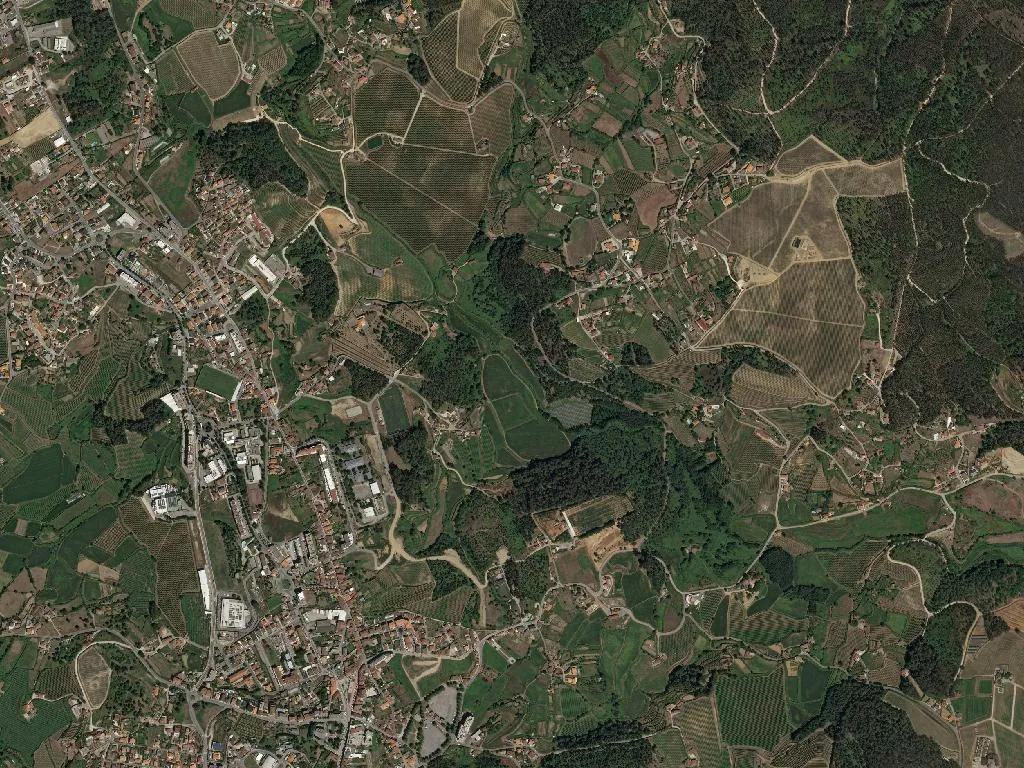
First came the diesel growl, then the tractor itself—red paint sun-bleached to the colour of roasted pepper—crawling up the granite rib of hill at the speed of a harvest. Behind it the vineyard files away in ruler-straight lines, wires humming between posts that have outlived most parish priests. This is Lixa, officially a city since 1995, still with clay under its fingernails.
The civil parish of Vila Cova da Lixa e Borba de Godim packs 6,081 people into a pocket-handkerchief 305 m above sea level, yet its CV stretches back to the twelfth-century charter that first put the land on parchment. Bureaucrats merged the two villages in 2013; the vines, oblivious, have gone on marrying granite to rootstock for centuries.
A church that stacks like a layer cake
Vila Cova’s mother church is architectural baklava: a smooth 1713 Rococo icing on top, 1148 Romanic stone beneath. Press your palm to the wall and you can feel the seam—granite polished like a billiard table giving way to blocks weathered as soft as chamois leather.
Across the boundary line, Borba de Godim ups the ante. Inside its chapel, a painted coffered ceiling ripples overhead like a nursery mobile designed by a Jesuit mathematician. Next door, the stone manor house known locally as the Paço de Borba comes with a double-flight stair wide enough for eighteenth-century bridal trains and egos to match.
The hill where Portugal fought with itself
Uber stops at the last petrol station; after that you walk. The Monte do Ladário delivers a 360-degree ledger of northern Portugal: Felgueiras’ tile roofs below, the Serra do Marão ridge beyond, and on very clear days the distant glint of the Douro. In 1834 Liberal and Miguelist troops used the summit as an open-air debating chamber, settling policy with musket butts. The Liberals won and promptly swapped the existing shrine for a Nossa Senhora das Vitórias—religion and politics here blend as naturally as red wine and braised kid.
What the glass pours and the oven roasts
Ask for cola and you will be met with the polite stare reserved for the recently arrived. This is vinho verde country: the local white pours the colour of young straw, tastes of lime skin and steel, and arrives in bottles calibrated for thirst rather than ceremony. The honey, from hives scattered through the gorse and heather, carries the caramel note of autumn heather; the kid goat is slow-roasted overnight so the meat loosens from the bone without complaint.
On a wooded spur above the village, the Estância do Seixoso—once a nineteenth-century tuberculosis sanatorium designed by Dr António Cerqueira Magro—stands hollowed to a romantic shell. Locals swear the air is still medicinal; certainly the view could lower a pulse rate.
The philosopher, the poet and the painter who clocked in
Leonardo Coimbra, the metaphysician Portuguese undergraduates love to quote and forget to read, was born in Borba de Godim. António Nobre, the consumptive poet who taught the nation to romanticise rain, spent enough damp afternoons here to immortalise them in “Só”. Even the baroque painter Sebastião Babo left a brace of brushes drying on a windowsill—proof, say villagers, that the light on these schist slopes is a colour you have to live with to believe.
Monday cabbages, September fireworks, year-round needlework
Monday’s open-air market spreads across the riverfront car park: cabbages the size of bowling balls, chickens that still taste of corn, and weather forecasts swapped like trading cards. In late September the romaria de São Miguel funnels half the municipality up the hill—some on their knees, others with a plastic cup of aguardiente for ballast. The local women embroider in the municipal museum every afternoon: cross-stitch executed at sewing-machine speed, eyes never leaving the frame.
Stay for the hour before dusk when the sun slips behind the Serra de São Domingos and every terraced vineyard turns the colour of heather honey. That is when you understand: Lixa is not a pin on a map but a half-chewed sweet in the pocket—sticky, familiar and impossible to throw away.