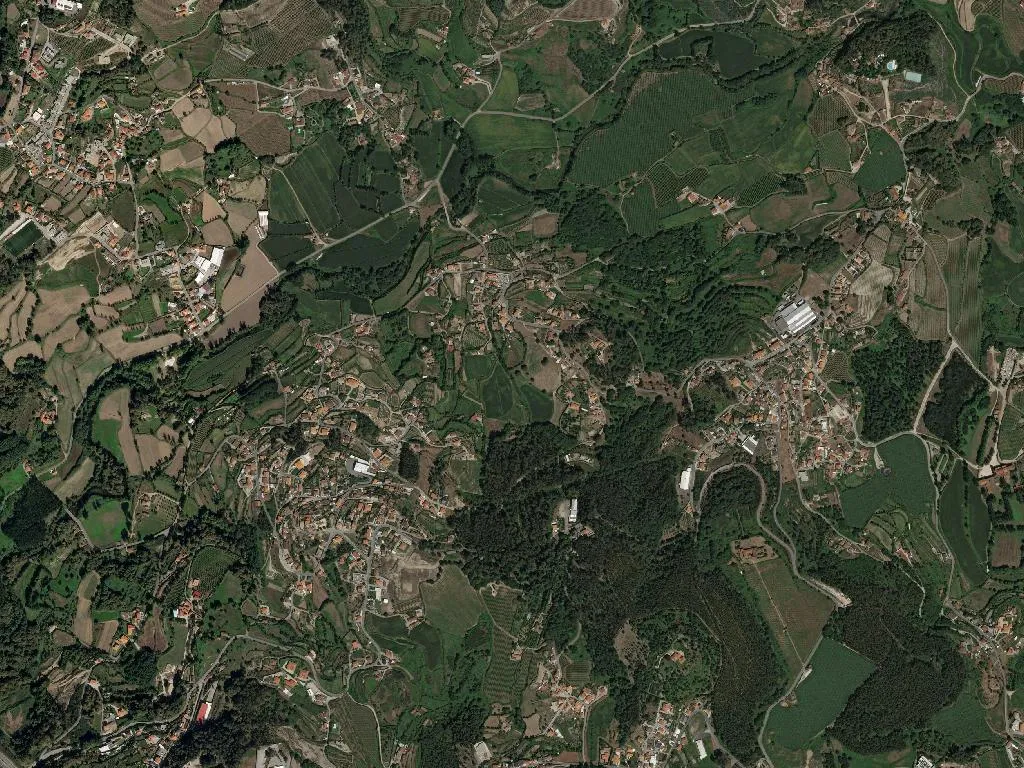
Full article about Vila Fria & São Jorge: Where the Air Tastes of Granite
Minho hill-parish where mist, maize and medieval bells outnumber people
Hide article Read full article
Where the Cold Got There First
The lane climbs gently between fields whose greens shift like silk in changing light. At a modest 193 m you feel the altitude in your lungs – the air carries a faint metallic chill even in June, and the breeze tastes of turned earth and the Sousa valley’s perpetual damp. Since 2013 Vila Fria and the hamlet of São Jorge have shared the same council letterhead, yet locals still give their address as one or the other, the way a Londoner insists on Bloomsbury rather than Camden.
A Name That Weather Made
Vila Fria – literally “Cold Village” – first appears in an 11th-century charter. Whether the label records winter fog that rises off the river and parks itself on the rooftops, or simply marks the settlement as a “cold” tax zone (medieval bureaucrats loved a colour-coded ledger), the result is the same: you pack a jumper even for August. São Jorge, grafted onto neighbouring Vizela, honours St George and whatever long-vanished priory once claimed the dragon-slayer as patron. No Romanesque priory remains, but the parish church still tolls its bell at noon, scattering swallows from the belfry.
Two Villages, One Council Tax Bill
The 2013 merger was a spreadsheet exercise – fewer councils, fewer salaries – yet identities refuse to balance. Stand in the bar of Café Central and within five minutes you’ll be told which family belongs where and whose festa fireworks are louder. The combined parish stretches across three square kilometres and barely 1,100 souls; 212 of them are over 65, only 137 under 18. Still, on summer evenings children reclaim the small plaza outside the chapel, chasing footballs between granite benches while grandparents keep a slow tally of goals and genealogy.
Granite, Vine and Maize
This is the Minho heartland in miniature: hand-stacked stone walls parceling fields the size of tennis courts, maize standing to attention, vines either pergola-trained or flung over trellises like green hammocks. No grand quintas here; instead every other garage hides a hand-cranked press that last week filled a neighbour’s five-litre garrafa with sharp, low-alcohol Vinho Verde. The granite itself – ash-grey, freckled with sulphur-yellow lichen – reappears in doorways, milestones and the 18th-century cross that marks the old junction to Pedreira. Touch it after rain and the stone drinks the water so fast the surface is almost dry.
The Unofficial Viewpoint
There are no brown signs, no coach parks, no gift-shop fridge magnets. What Vila Fria e São Jorge offer is a lesson in slow time. Attend the 10 a.m. Sunday mass and you’ll hear the priest intone the same responses his predecessor used in 1953; walk the lane behind the houses and a farmer will interrupt hoeing potatoes to point out the best angle for photographing the valley – not out of politeness, but because the view belongs to everyone. The closest thing to a lookout is the traffic island on the N14 where teenagers park at dusk, phones glowing, waiting for the sun to spill across the Sousa like molten brass. When the light finally drops, the only soundtrack is a distant tractor descending through its gears and, somewhere below, a dog rehearsing the same three-note complaint.