Full article about Baguim do Monte: oaks hush Gondomar’s densest parish
Hear granite bells duel traffic, then oak leaves hush Rio Tinto’s banks in Baguim do Monte.
Hide article Read full article
Baguim do Monte: where the city exhales among oaks
The bell of S. Bento das Pêras strikes nine and its bronze note is immediately swallowed by the growl of morning traffic along the N12. Yet walk fifty metres down the lane that tilts towards the Rio Tinto and engine noise dissolves into water lisping over granite. A cool, fungal scent rises from the banks; winter light drifts through the canopies of Portuguese oaks with the milky quality you only find north of the Douro on wind-scoured mornings. It is in this hinge—between tarmac and stream, between housing estate and what is left of farmland—that Baguim do Monte declares itself.
Density and disappearance
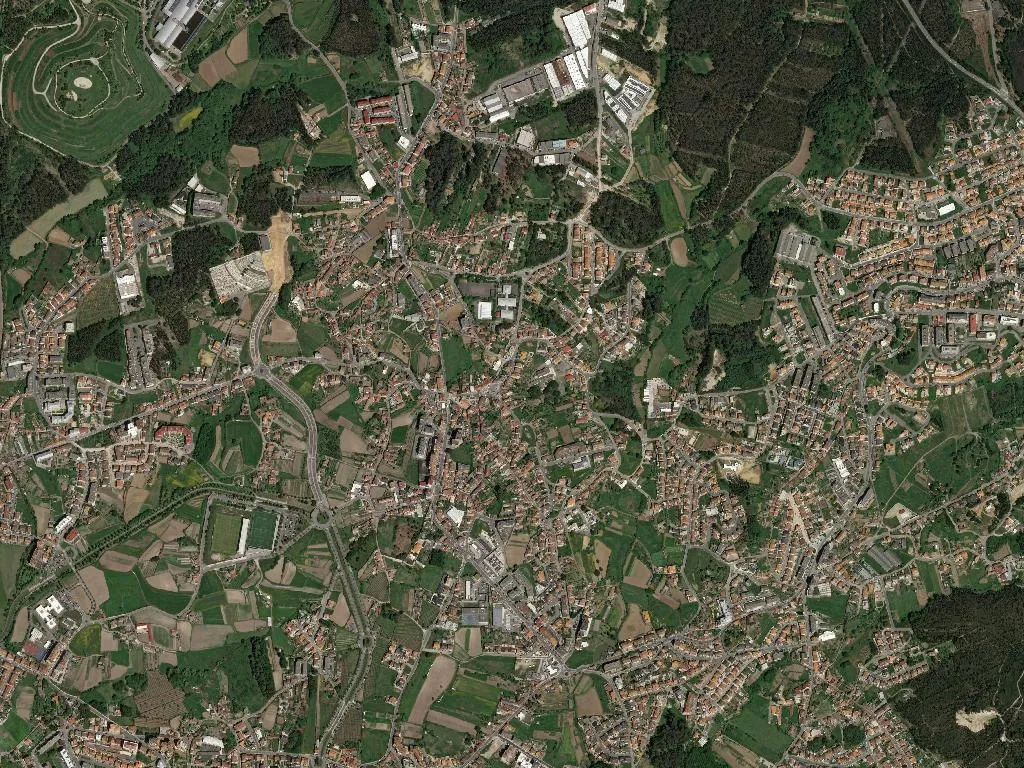
Fourteen thousand people are packed into barely five square kilometres, making this the most crowded parish in Gondomar—and one of the densest in northern Portugal. The figures translate into four- and five-storey apartment blocks thrown up from the late 1950s onwards when Porto's metropolitan expansion inhaled former hamlets. The name still carries agrarian freight: “Baguim” derives from the Latin “baccalis”, a granary or place of seed. Royal charters referred to “Baguim de Cima” to distinguish it from “Baguim de Baixo” next door. Outsiders routinely confuse it with Rio Tinto, but Rio Tinto is merely the largest urban quarter inside Baguim's borders.
Granite, gunpowder and blessed loaves
The parish church, built in 1753, anchors what little constructed heritage survives. Its granite façade—darkened by Atlantic humidity—stands between vegetable plots tucked behind terrace houses and the 1960s blocks that circle like a tide. Each July or August the feast of S. Bento das Pêras spills out of the building: sung mass, rockets cracking in the hot sky, temporary grills whose grease mingles with the spun-sugar scent of candy floss. Fairground bulbs reflect in surrounding windows, overlaying suburbia with the blur of a country pilgrimage.
On 3 February the feast of S. Brás is quieter. Locals trek to the hillside chapel where the "carnavalada de S. Brás" keeps pre-Lent revelry alive and the priest blesses bread—a relic of communal ovens that once baked the week's loaves. A handful of those ovens still function; their bread, thick-crusted and tight-crumbed, steams in calloused hands at breakfast time.
Rojões, blood rice and backyard wine
Baguim's cooking carries no PDO stamp, only the heft of the Sousa valley. Rojões à moda de Gondomar—pork shoulder diced small, fried in its own fat until chestnut-brown—appears with chestnuts or a flour-dusted tripe sleeve. Arroz de sarrabulho, almost black with cumin-laced pig's blood, arrives in deep, smoking terrines. In autumn some households still make pumpkin and butter-bean porridge; at festas chestnut soup keeps night air at bay. On pockets of south-facing slope, family vines produce a light, sharp vinho verde whose grassy bite begs for fatty meat.
Boardwalks on a miner's leat
The Rio Tinto Trail is a five-kilometre loop that starts beside the church and follows the old irrigation channel to Rio Tinto's urban park. Wooden boardwalks skirt marshy ground; elsewhere the path is beaten earth under cork oaks and eucalyptus. Where cover is dense, arbutus and gorse knit thickets that buzz with insects in spring. Narrow wet meadows attract herons and moorhens indifferent to walkers. Children who complete the circuit earn a playground at the far end.
Baguim also sits inside the Parque das Serras do Porto: rural footpaths link it to Fânzeres and Rio Tinto, and 200-metre hillocks give views across Greater Porto—on clear days you can pick out the Serra do Pilar and the Arrábida bridge.
Fifteen minutes to the city
Logistics is Baguim's quiet ace. Rio Tinto metro station, on the yellow line, deposits you at Trindade or São Bento in fifteen minutes—barely long enough to skim the headlines. On weekday mornings the parish market sets out lettuces and coriander on metal stalls; gossip ricochets between vendors. Three kilometres away, Gondomar's Cork Interpretative Centre explains how the county's charcoal burners turned to cork when the mines closed, while the Solar dos Condes de Baguim—an 18th-century rococo manor—offers a lesson in restrained aristocratic flair. Rainy evenings belong to the Multiusos pavilion where handball matches and touring theatre companies keep the lights on.
At dusk the church bell sounds again, unhurried now. Between the final clang and the silence that follows you can still catch, if you listen, the hush of the Rio Tinto running at the bottom of the lane—a signature the city has paved over but never quite managed to mute.