Full article about Fânzeres e São Pedro da Cova: Slate, Coal & Echoes
Walk black-shale terraces, ride the mining cage and taste fossils in Gondomar’s carbon heart
Hide article Read full article
The first thing you notice is the acoustics. A metallic ghost-note hums ahead of your head-lamp, ricocheting off 300-million-year-old shale as your helmet grazes the roof. In the beam, the rock face glints like wet charcoal and fossils of prehistoric ferns—pressed there long before dinosaurs—catch the light like fragments of dark lace. The air is cellar-cool, laced with iron and damp; you can taste geology. This is the subterranean gallery of São Pedro da Cova’s open-cast mine, the only above-ground mining museum in Portugal, and the descent feels less like tourism than initiation. By the time you climb back into daylight your lungs have clocked overtime and your palms carry the scent of Carboniferous seabeds.
Coal was first hacked from this hillside in 1795. What began as a scar became the engine of a pocket-sized industrial revolution: nineteenth-century adits multiplied, the population quadrupled, and by the 1920s more than 5,000 men rode the cages down Murraco Hill each dawn, making Gondomar the country’s second-largest coalfield. The 1843 strike—one of Portugal’s earliest mass walkouts—started here, at a time when the phrase “working from home” meant hewing coal in a candle-lit tunnel beneath your own kitchen floor. Today the pithead wheels are silent, but the terraced walls of black shale still read like tectonic marginalia: no ivy has fully managed to soften them.
Between the Cross of St James and St Peter’s Bell
The civil parish of Fânzeres e São Pedro da Cova was created in 2013 by merging two villages that had always orbited each other like binary stars. Fânzeres—its name a contraction of “Faf-araes”, the medieval estate of a Saxon-sounding warlord—briefly served as county seat between 1839 and 1852. São Pedro da Cova wears its split personality openly: “St Peter” for the fisherman-apostle, “Cova” (pit) for the cavities beneath. The unified coat of arms stitches St Peter’s bell to the scalloped cross of St James, and the symbolism is precise: the two mother churches lie exactly 3.2 km apart along a winding ridge road that locals still call “the pilgrims’ compromise”.
Inside the 1750s parish church of São Pedro da Cova—classified in 1974—single-nave gloom is interrupted by gilded baroque carpentry so dense it seems to muffle even the candles. Over in Fânzeres, the parish church of St James displays the same century in a brighter key: a detached bell tower, 1740s azulejo panels of cobalt that no modern glaze has ever quite matched, and a confident 1880s extension that gives the façade the air of a provincial cathedral. Scattered between them, chapels dedicated to Santa Bárbara—patron of miners since 1953—and to St Benedict of the Pears knit faith to labour in a landscape where the nearest outcrop of arable soil is often a railway embankment.
Bean stew, kid goat and the scent of wood smoke
The cooking here was calibrated for shift work. Feijoada à Moda de Fânzeres—brick-red beans slow-simmered with pork ribs, smoked farinheira sausage and chouriço cured over oak—was designed to replace the 4,000 calories a miner left somewhere underground. Chanfana de Cabrito, kid goat braised in red wine, bay and paprika, appears on feast days, its claret-coloured vapour drifting through granite alleys long before the pot is lifted from the hearth. In winter, lamprey and eel dragged from the Sousa and Douro rivers become caldeirada, thickened with dark corn bread that drinks the broth to the last rust-coloured stain.
The flavour that lingers, though, is folão—egg-rich doughnuts, sugar-dusty and cinnamon-hot, fried in July during the romaria of St James. Eat one straight from the oil and the crust shatters like thin ice; your fingers glisten for the rest of the procession. To wash away the sweetness, local brewers carbonate mineral water drawn from the old mine galleries and turn it into a gently sulphurous IPA—an elegant circular economy that runs from seam to stein.
Trails that thread spoil heaps and holm-oak groves
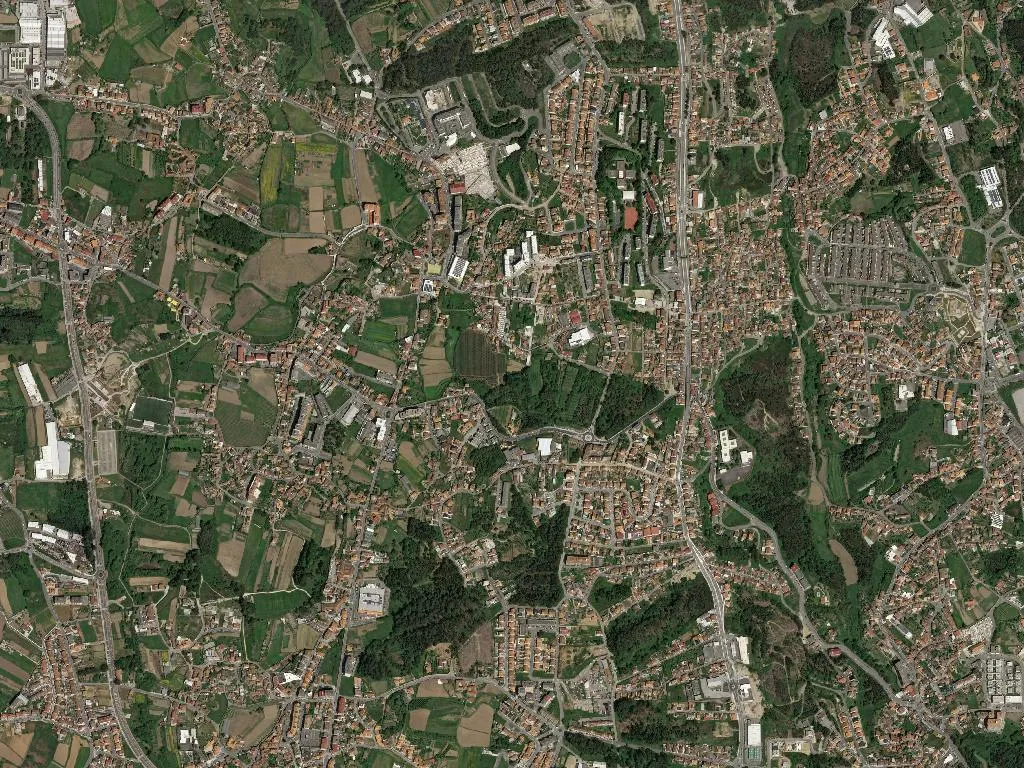
With 37,753 residents crammed into 22 km², this is one of northern Portugal’s most densely populated dormitory belts, yet the map still hides sudden lungs of green. The Levada Trail, an easy five-kilometre loop, follows the nineteenth-century watercourse that once fed the steam engines. Abandoned portals peer from the undergrowth like half-closed eyes, their entrances now upholstered with bracken and pyrenean oaks. Interpretation boards give the industrial précis, but it is the underfoot soundtrack—water trickling through hidden culverts, the metallic ping of a loose rivet somewhere in the leaf-litter—that turns the walk into a sensory archive.
In Fânzeres Urban Park, twelve hectares of lake, outdoor gym stations and dawn joggers provide the daily civic lungful; night herons sometimes over-winter among the reeds. A short climb north, the Mata da Senra is a survivor of the original Atlantic forest—holm oak and cork oak where goshawks hunt woodpigeons and midwinter orchids push through the leaf mould. At sunset, the summit of Murraco (290 m) delivers a miner’s compensation: a full sweep of the Douro valley dissolving into the kind of violet haze Turner would have recognised.
Rosemary, pears and other non-miracles
Festivals here are annotated with footnotes of practicality. On 3 February, St Blaise blesses throats with crossed candles and distributes sprigs of rosemary whose scent survives weeks in coat pockets. In March, the Festa de São Bento das Pêras hands out actual pears to worshippers—an agricultural IOU dating back to medieval field-clearing vows, nothing miraculous except the sweetness. Brass bands, heirs to António de Lima (1869-1931) whose marches still punctuate processions, rehearse in former coal offices where the acoustics were originally judged by how well they carried a warning shout.
Monday mornings belong to Fânzeres market: smallhold cabbages, heirloom beans, Terrincho cheese and sausages looped like edible Möbius strips. Behind the stalls, the 1875 railway terminus—Portugal’s first narrow-gauge line, built to haul coal to the Douro wharves—stands decommissioned since 1990, its iron canopy and stone water-tower intact, waiting for someone to write the next chapter.
When you finally emerge from the mine gallery and daylight knocks the pupils wide, there is a moment of vertigo. The black slate is behind you, but its mineral perfume—wet, ancient, obdurate—clings to skin and memory like the handshake of a mountain that refuses to let go.