Full article about Melres & Medas: Honey-scented valley below Porto’s radar
Oak-veined lanes, 280-kg August palanquin & bee-rich scrub in Gondomar’s quiet union
Hide article Read full article
The air smells of damp leaves and green bark the moment you nose the hire car off the N222. The road corkscrews between eucalyptus and oak, shedding altitude until the valley floor opens at barely 100 m above sea level. No tailbacks, no coach parks – just the soft pop of tyres on fallen leaves and, somewhere behind a low stone wall, the lazy bark of Bobi, the Courelas neighbourhood’s self-appointed sentry. Winter fog lingers until coffee time; when it lifts the hills glow a bruised gold that painters from the Porto School once tried – and failed – to trap on canvas.
A parish that kept the word for honey in its name
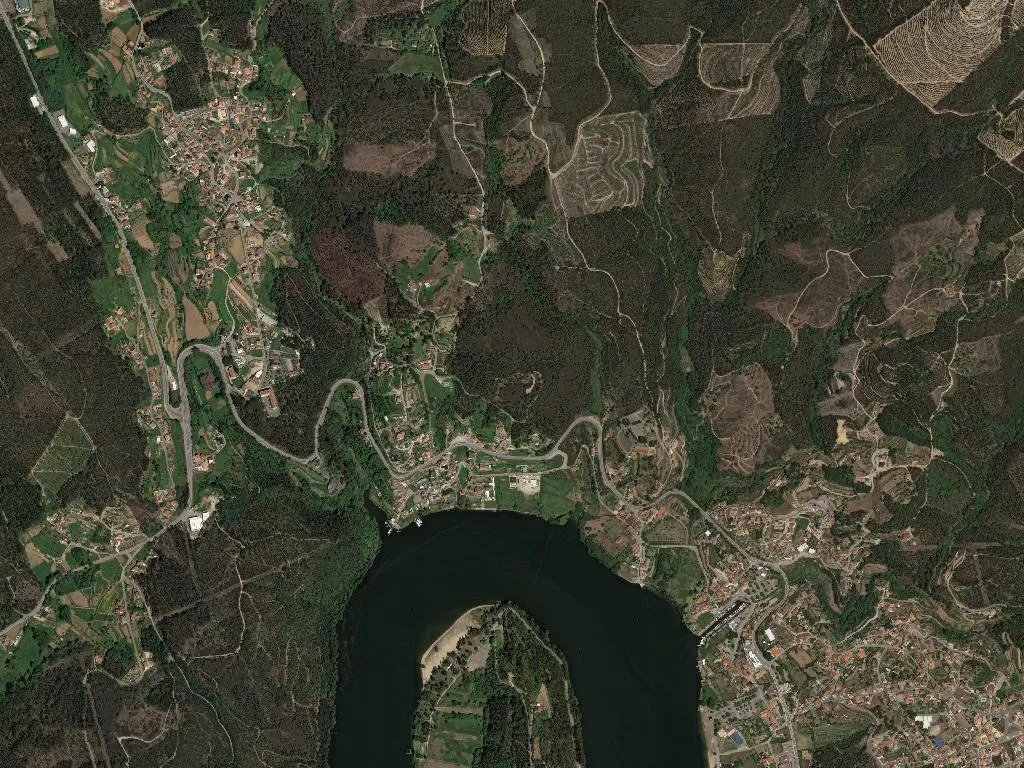
Royal charter paper from 1515 already spells it “Melres”, yet villagers insist the name was spoken long before a scribe inked it. Linguists trace it to the Latin mel (honey) and res (thing, place), evidence that these slopes once hummed with apiaries. The statistics still fit the fable: of the parish union’s 2,781 hectares, 1,430 remain wild scrub perfect for heather, and 1,120 are worked smallholdings where bright yellow broom and grey-leaved rockrose still feed Horácio Ferreira’s fifty-odd hives at Cimo de Vila. Medas, joined to Melres in the 2013 local-government shake-up, brings its own low-density mosaic of vines and allotments. Together they total just 5,295 souls – fewer than live within a single London Underground zone.
August in the square weighs 280 kilos
The parish church of Nossa Senhora da Assunção squats on a rectangle of granite setts where the EM533 meets Rua da Igreja. Manueline lace frames the belfry, but the real craftsmanship is human: every 15 August eight brotherhood men shoulder a 280-kg carved-and-gilded palanquin of the Virgin and walk 1.2 km through furnace heat. Former villagers fly home from Newark and Saint-Étienne-du-Rouvray for the privilege of shuffling behind. Candle-smoke from Azevedo & Filhos, the last working wax factory in neighbouring Marco de Canaveses, mingles with the papery perfume of Maringá’s artificial roses bought at number 14 Rua da Igreja. No tickets, no seating plan – only the right of return.
Two saints, two seasons
On 3 February the feast of São Brás begins with 9 a.m. mass and a single rocket from Valonguense Fireworks. The faithful climb the 220-metre São Brás hill where, in 1962, the bishop of Porto celebrated the first open-air mass of the post-war era. Two weeks after Easter it is São Bento das Pêras’ turn: the “As Flores” folk group from Medas, founded the year after Portugal’s 1974 revolution, performs the stick-and-scarf “Pau Verde” dance to a concertina played by Manuel “Tareco” Silva. Both parties spill out of the Medas sports hall where Dona Rosa’s volunteers skewer 200 kid goats on bay branches and Zé-Zé’s bar chills 47 bottles of Quinta da Boa Esperança white. Someone always mentions 1994, when hailstones whitened the bunting mid-procession.
A territory of fertile silences
Follow the footpath that links Casal de Ermelo to Quebrada and you cross the 1956 irrigation weir that still waters 80 hectares of small vegetable plots. The land undulates gently from the Douro’s edge at 40 m to the 260 m crest of São Brás; cliffs are absent, drama is not the point. After phylloxera ruined native vines in the 1880s, farmers grafted Jacquet American rootstock; 42 hectares survive, enough for household red and a little surplus for the parish social. Demography tilts elderly: 1,178 residents are over 65, only 568 under 20. Still, thirty guest rooms are now registered, from the three-bedroom Casa do Castanheiro on Rua Principal to a single en-suite in Grandma Zulmira’s cottage. Supper is served at “O Cego” on the old EN1089: rabbit escabeche marinated in Quinta da Pitarrela white, €9 with house wine.
The quiet gravity of belonging
There are no interactive museums, only the Rural Douro Interpretation Centre installed in Medas’ 1953 primary school, its walls lined with Emília Alves’ black-and-white photographs of haystacks and river baptisms. Way-marked routes barely exist; you download a GPS track labelled “Melres-Minas” and follow stone walls to the tungsten-mine adits abandoned in 1971. Time is kept by the church bell: twelve slow strokes at noon, seven again at dusk. In June Dona Alda Miranda’s wheat is still cut with a 1958 bar mower, and the annual festa is repeated because repetition, not innovation, is the local unit of authenticity.
Late afternoon, when the sun skims the whitewashed façade and throws the belfry’s shadow across the empty square, you may hear – if you stop texting, if you breathe through your nose – the low, steady hum of a late worker bee heading back to Sr Horácio’s hive. Almost inaudible, yet in a parish named for honey it is the oldest, most truthful bulletin that life here persists, stubborn and sweet, exactly as before.