Full article about Rio Tinto: Porto’s Breathless Granite Spill
Concrete balconies, brass saints and 5,411 neighbours per km² in Gondomar’s urban overflow
Hide article Read full article
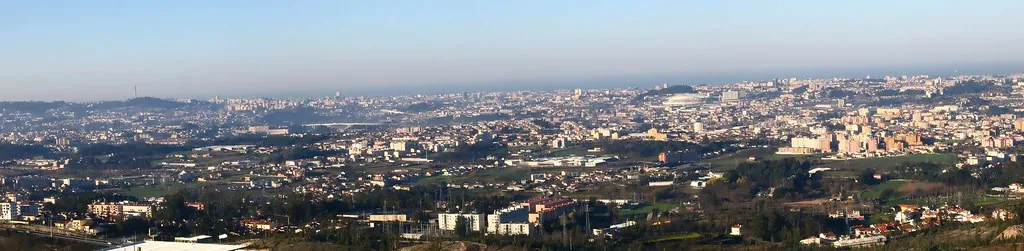
The bus exhales on Rua Central, just past Farmácia São Dinis, and 51 083 people spill onto a pavement barely wide enough for two. Bags from Pingo Doce drag across the slabs, walking sticks tap a brittle rhythm, and the EN12 keeps up its metallic drone. Rio Tinto introduces itself not with postcards but with breathlessness: 5 411 souls per square kilometre crushed into 9.43 km² of granite and poured concrete. Balconies almost graze each other above Café Silva; voices ricochet off the façades when windows are flung open at five to catch the afternoon air sliding down the 92-metre ridge.
We are still, administratively, in Gondomar, but walk ten minutes south-east and the Metro deposits you at Porto's Bolhão market. The border is nothing more than a fading line on a planner’s map, dissolved by apartment blocks and the lilac F-line trains. Rio Tinto is not a suburb; it is the city’s over-spill made flesh.
An ageing equation you can see from the benches
The 2021 census reads like a slow-motion film: 11 051 residents over 65, only 6 382 under 14. The imbalance is visible in the Jardim da Aldeia where men in pressed trousers dissect yesterday’s Jogo do Dia and women feed pigeons crumbs of broa. Before nine the Padaria Moderna is already a theatre of routine: exact coins counted out for pão de leite, coffee drawn short, no one checking the time—they already know it.
Density writes the timetable. Queues curl out of Micaelense butchers; cars half-mount the kerb on Rua do Moinho; neighbours negotiate bin-day like UN diplomats. Every square metre is contested, and that friction gives Rio Tinto its texture—urban life stripped of Porto's belle-époque gloss but humming with the same urgency.
Saints who halt the traffic
Twice a year the calculus is interrupted. At the end of August the parish church of Fânzeres hauls out its brass band for São Bento das Pêras; fireworks from Sr Albano's crate rattle the windows of the Lidl next door. Mid-February belongs to São Brás, throat-doctor saint, whose procession corkscrews down freshly tarred Rua Eduardo Ferreira dos Santos. Locals press lace handkerchiefs to his niche, a gesture older than the nearby Vodafone shop, and the scent of beeswax from Casa Pereira drifts over the dual carriageway.
São Bento’s odd agrarian surname—"of the Pears"—is a reminder that orchards once quilted these slopes before granite replaced loam. The name is a crack in the asphalt through which the 19th century still leaks.
Where to stay when you’d rather not pay Porto's premium
There are 36 licensed beds: a hostel overlooking the small municipal park, a spare room in Dona Elisa’s art-deco house on Rua de Santa Comba, a converted T1 in Edifício São João with induction hob and fibre-optic broadband. Expect £18 for a bunk, £45 for an entire flat, and breakfast pão-de-ló if Dona Zulmira is in an affectionate mood. No one is polishing marble lobbies for you; the value is proximity—19 min to Bolhão, 25 min to the airport, zero need to haul a suitcase up Sé’s cobbles.
Evening choreography, unchoreographed
Dusk is a change of shift. Pensioners relocate from park benches to the pavement tables of Café Progresso; children pour out of EB1 José Régio, backpacks thudding like drums; neon flickers over Rosa & Filhos’ window where mannequins have stood in the same pose since June. Miguéis the butcher hoses down his threshold, the smell of bleach mixing with grilled sardines from a first-floor kitchen.
Nothing is curated for the visitor. Rio Tinto scores 70/100 on the national liveability index, a figure you can feel in the creak of the City Park slide that still carries 200 kids a day, in the pharmacist who remembers your prescription before you pronounce it, in the Metro barriers that beep you toward Porto's centre in under twenty minutes.
The river that forgot its own name
Night traffic on the EN12 never fully ceases—just thins to a growl. There is always a Clif-sponsored health centre door clanging shut, always a late bus sighing, always Maria da Luz’s television leaking telenovela dialogue into the stairwell. Yet beneath the tarmac, if you stand long enough between parked cars and listen, the Rio Tinto itself keeps going—an iron-tinted stream tunnelled under warehouses and football pitches, murmuring to 51 083 people too busy to look down.