Full article about Nevogilde: Where 13th-Century Dues Still Buy Torchlight
Granite stairs, gilded church and midnight brotherhood processions in Lousada’s smallest parish.
Hide article Read full article
The granite step still holds the morning damp
The churchyard sits on a slight rise, its stone stairs darkened by dew. Below, schist walls dissect the slope into handkerchief vineyards that stagger downhill until the first sessile oaks take over. At noon the bell rings – the same one re-cast in 1947 after being requisitioned in 1936 for Franco’s war effort – and the sound drifts across terracotta roofs, across patios where sheets billow like spinnakers, across vegetable plots where a figure bends between the cabbages.
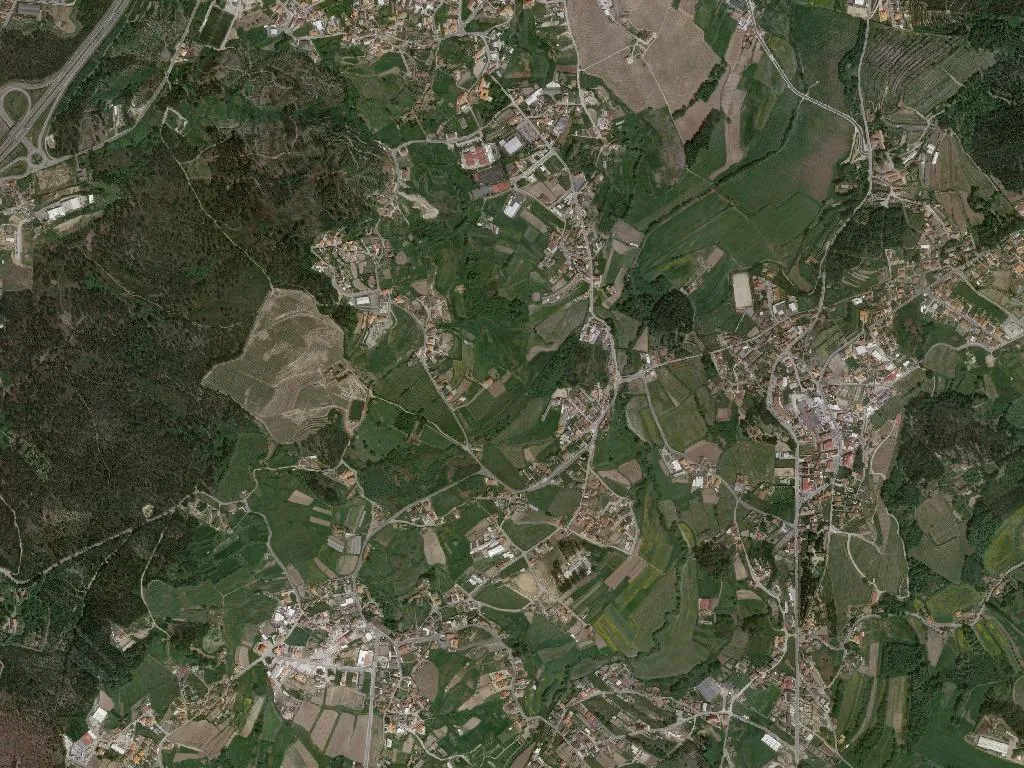
Nevogilde never announces itself. The parish covers barely 343 ha of Lousada’s municipality, yet its name carries the freight of eight centuries: Nova Gilda, the “new guild”, first taxed in 1258 in King Afonso III’s charter book. The thirteenth-century survey already lists ovens, mills and compulsory levies to the Knights of Fontarcada; collective labour is older than the oaks. Of today’s 2 451 residents, 112 still pay their annual dues to the Irmandade do Senhor dos Aflitos, founded 1713, the Sousa valley’s oldest penitent confraternity. Every June the brotherhood’s torch-lit procession follows an 1854 route unchanged down to the centimetre: out past the cemetery gate, left into Rua da Igreja, up to the 1782 granite cross, back across the churchyard that becomes an open-air dance floor until the embers cool.
Golden baroque and 18th-century tiles
Rebuilt between 1723 and 1738 under Prior Domingos de Araújo, the parish church turns its plain granite face to the square while the interior combusts with gilt. José de Sousa’s 1734 high altar catches the side-light and throws warm reflections onto 48 Rato-factory panels (1742-45) narrating the Virgin’s life in cobalt that has not shifted a shade; on the Annunciation tile you can still see where the left-hand border missed the kiln’s hottest pulse. Half a mile beyond the last house, the chapel of Santa Águeda keeps its own time: erected 1666 by landowner António Dias Carneiro, it shelters a granite font whose Latin inscription – Hic primum lavantur – is legible to any finger tracing the serifs. On 5 February women in black cloaks carry the saint to the altar, followed by trays of saffron-yellow cake whose recipe Maria da Ascenção guarded for 73 years; her granddaughter now weighs twelve eggs to every two kilos of flour and still refuses electric beaters.
Vineyards, streams and schist footpaths
At only 183 m above sea level the land rolls like a crumpled tablecloth: chestnut groves, small holdings, oak brakes. Clear streams run north-east to the river Sousa; the Nevogilde brook rises under the São Mamede ridge and travels 14 km before joining the larger water at Freamunde. Along its banks grows the dark velvet moss that disappears in drought years – locals still read it as a winter omen. A 4 km loop, way-marked in 2008 by the local hunting association but following medieval drove lines, links the church to Santa Águeda. Between schist walls furred with ferns the Loureiro vines – replanted after phylloxera in 1892 – hang above head height; cork oaks offer natural pergolas for picnics. No nature reserve status protects the mosaic, yet the average field is 0.3 ha, the soil is worked by tractors older than their drivers, and the loudest sound in August is a blackbird staking territory.
Wood-oven flavours
Smoke is the base note of Nevogilde cooking. The communal oven, rebuilt in 1952 on the footprint of its 1847 predecessor, fires every Saturday: book with Dona Ilda before the first Tuesday of the month, bring your own oak or cork logs, pay €5 for the sweep-out. Kid goat emerges burnished, skin crackling, flesh collapsing at the nudge of a fork. The day after the January pig-kill, sarrabulho rice thickens with blood, liver and cumin from local seed saved in paper envelopes; the dish is stirred in copper pans over vine-prunings and tinted with scarlet paprika from Esposide mill. During festas the parish hall serves a country cousin of Porto’s francesinha – pork loin, blood-sausage and corn bread welded together with cheese and chilli – that predates the city’s trademark sandwich by decades. Desserts obey convent arithmetic: toucinho-do-céu first recorded in 1912, fried bilhóres glazed with new-oil from the December press, egg-yolk sweets that taste of sunshine reduced to a spoonful. Between bites, green wine from Quinta do Outeiro – hand-picked into 20 kg boxes, fermented in 1963 concrete vats – rinses the palate with Atlantic fizz.
The path to Lousada and a Pentecost picnic
An unpaved lane drops from the churchyard to the county town, a route used for eight centuries by muleteers heading to market or couples walking to the larger church for marriage banns. Half-way down, a riverside clearing offers flat boulders polished by generations of cloth-wringing women and Sunday boot-soles. Since 1974 Pentecost families have gathered here: iron pots of sarrabulho rice, clay jugs of wine, children ankle-deep in water until dusk turns the stream pewter. No signpost advertises the spot; you arrive by recognising the oak that leans like a listener over the water.
When the lowering sun ignites the whitewash and the granite jambs glow amber, Nevogilde reveals itself in quiet inventory – the tang of wood-smoke drifting from 73 % of chimneys (Census 2021), the ricochet of footsteps on schist slabs quarried at Santa Comba until 1983, the weight of centuries leaning in every stone doorway. Daily life here needs no audience; it simply continues, bell by bell, furrow by furrow, loaf by loaf.