Full article about Torno’s Frost-Bitten Dawn & Spinning-Wheel Echoes
Visit Torno, Lousada: 19th-century granite church, wayside granite crosses, fiery Santa Águeda drums and vinho verde vines.
Hide article Read full article
The Bell’s Echo in Torno
The single note of the matin bell slips over frost-stiffened rye and drifts up the folds of the Sousa Valley. Dawn catches the 19th-century granite of Igreja Matriz at a low angle, turning its stone the colour of wet sand; wood-smoke, oak-scented and straight as a plumb-line, rises behind the houses that ring the praça. In February the air is sharp enough to keep every sound intact, so the bell seems to spin on its axis, a distant reminder that Torno—named for the wooden spinning wheels that once turned flax into thread—still measures time by fire and fibre rather than fibre-optic.
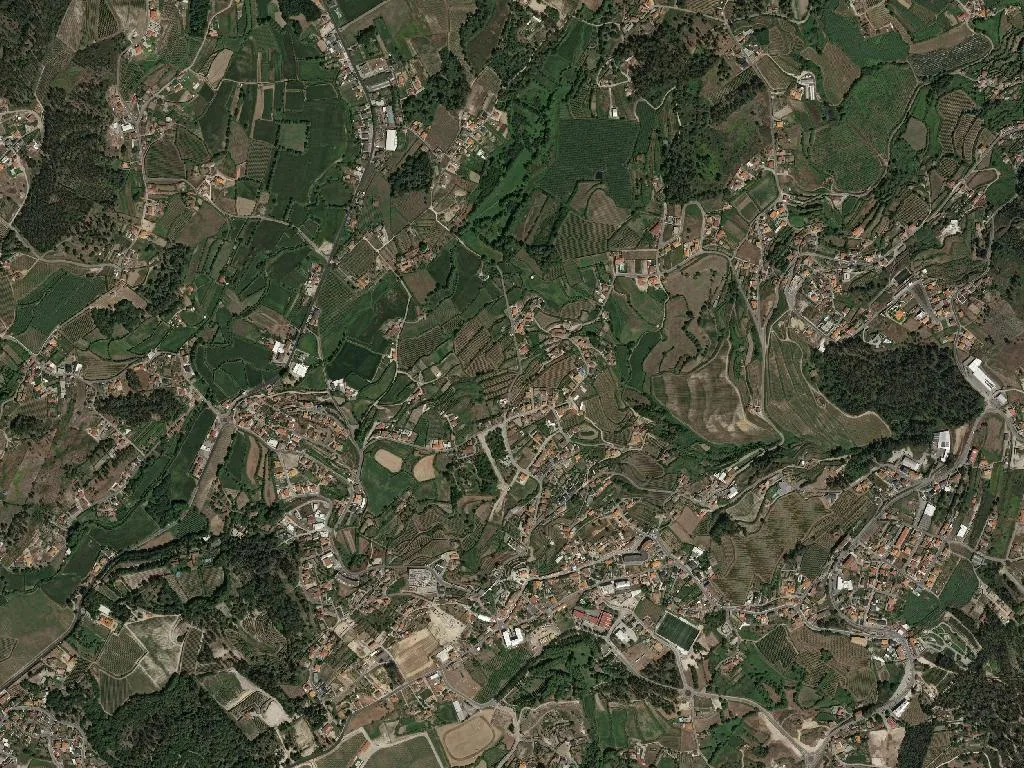
Officially created a parish in 1835, the settlement had already been humming for centuries. Water-powered fulling mills stood on the little river Veiga, and women walked home from the looms with skirts flecked by lint. Today the 375 hectares are given over to smallholdings of maize and vinho verde vines, worked by 2,451 people who can tell you, without checking, which row of vines belongs to which cousin. Population density: low enough for silence, high enough for gossip.
Church & Crossroads
The parish church, listed in Portugal’s public-interest register, is a lesson in proportional restraint: whitewashed planes, granite door-frames the colour of rain-soaked slate, a single rose window that throws a pale disc across the nave at ten past nine each winter morning. Walk any lane out of the centre and you will meet a wayside cross—granite arms, moss-filled inscription, sometimes a niche no larger than a postcard holding a painted ceramic saint. They mark the points where footpaths fork, once used to renegotiate boundary stones or, more simply, to decide which way the cows should come home.
February Fires: Santa Águeda
On 5 February the square sheds its weekday hush. The feast of Santa Águeda—patron of both women and grain—begins with a dawn procession: three brass bands, 48 hours of steady drumming, and a statue of the saint carried shoulder-high through streets barely two metres wide. Locals insist the timing is agricultural as much as liturgical: the first blessing of seed corn, the moment when winter rye is still short enough for a procession to pass without trampling next month’s bread.
The Greater Feast: Senhor dos Aflitos
If Santa Águeda belongs to Torno, the Festa Grande belongs to everyone. On the last Sunday of May the parish swells ten-fold. The square becomes a grid of pop-up kitchens: cast-iron pots of sarrabulho—rice darkened with pork blood, cumin and smoked morcela—bubble beside trays of rojões, nuggets of shoulder pork glossed with paprika-lard. Between courses you are handed a cavaca, an egg-yolk sweet so brittle it shatters at first bite, and a thimble-glass of vinho verde that snaps the palate back to life. At dusk the statue of Senhor dos Aflitos is shouldered down the hill, followed by a brass band playing a march that sounds, inexplicably, like New Orleans slowed to 80 bpm.
Tracks, Streams & Stone
The rest of the year rewards slower motion. From the church door a web of cobbled lanes unspools between fields of maize and pergola-trained vines; the average altitude is only 245 m, but the land rolls enough to hide a stream until you hear it. Follow the water and you reach Ponte da Veiga, a single Gothic arch thrown across the river in the early 1400s by the monks of Pombeiro. No souvenir stalls, no ticket booth—just the sound of your own footsteps replacing the clack of hooves that crossed here six centuries ago.
Evening brings the second bell: six slow strokes that fold the valley back into itself. Smoke lifts again from the chimneys, carrying the same tannic note of burning oak that once kept spinners alive through winter nights. The wheels are gone, yet something in Torno still turns.