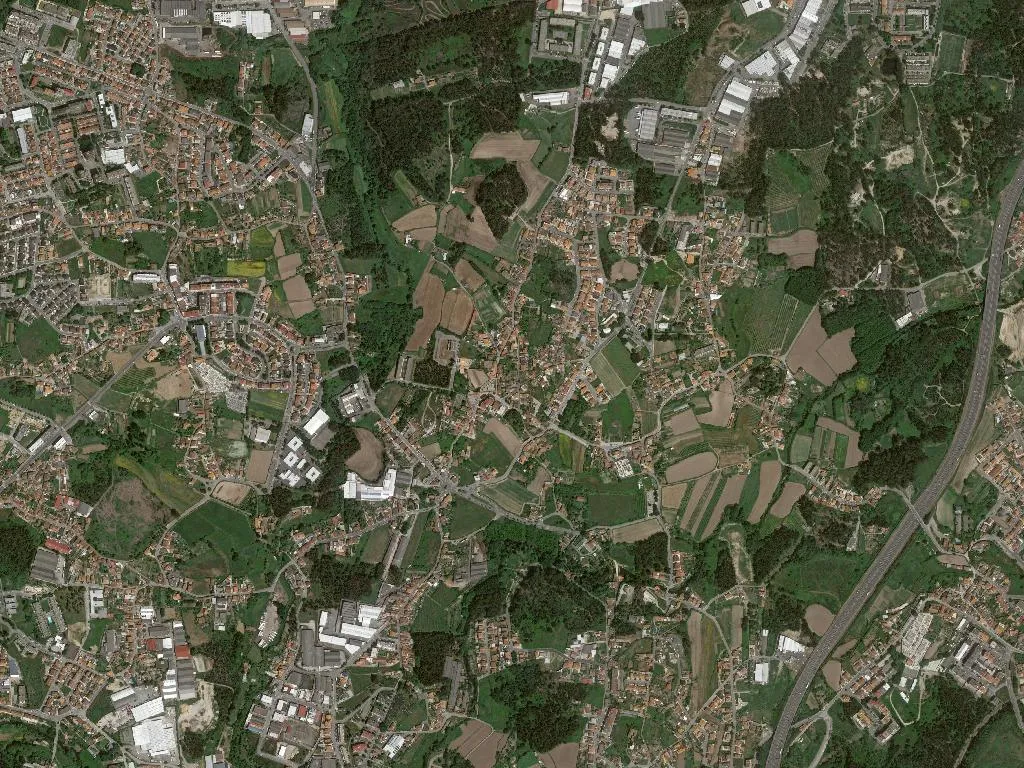
Full article about Milheirós: Dawn Footfalls on Granite Cobbles
Between twin Caminho trails, elders guard vines and vintage stories in Maia’s quiet parish
Hide article Read full article
Footsteps on granite: Milheirós at 7 a.m.
The Portuguese pavement sings under your soles as you walk Rua da Igreja. Each black-and-white calcada tile clicks like a metronome, the sound ricocheting between granite walls still cool from the night. At seven-thirty the sun clears the ridge of Maia’s high ground and slaps the whitewash so hard the glare bounces back onto your face like a photographer’s reflector. Somewhere a shutter rolls up with the reluctant drag of metal on stone; somewhere else a dog gives a single, business-like bark. Nothing else moves. Milheirós holds its breath.
Two Santiago trails and a handful of vines
The village is barely three square kilometres, yet it is crossed by two separate routes of the Caminho de Santiago: the Central and the Coastal. Forget the Instagram pilgrims with laminated credentials and trekking poles that click like ski sticks. Here you meet the walkers who smell of rain-soaked fleece and ask in phrase-book Portuguese for a tap to refill a dented bottle. They follow yellow arrows painted on electricity boxes, past trellised vines that survive more from habit than profit. The soil—granite sand laced with loam—could still make a decent Vinho Verde, but most parcels have been sold off for semi-detached houses with porte-cochère garages. What remains are backyard pergolas: pergolas of granite posts and rusty wire where a few red grapes swell for homemade aguardente.
Demography is the real story. Census figures show almost a thousand residents over 65 and fewer than seven hundred children. Come mid-afternoon the benches in front of the 18th-century Igreja Matriz are fully subscribed: cardigans buttoned to the throat, walking sticks hooked over one knee, eyes fixed on the same patch of road they have monitored since the 1950s. They watch traffic the way others watch Netflix.
Festivals that still run on wax and sardine oil
Faith here is analogue, not digital. The liturgical calendar resets the parish clock twice a year: the Festa de Nossa Senhora do Bom Despacho (late August) and the Festa de Nossa Senhora da Hora (third weekend of October). No tour coaches from Salamanca, no LED stage. Instead, a temporary altar appears on the tarmac, draped in crocheted lace. Women in black aprons sell bifanas from aluminium trays; teenage drummers rehearse the same march they learnt from their grandfathers; the valley fills with gun-powder and grilled sardine smoke so thick it films your sunglasses. At 23:00 the priest blesses the crowd with a brass monstrance, and someone’s grandson sets off a final, defiant rocket.
Between the city and the altitude of 72 metres
Stand on the balcony of the new-build flats on Rua do Monte and, on a rinsed winter afternoon, you can see the Atlantic sprawl of Porto 12 km away—tower cranes, hospital helipad lights, the faint stripe of the Freixo bridge. The N14 is the only artery in or out: a single-carriageway national road that doubles as the high street. Commuters leave at 07:40 for the industrial parks of Águas Santas or Maia’s Europarque, return at 18:15, eat dinner at 21:00 sharp. Many have never driven across the Douro river into the city proper; they claim not to miss it.
There is precisely one registered guest-house, a private house with three rooms above the owner’s hairdressing salon. No gift shops, no viewpoints with orientation boards. Visitors arrive because Google Maps routed them round the A41 ring-road traffic, or because they are tracing great-aunt Maria’s baptism record. Milheirós does not perform for tourists, which may be the most subversive luxury it offers.
Evening brings the same score: platanus leaves rattling like dry bones, the bakery van loud-hailing “pão quente”, the church bell counting the hours no one has forgotten how to read. A woman crosses the road with yesterday’s loaf tucked under her arm, moving at the pace of someone who already knows tomorrow’s weather. The village exhales. The calcada tiles keep the last of the sun, and the granite walls store the warmth for pilgrims who will pass at first light.