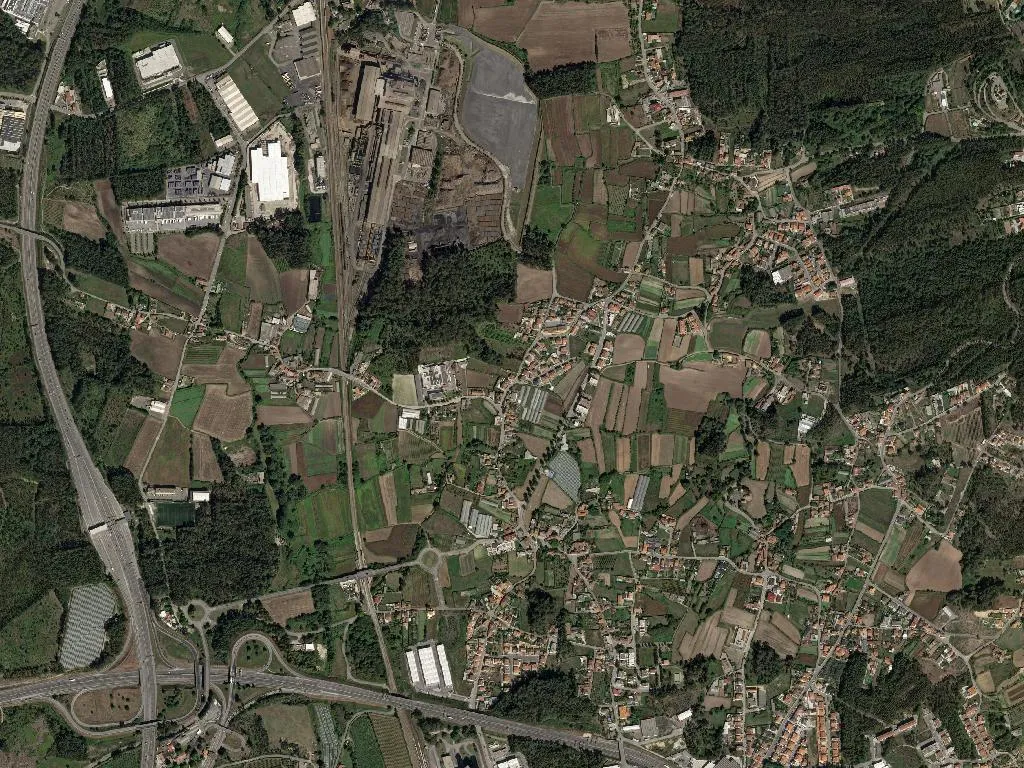
Full article about São Pedro Fins: Where Cornbread Crust Crackles Above Porto
Follow the scent of nutty broa drifting from a wood-fired oven in this granite village above Maia.
Hide article Read full article
The Scent of Warm Broa
The communal oven exhales a plume of sweet, nutty steam. Inside, a baker flips a loaf of broa de milho onto a wooden paddle without bothering to check the time; the crust crackles like a log fire and the crumb is the exact shade of maize that tells her it’s ready. Saturday in São Pedro Fins begins this way, eight kilometres inland from the ring-road sprawl of Maia and 108 metres above the traffic noise. Outside, the granite fountain on Rua do Meio still trickles into tin buckets while two women swap yesterday’s news. Nothing rushes here.
Where the Land Once Ended
The name itself is a boundary stone: “Fins” means “limits”, the outer edge of the medieval lordship of Maia. When the parish church of São Pedro went up in the 16th century, terraces were already being scratched into the River Este valley and water-mills were grinding millet. Horse-racing on the Carreira meadow became so popular by the 1700s that the place-name stuck and festival betting purses were measured in gold cruzados. Inside the church, gilded carved cedar and 18th-century azulejo panels insist on continuity: this is soil that people stay on, even though plenty pass through. Yellow arrows of the Portuguese Coastal Camino skirt the medieval bridge over the Este and lead pilgrims to the albergue at Bom Despacho—pay-what-you-wish, silence guaranteed.
Granite, Water and What Lasts
Grey stone sets the rhythm. A baroque pilgrimage cross catches the first light; farm walls are stitched together without mortar; the chapel of Nossa Senhora da Portela, built in 1753, keeps watch over the cemetery like a sober chaperone. Behind high ivy-clad walls, the Quinta da Ventuzela still belongs to the same family whose coat of arms is carved above the wine cellar door. Downstream, the Carreira mill—restored in 2004—creaks back into life every Saturday: the Este turns the wooden wheel, maize becomes yellow flour that smells of damp earth and cut grass. The 3.5-kilometre Mill Trail follows the water through meadows where grey herons land at dawn and kingfishers streak cobalt arrows across the surface.
What the Day Feeds You
At “O Moinho” restaurant, kid goat is slid into a wood-fired oven rubbed with garlic, white wine and pork fat. An hour later the skin blisters, the juices hiss on terracotta, and the dish arrives with sarrabulho rice—dark, almost black, sticky with smoked blood—and a torn wedge of broa still hot enough to melt butter. On feast days—Bom Despacho the first Sunday of May, Nossa Senhora da Hora on 15 August—the menu widens: rojões (pork shoulder fried in lard), caldo verde sharpened with onion chouriço, toucinho-do-céu almond slabs that gleam under candlelight. 29 June belongs to São Pedro: cinnamon-and-fennel cakes for children, a priest’s blessing for the fishermen who still cast nets in the Este. Carnival brings caretos—locally-made wooden masks hung with coloured wool, bells clattering through the lanes like something out of a Bergman film.
Between River and Plateau
Southwards the Este draws a green ribbon of water-meadows and willow scrub; northwards the ground lifts gently to the Santa Cristina plateau where gall-oak and cork tree scent the air with resin and leaf-litter. Population density is the lowest in the municipality—barely 385 souls per square kilometre—so there is acoustic space to follow the dip and rise of a chiffchaff or to pause at the Olaria do Este workshop and press your own bowl from local clay that fires the colour of terracotta roof tiles.
When the sun drops, low light ignites the granite and the church bell strikes six: three slow peals, a breath, three again. The echo crosses the valley, climbs the woods, returns. It hangs in the air like an unfinished sentence, suspended between stone and water.