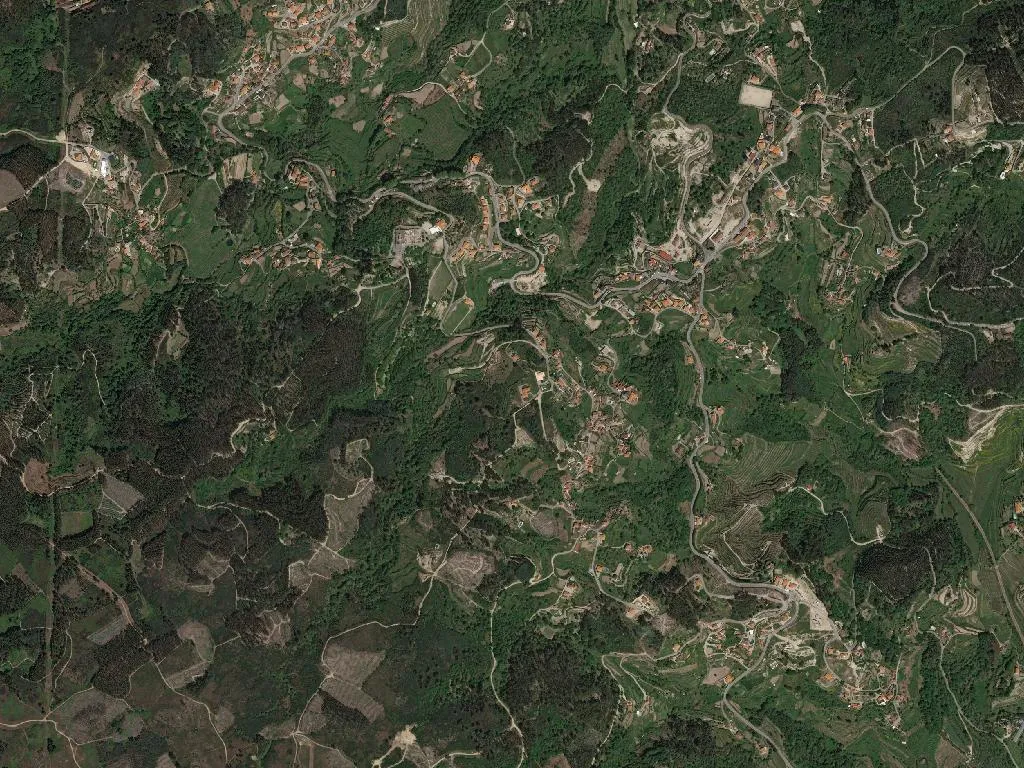
Full article about Granite fog & Alvarinho terraces of Paredes de Viadores
Winter mists veil schist hamlets where children cycle past 1756 chapel
Hide article Read full article
The Granite Edge of the Valley
The granite emerges from the roadside embankments, a dark grey that glints with the remnants of the morning’s rain. The parish spreads across 1,311 hectares of slope, a landscape where valleys open into terraces and vineyards climb halfway up the hillside, always visible against the irregular silhouette of the Serra do Marão. At 391 metres above sea level, the air arrives cold on winter mornings and the fog lingers, leaving the schist houses suspended in a whiteness that erases their outlines.
Paredes de Viadores e Manhuncelos was born from the administrative union of two distinct places in 2013 — Paredes de Viadores, with its 1756 chapel dedicated to São João Baptista, and Manhuncelos, whose medieval-rooted parish church of São Mamede still stands. The 1,534 inhabitants are distributed across hamlets like Carvalhal, Formigoso and Outeiro, in a network where neighbours are still known by name. There are 207 children between 0 and 14 years old — high-pitched voices in the playground of the primary school, bicycles leaning against the chapel wall — but also 270 elderly who remember the communal threshing floors where corn was threshed and the harvests that began at dawn, when you could hear the "ai jesus" of women climbing the slope with baskets on their heads.
Green Wine and Highland Honey
The territory is part of the Amarante sub-region of Vinho Verde — the smallest in extension, but where the granite soils and southern exposure produce the most structured Alvarinhos. The vineyards occupy the mid-slope terraces, protected from the northern winds, the vines aligned on chestnut wood trellises or trained on espaliers, depending on the age of the plantation. In the Manhuncelos cooperative winery, founded in 1964, grapes were still foot-trodden until the 1980s. Today, private cellars maintain the oak barrels where the wine rests until February, when the "magra" is made — the first racking after malolactic fermentation.
But the parish preserves another certified product: Mel das Terras Altas do Minho DOP, collected from the 180 hives that dot the meadows along the Ovelha river. The honey here has a dark amber colour, crystallises in 15 days, and carries the flavour of wild flora — heather, strawberry tree, bramble — that blooms in layers throughout spring. At José Augusto's house in Outeiro, traditional cork hives are still kept, 80-centimetre dark cylinders that testify to beekeeping perpetuated since at least 1897, the date of the first parish certificate recording a beekeeper.
Calendar in Two Times
The life of the parish is marked by two high points: the Festa de São João, on 24 June, when bonfires are lit at dusk beside the chapel of Paredes de Viadores and the smoke rises straight into the still air — bringing back emigrants who holiday in July — and the Festas do Marco, on the first weekend of September, a municipal celebration that brings the "Viúvas de Manhuncelos" folk group to parade through the streets of Marco de Canavezes. Outside these days, the rhythm is different — the vineyard pruning in January, the bell that rings at noon from the tower of São Mamede, the AVIC bus that passes at 7:15 am and 5:30 pm at the Formigoso stop, connecting to the municipal seat.
There are thirteen registered accommodations, between houses and rooms, an offer that emerged after 2015 when the Town Hall created the "Aldeias de Marco" programme. Those who stay sleep in granite houses restored with community support — like the Casa do Castanheiro, where you wake to the neighbour's rooster, have breakfast with cornbread from the Silva bakery that opens at 6:30 am on the national road. Logistics don't intimidate — we're 8 kilometres from Marco de Canavezes, accessed via the EN319 — but the experience demands time to reveal itself. There are no crowds, no compulsory itineraries. There is, instead, the possibility of walking the marked PR1 trail "Entre Viadores e Manhuncelos", 7.3 kilometres that connect the São Bento spring, where women reportedly washed clothes until 1960, to the chapel of Nossa Senhora da Saúde, built in 1948 after a vow made during the Spanish flu.
What remains, in the end, isn't a photograph to frame. It's the sound of footsteps on the irregular granite paving that connects Paredes de Viadores to Manhuncelos, built in 1953 by the "Serviço de Hidráulica Agrícola" when the Outeiro stream was channelled. It's the weight of silence when the wind stops, before hearing Mr. Joaquim's tractor climbing the field at 6:30 pm where he planted potatoes. It's the taste of dark heather honey spread on cornbread that D. Lurdes takes from the oven on Wednesdays. And the certainty that there are places where life is measured by the agricultural calendar, not by the number of likes — where Facebook time doesn't replace sowing time, which here is still done on March's waxing moons.