Full article about Sobretâmega: stone church above pewter Tâmega
Sobretâmega, Marco de Canaveses, hides a 14th-century river-guarding church, schist vineyards and silent Tâmega views.
Hide article Read full article
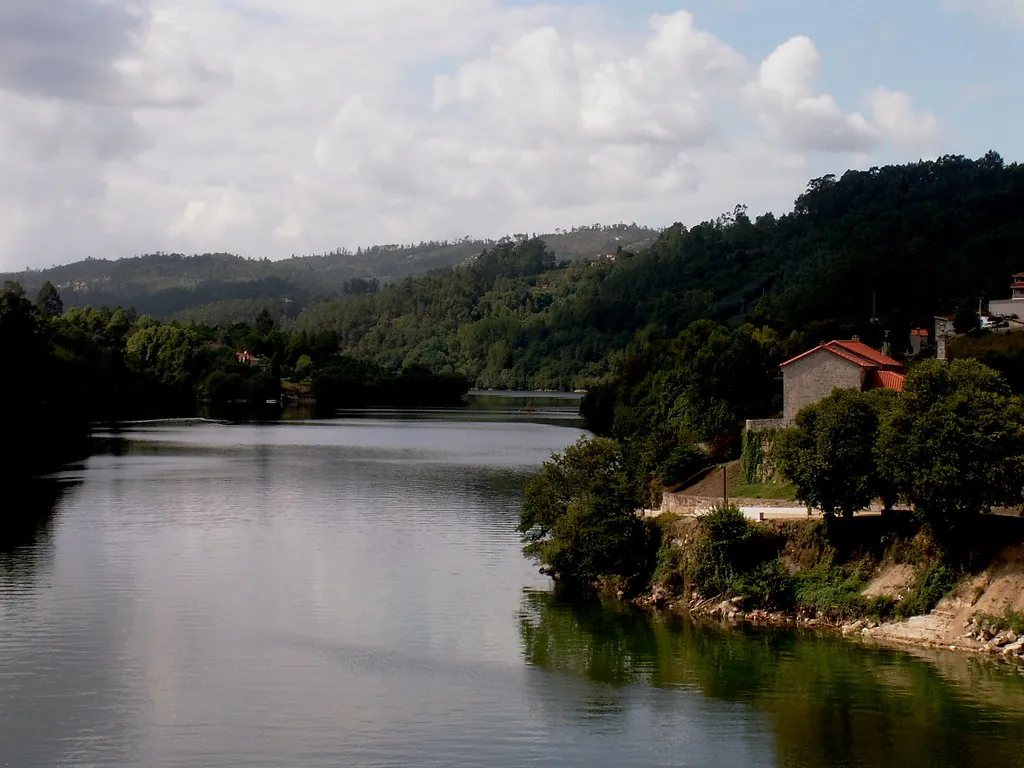
You hear the Tâmega before you see it. Not as a roar, not even a ripple—just a steady, metallic hush that fills the valley floor. At dawn the river is a band of pewter beneath mist, and Sobretâmega, population 1 084, seems to hover above it like a stone boat. The air smells of wet schist and leaf-mould, with a back-note of Touriga Nacional drifting down the terraces. No one comes here by accident; the parish road dead-ends at the water, and the old ferry chains that once linked this bank to São Nicolau have long since rusted away.
A church that once guarded a crossing
Santa Maria does not bother to impress. Built just after 1320, at the tail-end of the Romanesque moment, it stands with its back to the slope and its granite feet in nettles, portals trimmed only by the chisel-marks of the masons who cut them. Pilgrims coming from Canaveses would have seen its square tower first, a beacon that announced safe passage across the Tâmega. Directly opposite, the sister church of São Nicolau mirrored the gesture, the two buildings acting like medieval lighthouses minus the light. The ferry is gone, but the dialogue remains: stone answering stone across 150 m of current.
Inside, the nave is a cool lung of air. Walls eight hand-spans thick muffle the valley; the only percussion is the occasional drip of condensation hitting slate. No gilded carving, no baroque theatrics—just a single slit window that throws a blade of light onto the altar slab at terce, exactly as it has since the Avignon papacy. The Rota do Românico leaflet calls the building “modest”; the place itself prefers the word “exact”.
Vineyards that fall into the water
Below the church the valley arranges itself in geological tiers: river, alluvium, vegetable plots, then vines pegged to granite stakes the colour of week-old bread. This is the southern limit of the Vinho Verde zone, and the local sub-zone—Sobretâmega’s amphitheatre of heat-retaining schist—ripens grapes a full fortnight ahead of the coastal quintas. The vines are trained high on pergolas so that vegetables can grow underneath; in August the bunches hang like opaque green lanterns, giving off a scent of Williams pear skin.
The same slopes feed wild heather, lavender and strawberry tree to the bees that produce Mel das Terras Altas do Minho DOP, an amber honey with enough acidity to slice through the local fatty pork. Ask at the parish council and they will ring Sr. Armindo, who keeps hives on the cliff above the river; he’ll sell you a kilo jar with the wax still on top, no label required.
What lunch remembers
Roast kid arrives with crackling that shatters like thin ice, the meat scented only with bay, white wine and the smoke of olive wood. Minho-style pork cubes—rojões—come stained orange with sweet paprika, cushioned by boiled potatoes and discs of orange that you squeeze over the plate. The caldo verde is cut so fine it resembles ribbon, the chorizo oil forming small golden coronets on the surface. Pudding is toucinho-do-céu, literally “bacon from heaven”, a dense almond-and-egg yolk slab invented by nuns who had more yolks than patience.
Green wine, slightly pétillant, is poured into narrow glasses that resemble laboratory beakers; the rule is to refill before the level drops below half, so the CO₂ never escapes. Conversations stretch accordingly. The only hurry is the cook’s: she needs the oven free for the next tray.
Paths that remember you
There are no brown-and-yellow waymarks here, just stone walls coated in lichen the colour of army webbing. One lane leaves the village between terraced vegetable plots, becomes a track, then a tunnel of alder and wild fig, and finally a sheep path that contours above the water. You can walk for an hour and meet only a single fisherman thigh-deep in the river, his rod held motionless like a surveying staff. Grey herons work the far bank; when the sun comes out they turn suddenly white against the schist, as if someone has switched on a light inside them.
Evening arrives with the three-note bell of Santa Maria, the sound rolling across the water and bouncing back off the opposite escarpment. São Nicolau, now invisible in darkness, keeps its silence. Between the two churches the Tâmega continues its metallic murmuration, carrying with it whatever tried to cross and never quite made it—ferry ropes, pilgrims’ sandals, the odd secret.