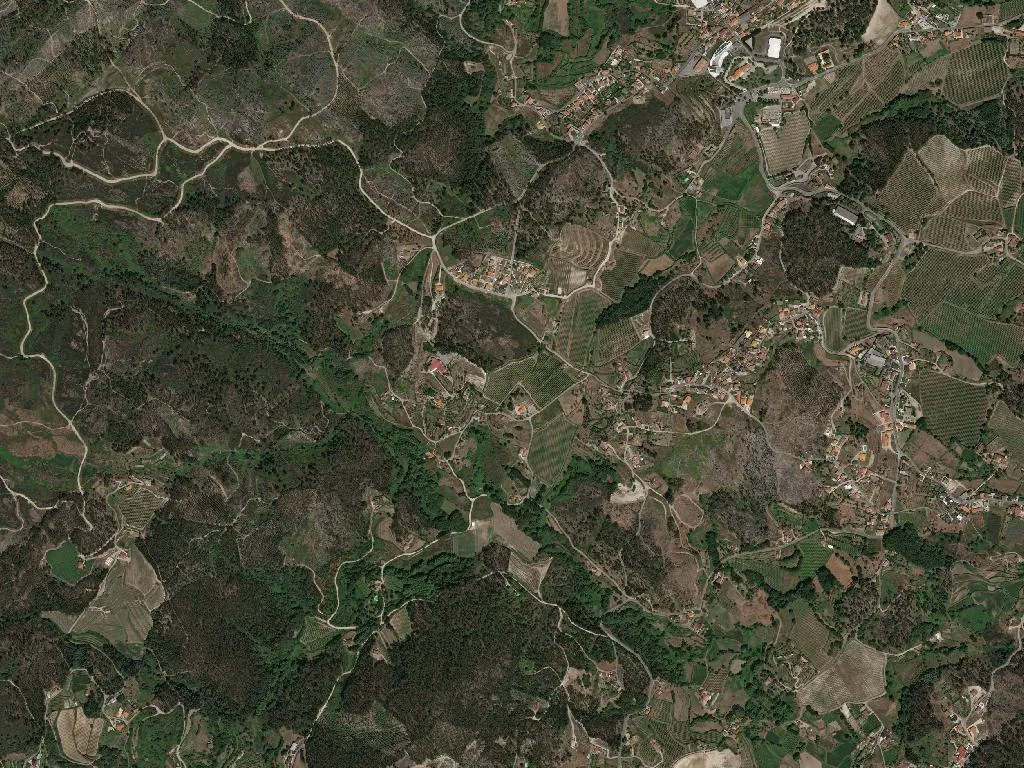
Full article about Vila Boa de Quires: Where Oak Smoke Meets the River
Vila Boa de Quires e Maureles hides Copper-Age ramparts, Augustinian churches and palace ruins where swallows nest above oak-smoked kitchens.
Hide article Read full article
The oak leaves sieve the toll of the parish bell, letting it drift downhill until it meets the hush of the Ribeira de Bufa. At 320 m above the Douro’s tidal reach, the air in Vila Boa de Quires e Maureles smells of damp schist and of oak-wood just lit in kitchen ranges. Manorial walls – dated 1512, 1737, and every century between – are stitched together by masons’ marks, a stone ledger of the time when this parish was a self-governing couto with its own pillory, court and gaol.
Three millennia of granite and a Germanic name
Above the village the Castro de Quires rides a granite ridge. Three concentric ramparts, first raised in the Copper Age, were reused by Romans and later christened by Suebic settlers who followed the fall of empire. Their leader Quederici left his genitive in the toponym; the Portuguese tongue softened it to Quires. In 1129 Dom Flâmula Moniz bequeathed the surrounding land to Paço de Sousa monastery; around 1185 the first community of Augustinians raised the building that still serves as parish church. Step inside and you pass through strata of time: a gilt Baroque retable glints in candle-light, while on the north wall a 17th-century Last Judgement reminds worshippers that the scales weigh deeds, not intentions. Victorian restorers found, then promptly lost, a pre-Roman inscription – an epigraphic ghost that quarrymen still swear they hear whispered at dusk.
Beyond the porch the settlement unrolls in armorial houses: Casa do Carvalho (1737), Casa de Cavalhões (18th c.), Casa da Lavandeira (1512), Casa de Eidinho (15th c.). At the lane’s end the unfinished palace of the Portocarreiro family – who gave their name to the Honra (seigneurial honour) in 1057 – stands roofless, its windows empty frames for passing swallows. Locals shrug: “They began with ducal ambitions, but the money ran out before the dream. Now it’s a palace of wind.”
Green wine, mountain honey and midsummer fires
The cooking is inseparable from the slope. Vinho Verde drawn from local azal and arinto grapes – villagers call it “coloured water” – accompanies rojões (cubed pork marinated in vinha d’alhos) and the paprika-darkened sarrabulho stew, served in black clay bowls still turned in nearby Travanca. Kid goat spends four hours in a bread-oven, basted every thirty minutes with white wine; meanwhile oak-smoked chouriço, salpicão and linguiça cure above kitchen hearths, ready by the time the storyteller has finished recounting how each sausage got its shape.
On the eve of 24 June the feast of São João turns the parish into an open-air kitchen. Every quarter stacks its own bonfire; sardines sell at €2 a dozen; brass bands thread through alleyways in rusgas that last until the sun rises over the Marão. Boys still tour houses asking for the lenço de São João, a cotton scarf offered by girls and redeemed, if courage allows, with a kiss the next morning. During the Festas do Marco (first weekend of September) the churchyard fills with processions, straw-hat auctions and stalls where 87-year-old Albertina demonstrates rye-straw plaiting: “Cut in August, soak, press, weave. A good hat lasts a lifetime – longer than the wearer, usually.”
Footpaths between dolmens and streams
A way-marked loop climbs from the castro to the Mamoa de Chã de Chouçal, a Neolithic burial mound stranded among olive and cork oak. The trail switchbacks across narrow socalcos (dry-stone terraces) where the vines are trained on granite posts, fords the Ribeiro de São Paio – children still hunt freshwater clams here in July – then crests Monte de Perafita. From the top the Matriz tower pokes above treeline like a forefinger accusing the sky. Blackbirds and pintarroxo bullfinches keep you company; the nearest espresso is 3 km away, so pack water and a slab of pão de maturada, tooth-breakingly hard until married to a sliver of mountain cheese.
In the quintas tastings happen in granite cellars whose barrels sweat greenish wine. Mr Armando at Quinta da Veiga pours into a tumbler “to see the colour; if it’s pretty, it’s good”. Buying Minho Highland Honey DOP involves a tutorial on heather bloom and transhumance; purchase two jars and the beekeeper knocks off a euro “so your mother-in-law can’t say you only remember her at Christmas”.
When late-afternoon light bronzes the façade of Casa do Carvalho and the bell tolls again, the echo lingers inside the roofless palace. It hangs in the cold plateau air, braided with the scent of vine leaf and wood-smoke – a sensory password to a parish where a Suevic war-leader’s name still reverberates through three thousand years of granite.