Full article about Leça da Palmeira: Atlantic lung of Porto
Granite alleys exhale salt & cranes; a vanished palm once steered caravels home
Hide article Read full article
Leça da Palmeira: Where Concrete Meets the Tide
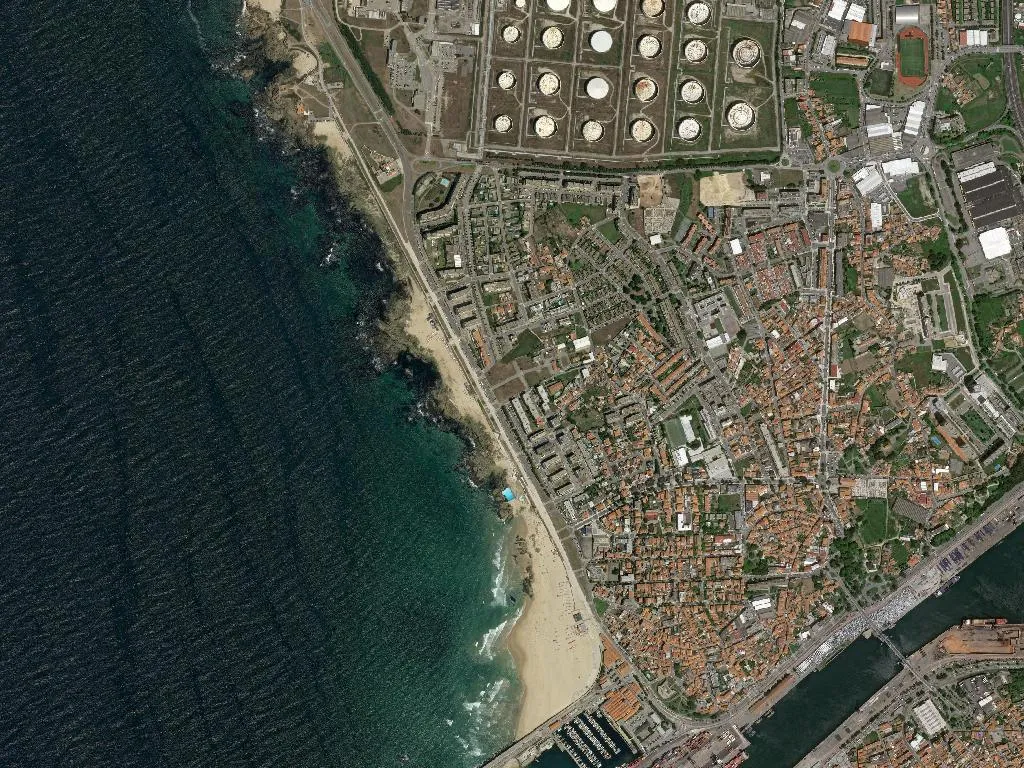
The first thing you hear is the break. Not the winter-storm crash that rattles the windows of Porto's seafront cafés, but the steady respiration of an Atlantic tide slipping over dark granite, then exhaling in a lace of foam. Next comes the smell: iodine-thick, sun-baked wrack, and underneath it the faint metallic breath of Leixões Harbour, Europe's second-largest container port, shifting into gear only a few hundred metres away. No fanfare, no greeting—just salt water and industry sharing the same lungful of air.
Nine metres above sea level, compressed into seven square kilometres, Leça da Palmeira carries the weight of 24,500 souls and almost a millennium of maritime traffic. The population density rivals central Lisbon, yet every street still tilts westward until the world ends in a thin graphite line of ocean.
The Palm Tree That Mattered
Centuries before GPS, a lone maritime palm stood here as a daymark for caravels running north before the trades to find the mouth of the Rio Leça. The river's name predates Rome—possibly Celtic—while the palm has vanished, leaving only a memory in the parish's coat of arms. A Benedictine monastery anchored the first settlement in the thirteenth century; in 1832 liberal troops splashed ashore to establish one of the earliest beachheads of the constitutional revolution. Four years later the Crown elevated the fishing hamlet to a parish, but the real hinge of fate came with the construction of Porto's artificial harbour between 1884 and 1892. Overnight, Leça became the North's maritime engine room. In 1890 the SS City of Paris tied up here—continental Portugal's first cruise liner, disgorging Gilded-Age Americans en route to the Douro vineyards.
Granite, Concrete and Wooden Arrows
The parish church, started in the mid-1500s, shelters a Mannerist altarpiece classified as a National Monument—timber carved with the patience of men who believed time belonged to God, not to deadlines. Five minutes away the Forte de Nossa Senhora das Neves—everyone says "Castelo do Queijo" because the seventeenth-century bastion sits on a bun-shaped boulder—keeps wind-battered vigil over the cliff. Further inland, the tiny Chapel of São Sebastião, a Tudor-Gothic oddity, still receives its annual gift: fresh wooden arrows hammered into a statue of the saint every January by fishermen renewing a vow no one can date. On the 20th, the Feast of the Martyr parades the image through streets that smell of wet wool, melting candlewax and brine.
Where Siza Tamed the Atlantic
Descend the board-formed concrete steps of Leça's tidal pools and your calf muscles hesitate. Atlantic water, refreshed by every flood tide, floods the rock-hewn tanks at 14 °C—cold enough to reboot the nervous system. Álvaro Siza Vieira designed the complex in 1966, when he was barely thirty, pouring concrete in situ so that the grey planes grow out of the reef like natural strata. At high spring tide the pools merge with the ocean; the horizon becomes a continuous sheet of gun-metal. A kilometre north, the 1926 Boa Nova lighthouse—reinforced-concrete tower with a riveted gallery—marks the point where the coast kinks and the wind swings round to the north-west.
Fish Stew, Cornbread and Convent Sweets
Inside Taberna da Esperança the caldeirada stops being recipe and becomes cartography: scorpionfish first, then gurnard, ray last, each laid into a copper pan in strict maritime order. Coruche sweet-paprika inks the broth; coriander is chopped with a mountain knife broad enough to double as an oar. Outside, sardines blister over roadside grills; cornmeal loaves, snatched from wood-fired ovens in the Padrão quarter, are split and sponged with the fish's oily juices. Dona Amélia has moulded Doces de Ovos da Palmeira in tin scallop-shells since 1962, using yolks from her own hens—a convent sweet that survived the dissolution of the monasteries. Wash it down with a glass of Loureiro from Quinta da Aveleda: bright enough to cut through the oil and demand another forkful.
Three Kilometres Between Cheese and Open Sea
The Marginal boardwalk runs three kilometres of pale ipê from the "Cheese Castle" to Leixões Harbour—cyclists, joggers and Coastal-Camino pilgrims sharing the same strip of timber without jostling. Rosa Mota, Portugal's Olympic-marathon medallist, logged her base miles here; the straight Atlantic lane offers a perpetual tail-wind and a horizon that tugs you forward. Leça da Palmeira beach unrolls white sand and protected dunes; Aterradura cove, tucked between gneiss outcrops, funnels swell for surfers who like their waves concise. South of the harbour mouth, Matosinhos' 83-hectare City Park—Portugal's largest urban green—bleeds into the parish with its reed-fringed lakes and packed-clay trails. Where the Leça estuary meets the sea, a Natura 2000 saltmarsh inhales and exhales with the tides; spoonbills and whimbrels pause on migration routes that pre-date every treaty.
The Sound That Stays
In the Jardim da Memória an anchor from the hospital-ship Gil Eannes rests on a granite plinth. The iron is rusted the colour of roof-tiles; touch it and you feel the abrasive chill of metal that has drifted Arctic waters off Newfoundland. The object is land-locked, obsolete, yet still seems to strain seaward. Everything in Leça pulls oceanward—the wind, the light skimming the wet concrete of Siza's pools, the smell of diesel mixed with kelp. But one detail holds you back: those fresh wooden arrows, hammered each January into the body of a plaster saint, fishermen rewriting by hand the only promise that still matters.