Full article about Perafita: Atlantic wind, stone graves & vanished pears
Where pear orchards once bloomed, salty dunes now cradle open-air tombs and lobster boats.
Hide article Read full article
Perafita: where the plain ends and the salt begins
The wind gets there first. It rolls in off the Atlantic laced with iodine and a film of moisture that lacquers skin, frizzes hair and snaps coat tails like badly trimmed sails. At a mere 16 metres above sea level, Perafita unrolls in slow motion—lettuce plots giving way to dunes, dunes giving way to spray. You expect to hear Porto’s ring-road, only ten kilometres south, but the soundtrack is older: granite being rinsed by the tide, over and over, the city’s metronomic breathing.
Pear trees no-one planted
The name remembers an orchard that vanished. “Pera” once scented this littoral; pear trees were replaced first by fishing nets drying in the sun, then by red-roofed estates that now house almost ten thousand people. A civil parish since the 19th century, folded into Matosinhos council in 1948, Perafita still wears two uniforms: the waterproofs of ribeira crews who go out for langoustine, and the pressed shirts of commuters who work in Porto's glass towers. Density tops 1,300 souls per km², yet pockets of quiet survive—a dirt lane between cabbages, the Leça greenway where the loudest noise is a bicycle freewheel and the river muttering towards its mouth.
Graves open to the sky
Halfway between nursery tunnels and the beach, granite was quarried not for walls but for the dead. The medieval necropolis of Montedouro is a scatter of anthropomorphic tombs chiselled straight into the bedrock, dated 10th–13th century and protected since 1970. Walk the site on a winter morning and cold rises through your soles; rainwater pools in the sockets meant for shoulders and knees, leaves plaster themselves to stone. There are no roofs, no aisles—one of the country’s few open-air early cemeteries—and the low sun sketches shadows so deep the rock itself seems to inhale.
Five minutes away, the 18th-century parish church reasserts vertical ambition. Inside, a gilded baroque retable ignites when the side door is left ajar: gold leaf flashes across the nave’s dark basalt. Melted wax and centuries-old pitch scent the chill air; every footstep on the slab floor ricochets like a dropped coin.
January cake that tastes of gunpowder
The third weekend of the year detonates with rockets and the yeasty sigh of rising dough. The Festa do Mártir São Sebastião—Perafita’s candle-lit heartbeat—pairs a sung Latin mass with a procession that rocks gilt statues through the streets, fire-crackers hanging in the sea-haze like grey lace. Edible star is the bolo de São Sebastião, a soft slab scented with cinnamon and candied orange peel, handed out as you leave church or at pavement cafés along Rua da Igreja. Outside festival season the same cake lurks in local bakeries; cinnamon shouts first, then orange cuts through, bright as winter sun on wet sand. (Head to Padaria Moderna when the parish hall is shuttered.)
Everyday menus follow the coast’s logic: caldeirada whose saffron liquor tastes of ship’s hull and tomato, monkfish rice thick enough to grip the spoon, sardines grilled over carob so the smoke climbs in neat spirals on the rare afternoon the Atlantic forgets to blow.
Yellow scallops on the way to Santiago
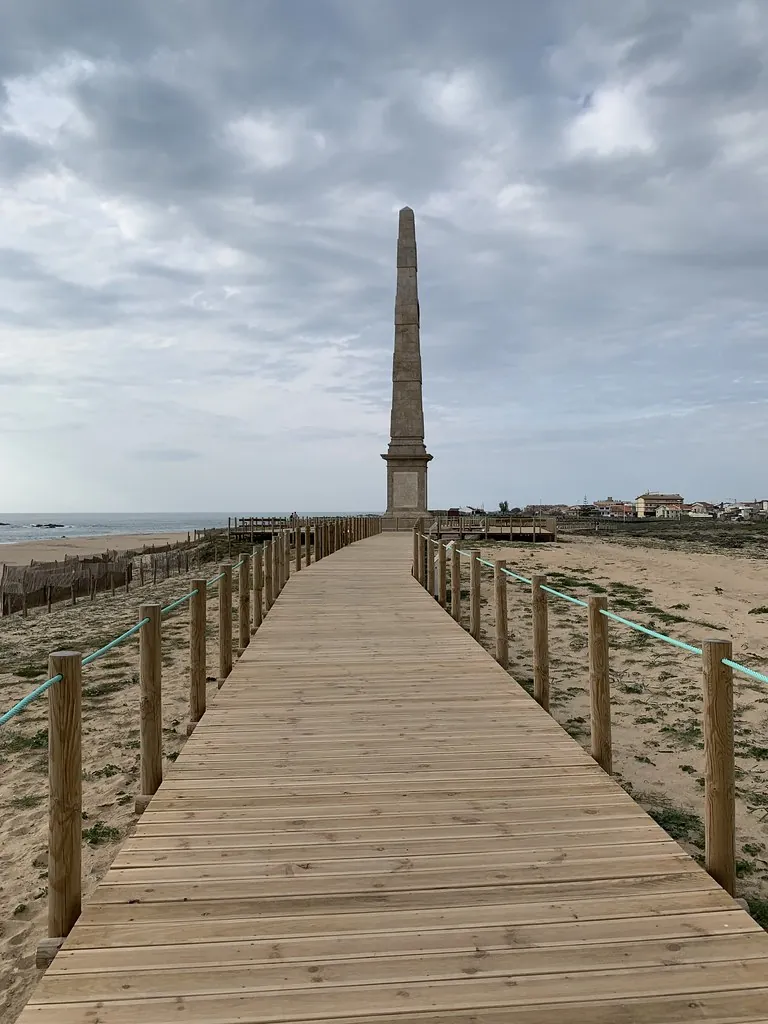
One of the finest ways to read the parish is on foot, following the yellow scallop tiles of the coastal Camino. (Take water; the breeze masks thirst and cafés are absent for 7 km.) The path threads market gardens, low dunes and European beachgrass that stitches the sand together. Where the track meets Praia da Memória the ground changes from earth to compacted sand, the horizon unzips, and the ocean’s rumble moves from background to breastbone.
Prefer pedals? The Leça greenway unspools a 4 m-wide cycle track between fields and foredunes. On foggy dawns cyclists become paper cut-outs dissolving into white. Civic pride—visible in the freshly re-clad parish auditorium, voted for in Portugal’s participatory-budget scheme—also fuels the monthly “Perafita ConViva” fair: pottery, pickled mackerel, jazz trios, the smell of cumin drifting over parked bicycles.
What the tide leaves
Evening light slides across the coastal plain and the sky takes on the bruised orange only the North Atlantic can mix. Perafita’s distinction is that contrast within a two-kilometre radius: medieval graves carved into bedrock and, a brisk walk away, fresh sand where children race the receding foam, seven centuries erased with every wave. You leave not with a postcard panorama but with a synaesthetic flicker—cinnamon and orange dissolving on the tongue while salt wind cracks your lips, the tide still at its slow labour, sizing tomorrow’s coastline.