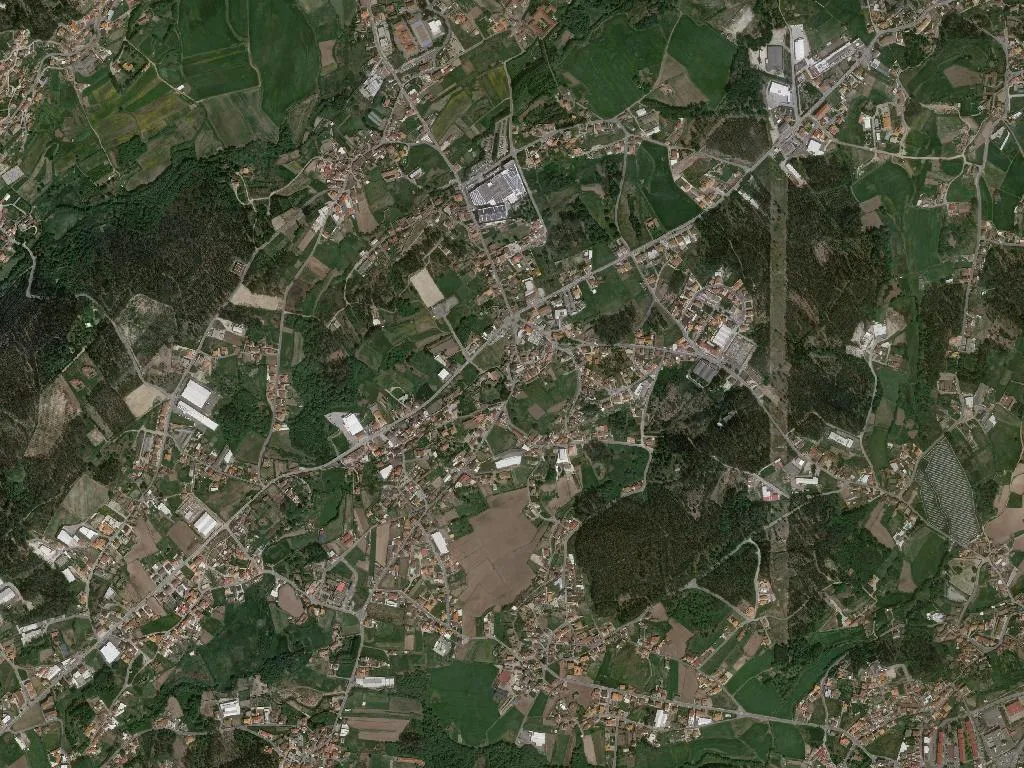
Full article about Carvalhosa: Where the Rio Whispers Through Potato Rows
Carvalhosa, Paços de Ferreira, hides a murmuring river, Templar-carved church and January torchlight parade in just 598 hectares.
Hide article Read full article
The River’s Quiet Conversation
Water talks here, but politely. Ten kilometres of the Rio Carvalhosa slip between potato rows and smallholdings without ever raising its voice—no cascade, no theatrical rush, just a steady hush that sounds like someone turning pages in the next room. From the spring at Lustosa to the confluence with the Ferreira, the river keeps its own time, irrigating vegetable plots that smell of wet soil at dawn and wood-smoke after dusk. The hamlets it threads—Abelheiras, Baiuca, Fontão, Sanguinhais, Vila Cova—have the ring of medieval marginalia, places that were already old when the first Ordinance Survey mappers inked Portugal on vellum.
Stone Memory, Templar Cross
The parish church stands in the geographical centre like a notary’s seal on parchment. Step close and you notice the Latin dedication block is out of chronological order: the masonry is 18th-century, yet the carved cross inside is unmistakably Templar—equal arms, splayed terminals, the geometry of crusading credit. Knights Hospitaller once administered these lands from the commandery at nearby Chã de Ferreira; their mark survives in the modern coat of arms approved in 2002, where the same cross shares space with corn cobs, a cogwheel and the Roman bridge at Vila Cova. The message is deliberate: fertility, industry and passage, layered like glazes on azulejo tile.
Carvalhosa paid tax to the crown in 1258—ninety-two hearths listed in Afonso III’s royal inquest—because the royal road from Guimarães to Porto already threaded through this plateau. Seven centuries later the through-route is the EN206, but the parish still measures only 598 hectares, enough for 4,514 souls to achieve a density London boroughs would recognise. Children and pensioners are almost numerically matched: 634 under-14s, 682 over-65s, a demographic equilibrium rare in rural Portugal.
When the Bells Call the Parish Home
Festivity is calendared by winter saints. On 20 January the Sebastianas honour the martyr with processions of girls in white mantillas carrying arrows—an echo of Saint Sebastian’s attribute—while on 3 February São Brás receives throat blessings from a priest wielding two crossed candles, a ritual older than antibiotics. These are not pageants staged for visitors; supermarkets close, traffic yields to the statue-bearers, and every scattered household reassembles around the church steps. Wayside shrines—an 1897 crucifix, a 1755 chapel to São Domingos, a 1717 niche to São Roque—act like medieval mile-markers, reminding you that footpaths, not tarmac, once organised this territory.
Corn, Wine and Capon
The cuisine is dictated by altitude and Atlantic rain. Maize ripens late here; its flour thickens caldo verde shot through with chouriço, binds sarrabulho porridge at pig-killing time, and gives the crusty edge to broa cornbread that arrives at table still warm inside a linen cloth. The local vinho verde—planted on abandoned terraces above Santa Comba—keeps its malic snap because the Serra de Santa Justa blocks the afternoon heat. Order a glass with rojões (braised pork shoulder) and you understand why Minho cooks never reached for Bordeaux.
Sunday lunch might finish with toucinho-do-céu, a yolk-sweet that originated in Ferreira’s now-vanished convent, its name translating literally as “bacon from heaven” though it contains neither bacon nor theological argument. The real regional star is Capão de Freamunde, a castrated cockerel fattened on maize and slaughtered at 180 days, its flesh protected by IGP status since 1996. The skin, lacquered and amber, tastes of slow Sundays and small pensions well spent.
Footpaths Between Two Rivers
Walkers should follow water. A second stream, the Fontão, joins the Carvalhosa beside the water-mill at Sanguinhais after wriggling 2.5 km under two different names—Ribeira da Várzea in Vila Cova, Ribeira da Fonte da Moura in Fontão—depending on which parish it is courting. The dirt lanes that shadow both rivers are tunnels of arbutus and holm oak, opening suddenly onto potato flowers or a saw-tooth skyline of furniture factories. At 336 m above sea level the air is clear enough to pick out the Senhor do Monte pilgrimage church on one horizon and the granite bulk of Santa Justa on the other.
Those factories explain the cogwheel on the coat of arms. Since the 1960s Paços de Ferreira has become Portugal’s answer to High Point, North Carolina: chair legs and table tops stacked like cordwood beside the N206. Yet 42 per cent of Carvalhosa’s residents still draw part of their income from the soil, and the river keeps its own counsel, murmuring beneath conveyor belts and spray booths, the same sound that accompanied Templar packhorses and medieval tax clerks. Stand on the Roman bridge at dusk and you hear it: water on stone, a conversation centuries old, still in progress.