Full article about Recarei: Where Vinho Verde Sleeps in Granite Lagares
In the Sousa valley, Recarei’s terraced loureiro vines, 18th-century church and echoing lanes breath
Hide article Read full article
Between valley and vine
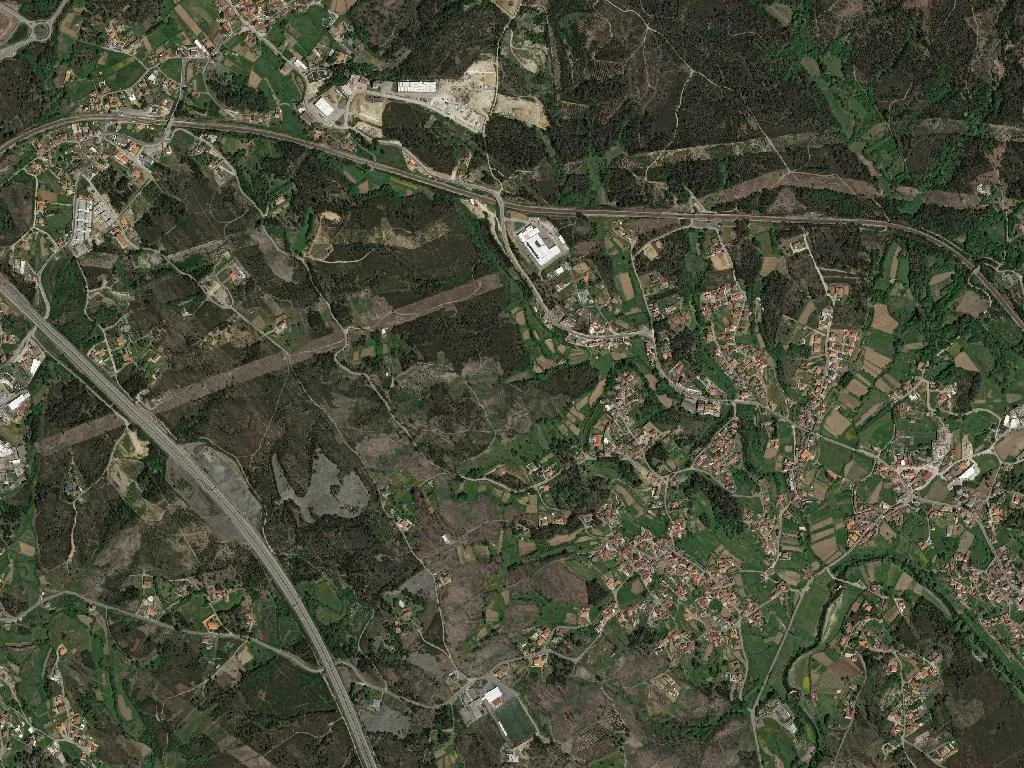
Woodsmoke rises in a dead-straight column from the chimneys of Recarei, held still by an October morning that smells of oak, eucalyptus and the damp basalt soil of the Sousa valley. The parish covers just under fifteen square kilometres of creased granite hills, a patchwork of narrow terraces planted with loureiro and arinto vines, vegetable plots the size of tennis courts, and stone walls the colour of weathered tweed. At only 122 m above sea level the settlement never claims a grand view; instead it stretches, unshowy and horizontal, along lanes that lead to hamlets called Caramos, Lordelo or the chapel of São Sebastião where the football ground of UD Recarei sits behind a low rail.
Recarei’s 4,479 residents (2021 census) are spread thinly enough that footsteps echo. Density is 300 people per km² on paper, yet the sensation is of elbow room: someone watering lettuces beside the Ribeira de Recarei, a neighbour rattling home with yesterday’s bread from the pastelaria, a conversation conducted across two balconies on Rua do Cruzeiro where maize cobs are still strung to dry each September. The parish church, completed in 1785, wears a mannerist pediment; in front of it the monthly market sets up on the first Saturday, canvas awnings snapping above crates of custard apples and cabbages the size of bowling balls.
The vineyards climb in tight benches of schist that hoards the day’s heat and releases it after dark. This is the Sousa sub-region of Vinho Verde country, the wine “green” not in colour but in age: low-alcohol, razor-edged, with a prickle of natural CO₂ that snaps across the tongue. Rows are worked by hand—no room for tractors on gradients this steep. At Quinta da Leite de Vasconcelos the family keeps its 1923 adega intact: granite lagares deep enough to stand in, chestnut beams blackened by nearly a century of fermentation. By late August the lanes taste of ripe loureiro grapes; wasps drone drunkenly and older residents recall harvest songs sung in improvised duels between neighbouring quintas.
The correct taste of things
The parish pantry is governed by protected names. Capão de Freamunde IGP—free-range cockerels fattened for three months—arrives at Christmas tables roasted with chunked potato and a glass of white from the Paredes cooperative, founded in 1958 and still painted the colour of pale ox-blood. Dark, thick Mel das Terras Altas do Minho DOP carries the resinous bite of heather and chestnut blossom; twelve registered beekeepers extract it in a converted railway warehouse beside the old Lordelo halt. Their hives sit among the vines, the bees commuting between flowering rows and wild scrub on the valley rim.
Tradition is preserved less as museum piece than as muscle memory. The communal bread oven in Lordelo, rebuilt in 2004, fires on the first and third Sunday: dough mixed at home, carried down the street on wooden trays, slid in with a seven-foot peel. Chouriça de porco preto bísaro—jet-black Bisaro pork—hangs for ninety days in a smokehouse scented by holly oak. Caldo verde is cut whisper-thin, the galician cabbage sliced into ribbons that float like green lace in potato broth thickened with a splash of the same young wine. Meals are measured by conversation, not clock: Martinmas lunch stretches until the aguardente appears, a 1996 bagaceira from Quinta da Aveleda poured into tulip glasses still warm from the dishwasher.
Memory and the calendar
Demography tilts towards recollection: 558 children under fourteen, 923 residents over sixty-five. Yet Recarei refuses to live as a mausoleum. The Casa do Despacho, an eighteenth-century clerk’s house beside the church, once quartered French troops during the 1809 withdrawal to Porto; today it hosts coding classes for primary-school pupils who Skype their grandparents in Paris. Adaptation, not nostalgia, is the local reflex.
Festas mark time like a liturgical clock. São Miguel in neighbouring Rebordosa on 29 September turns the square into an open-air dining room: long tables, paper tablecloths, bottles of vinho verde plunged into plastic buckets of ice. The Divino Salvador procession in Lordelo (second Sunday of August) follows a brass band through streets carpeted with sawdust mosaics dyed cobalt and vermilion. Paredes town ends August with its own Divino, fireworks ricocheting off the granite cliffs above the Sousa while the Recarei volunteer fire brigade grills 300 sardines over green laurel sticks. Emigrants fly in from Geneva or Toulouse, their rental cars clogging the EN106 for forty-eight hours. Grandchildren who attend school in French negotiate custard tarts in rusty Portuguese, switching to English when the waitress looks blank.
There is only one place to stay: Casa da Eira, four guest rooms in a converted granite threshing floor looking across the valley. Wake to a cockerel that belongs to Sr Carlos next door, to the church bell that has tolled the hour since 1785, to a dawn so unhurried you hear the click of vine ties being tightened by a farmer two fields away. The municipal swimming pool—opened by António de Oliveira Salazar on 6 August 1961, its fascia still carrying the regime’s coat of arms—opens at ten. Early swimmers pad across dew-wet asphalt, towels over shoulders, anticipating water cold enough to make the heart skip. The day begins, slowly, like a deep breath before the plunge.