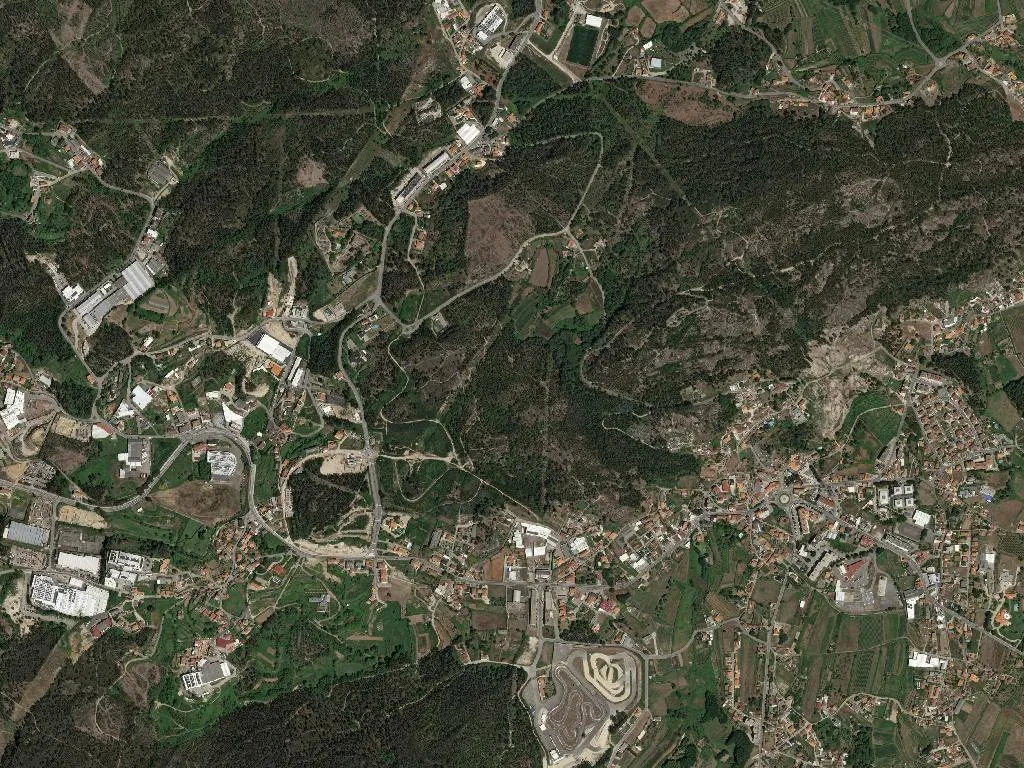
Full article about Vandoma: Stone, Vine & Sunday Bells at 442 m
Granite hamlet above Porto where elders sip coffee, kids spill from church and vines climb sky-high
Hide article Read full article
Granite breathing between terraces
Granite thrusts through the terraces at 442 m, the stone the colour of weathered pewter and just as unforgiving under the fingertips. Up here in Vandoma, a parish that fits into barely five square kilometres of Paredes municipality, the wind carries the slow toll of S. Miguel’s bell — a cadence that belongs only to this ridge. Clouds skim the fields, grazing the rows of vines that step down the valley like green ladders. Dry-stone walls, some three generations old, stitch property to property; their tops bristle with lichen the colour of oxidised copper.
The 2,306 inhabitants leave room to breathe. On Sunday mornings you feel the equilibrium: 342 children under fourteen spill out of mass while 330 pensioners claim the plastic chairs outside Café Central, arguing over the last football coupon. Space and society coexist.
Stone that remembers
Officially, heritage begins and ends with the sixteenth-century mother church, but the real archive is the row of spike-roofed farmhouses along Rua do Barreiro. Sr António’s cider-press is still bolted to the granite façade; inside, the smell of sawdust drifts into the cellar where he foot-treads Alvarelho grapes for his yearly 300 bottles of Vinho Verde. Walk the older lanes and you read a building code written by people who understood how granite sweats in August and how March rain slides off a 40-degree roof pitch. Windows face east to net the dawn; eaves overhang just enough to keep Atlantic squalls from the doorstep.
Vine and smoke
Vandoma sits inside the Vinhos Verdes demarcation. On sun-flushed slopes the vines are either ramada-trained on high pergolas (grandfathers’ style) or wired low in espalier (sons’ and daughters’). At the parish cooperative the must ferments in concrete vats; by mid-September the air tastes faintly of bruised apples and laurel. In kitchens the north-country canon rules: rojão à moda de Vandoma — pork shoulder simmered with home-grown white beans and field marjoram — and corn bread that appears, still steaming, from the wood oven behind the pharmacy every Wednesday and Saturday. D. Alda’s grocery sells heather honey from Monte de S. Félix in half-kilo swing-tops; the same moor feeds the bees that flavour the local aguardente.
Calendar of belonging
The parish diary is shared with neighbouring villages, but the night of 29 September — S. Miguel — is Vandoma’s alone. When the brass band strikes up on the church steps, white chairs fill like theatre stalls: elders in front, children weaving between chestnut roasters and the doughnut cart. Bacalhau com todos is served standing up at long deal tables in Rua da Igreja; wine moves faster than conversation.
Where the day ends
There are no hotels, only the front bedroom D. Amélia sheets with hand-blocked cotton for the occasional walker. Wake to the cooperative’s cows grazing the mist that pools in the valley, and to Sr Joaquim’s diesel tractor climbing the lane at 7:29 sharp. Authenticity is not a slogan here; it is simply the way the day unfolds: the baker’s metal shutter rattling up, wood smoke rising when the temperature slips, the distant bark of Alberto’s German shepherd.
At dusk the low sun ignites the west-facing granite and throws long shadows down the broken asphalt from Rebordosa. The air smells of burnt oak and Rosa’s bougainvillea; the church step is still warm from the afternoon congregation. You leave with the taste of neighbourly pumpkin jam — transported, as always, in a blue plastic tub — and the memory of a place whose hours are measured by bells, vines and the slow retreat of cloud.