Full article about Eja: Where Granite Manors Outnumber Residents
Sun-struck Paço, terraced Loureiro, 863 voices echoing across Penafiel’s quiet ridge
Hide article Read full article
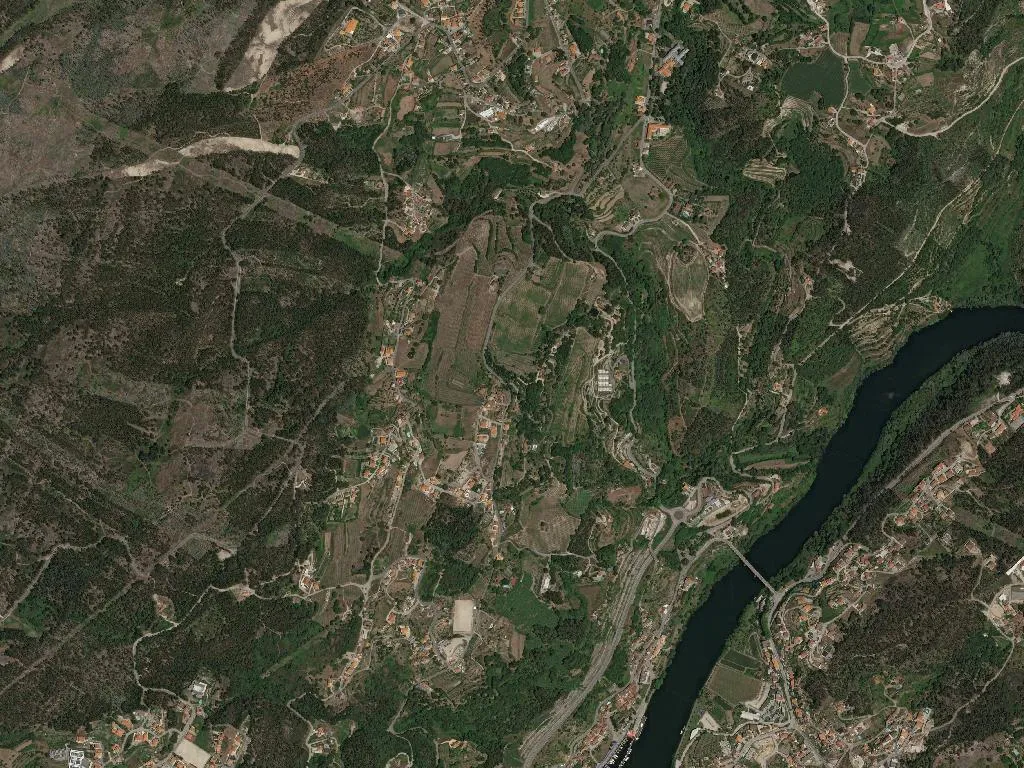
The hillside exhales slowly. In the Sousa valley, granite ribs push through low vineyards and tumbled stone walls; Eja unfurls across 492 hectares without urgency—863 neighbours (2021 census) scattered thinly enough for every voice to carry. Silence is punctuated by the rasp of a hoe, a dog barking two terraces away, wind combing the Loureiro vines into parallel ranks that follow the land’s own curve.
Stone that remembers
High on the ridge, the Paço de Eja has watched the weather since the 1520s. Built for Dom João de Menezes, lord of Penafiel, its Manueline façade survived both French infantry and the 1834 dissolution of the monasteries. The honey-coloured blocks came from Paradela quarry three kilometres south; ox teams dragged them uphill for a season, villagers still boast. Grade-I listed since 1978, the manor stands empty, yet at dawn the rising sun strikes the Menezes coat of arms so sharply you can read every quince and crescent.
Population density is officially 175 souls per km², but numbers mislead. Houses dribble along eleven kilometres of council road: the CM1061 snakes from the N15 beside the Sousa river up to Eiriz hamlet, passing Eja de Cima—home to just twenty-three residents. Of Penafiel’s two legal holiday lets, one is Casa da Eira, a stone granary reborn in 2019 when a Porto architect and his partner swapped weekend traffic for olive saplings.
Grapes and generations
Forty-two hectares of vineyard are split between thirty-eight owners; the largest holding barely tops two. The maths explains why September Mondays find 72-year-old José Ferreira loading Loureiro and Vinhão into his beige van for the Penafiel co-op, founded the year Eisenhower reached the White House. In Calvos, Albertina—born the same vintage as the co-op—still treads her father’s granite lagar, bottling 600 litres a year beneath a slate ceiling that weeps winter condensation.
Demography is crueller than mildew. Only 109 children against 189 pensioners; the primary school shut in 2009 and reopened as a day centre for dementia patients. When the priest drives over from Penafiel to ring São Martinho’s bell at 11.30, fifteen communicants gather in the porch. Armando’s café “O Sousa” has served morning bica and Friday caldo verde since 1983; arrive after one o’clock and you’ll find the shutters half-closed—he’s pruning his half-hectare.
What endures
At six the westering sun ignites façades tiled in Marseille clay—thatch disappeared between the Carnation Revolution and Spain’s accession to the EU. Below Eiriz, the Couto watermill fell silent in 1974; only its granite sluice still feeds the levada. Yet the labour remains visible: dry-stone terraces laid by Adelaide’s grandfather now carry wire trellises—no one has time to harvest wild cane for traditional stakes.
Lean against the roadside wall, the Marão ridge dissolving into layers of olive, vine and schist, and you realise Eja gives nothing away. It lets you discover it—centimetre by centimetre—at the pace of someone walking nowhere in particular, finding in that very slowness the only urgency that matters.