Full article about Aver-o-Mar
Between vineyard and Atlantic, Póvoa’s wrack-heaped parish lives by swell and salt cod
Hide article Read full article
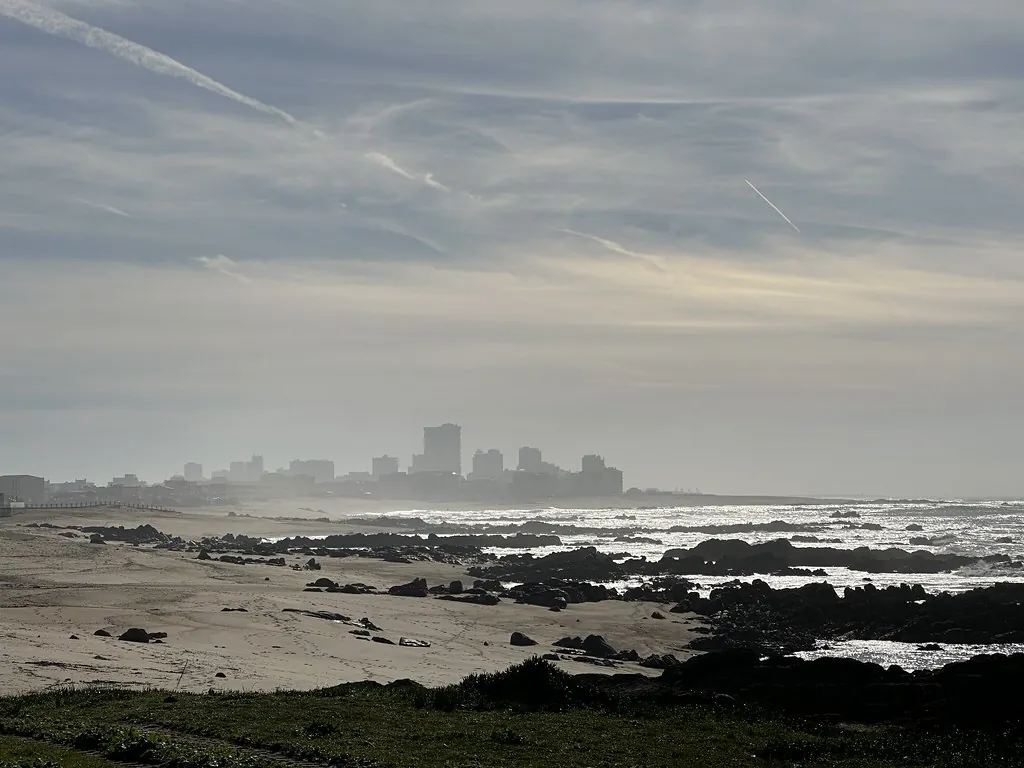
The easterly wind bullies the brine through the lattice of lanes. On the foreshore, chestnut-coloured hillocks of bladder-wrack bake in the sun—medas, the locals call them—heaped by men who still drag the weed from the Atlantic as their grandfathers did. Their tractor tyres carve deep grooves that the next tide smooths away like a clerk erasing ink. When the morning light shears through the Atlantic haze, it exposes a saw-edge of schist and granite: tiny coves where the sea turns bottle-green and strokes velvet-black moss.
Aver-o-Mar—“to have the sea in sight”—is geography, not poetry. The first charter, dated 1099, spells it “Abonemar”. For eight centuries it was merely the seaward quarter of Amorim, a scatter of thatched cottages whose occupants netted fish and gathered wrack between vegetable plots and the dunes. Parish independence arrived only in 1922, when the three-kilometre trudge to the mother church became intolerable.
Where the tide draws the boundary
Community life still sorts itself into two tribes: the homem da beira-mar, who can read a swell the way a broker reads the FT, and the homem da aldeia, whose smallholdings supply the vinho verde on every restaurant table. Between them rises the whitewashed Igreja de Nossa Senhora das Neves, its bell-tuned to the pitch of gulls; beside it, the Capelinha de Santo André, barely wider than a fishing boat’s beam, keeps watch over the vineyards.
On the Sunday closest to 7 August, the Festa do Orago fills the lanes with processions and the clipped rhythms of the Rancho Folclórico’s concertina. On 30 November, Santo André’s fair turns the parish yard into an open-air canteen: salt-cod febras sizzle next to charcoal-grilled sardines, both dispatched with chilled loureiro.
What the ocean gives and takes
Lunch is whatever swam into the nets at dawn—sea bass, gilt-head bream, sardines still trembling. Bladder-wrack, dismissed elsewhere as mess, is stacked, dried, and forked into the sandy soil as fertiliser or winter fodder. The harvest continues, though the youngest collectors now wear university hoodies under their oilskins.
The Coastal Camino cuts straight through the parish, waymarkers embossed with scallop shells pointing pilgrims toward the cliff-top boardwalk. Population density here is the highest in the municipality—4,751 people in barely five square kilometres—yet the ocean horizon still feels limitless.
At dusk, when the low sun plates the rendered walls in gold, the Atlantic keeps time. Wave after wave detonates against the rocks, the gulls wheel overhead, and the same sound that greeted the scribe who wrote “Abonemar” nine centuries ago settles over the village like a tide-drawn breath.