Full article about Ave-side parish where four villages share one river pulse
Maize rows, granite bells and a modernist chapel watch the Ave drift past
Hide article Read full article
In the Ave floodplain, where the soil remembers its own name
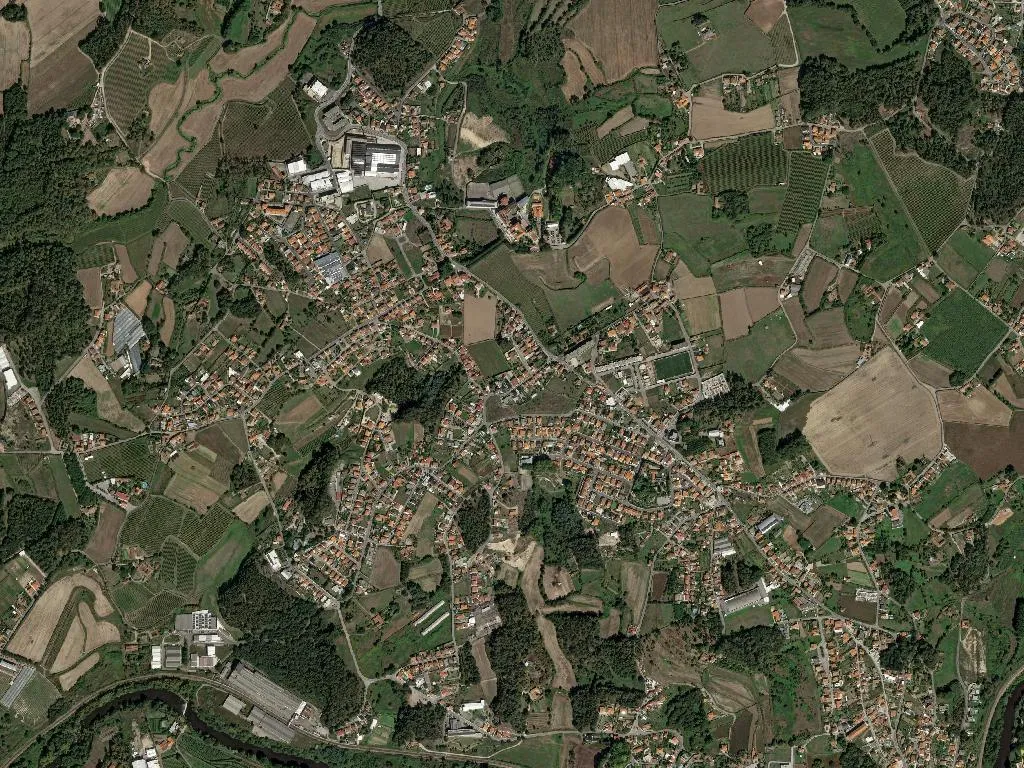
The Porto–Guimarães train brakes gently and the valley peels open like a triptych: maize stripes first, then terracotta roofs threaded through vines, finally the Ave itself – broad, unhurried, catching the thin September light. Step down at the unmanned halt of Areias, Sequeiró, Lama e Palmeira and you are standing on four villages that were welded into one parish in 2013 yet still measure distance by the toll of their separate church bells.
Six-thousand-three-hundred-and-sixty-nine people occupy 10.3 km² here, a density that would feel urban if the landscape did not argue otherwise. What you notice first are not houses but fields – beans, maize, potatoes – and the quiet machinery of water running in narrow irrigation channels that descend like veins to the river.
A modernist rupture among the oxen
Nothing prepares you for the Instituto Nun’Álvares. Between smallholdings of granite and ivy rises Fernando Távora’s 1985 library and chapel – white concrete, crisp geometry, a modernist sentence dropped into a 17th-century text. Inside, the air is filtered, the light textbook-perfect; outside, the same granite walls that enclose cattle also frame the building’s shadow. Távora, a Porto architect who cut his teeth with Le Corbusier’s disciples, proved that Minho ruralism could survive dialogue with the international style without losing its syntax of stone, moss and rainwater.
Religious architecture is scattered like punctuation: Santo António in Areias and São Tiago in Sequeiró both kept their gilded baroque retables after the 1755 earthquake and the Liberal confiscations; Nossa Senhora da Conceição in Lama and Nossa Senhora da Torre in Palmeira anchor the devotional circuit that swells each August. The 1934 road bridge to Vila Nova de Famalicão replaced a ferry service that had operated since 1853 and still feels like a seam between two counties rather than a mere crossing.
Smoke, blood and corn bread
The calendar is punctuated by three nights of fire and brass. On 24 June São João do Carvalhinho sets orange squares glowing; concertinas compete with the dry heat of bonfires and the smell of grilled sardines drifts into bedrooms. Fifteen days later the Romaria de São Bento scales things down – a single file of pilgrims climbing to the chapel, footsteps echoing off granite. Mid-August brings the Assumption: nine evenings of novenas, outdoor mass and a procession that squeezes through lanes where ivy has been trimmed back for the occasion.
These are the evenings when the kitchen reveals its taxonomy of smoke. Arroz de sarrabulho – dark, irony, thickened with pig’s blood and cumin – arrives first, followed by its cousin papas, the same flavours pulped into spoonable form. Rojões, cubelets of marinated pork, sit alongside chouriço smoked over oak for three months (chestnut smoke needs five, and people still know the difference). Five smallholdings still slaughter according to the lunar calendar; the Abreu family in Sequeiró supplies most of the restaurants between here and Braga. Corn bread, yeasty and damp, is torn not sliced. The wine is Vinho Verde from the sub-region of Sousa, sharp enough to reset the palate between mouthfuls of kid roasted over olive-wood embers. Desserts obey convent mathematics: egg yolks, sugar and a disregard for moderation – papos de anjo, trouxas de ovos, pumpkin glazed to a glassy finish. Recipe notebooks dated 1952, the year of the first agricultural show, are still in circulation.
Sulphur, pilgrims and kingfishers
Since 1882 the Caldas da Saúde thermal spa has diverted travellers who thought they were simply passing through. The water emerges at 27 °C, heavy with sulphur and calcium, and the 1930s pavilion still issues prescriptions for rheumatism and “nervous exhaustion”. The Central Portuguese Way of Santiago has also rerouted itself since 2014; yellow arrows now guide walkers from Rates through the parish en route to Ponte de Lima. The section is mercifully flat – average altitude 104 m – and vineyard walls give way to alder-lined streams where grey herons and crested grebes wait for fish.
At the Parque de Lazer de Nossa Senhora da Torre old oaks drop acorns into stone picnic tables; rural footpaths stitch the four former villages together, ending on the Ave’s marginal boardwalk where market-garden plots run ruler-straight to the water’s edge. Kingfishers stitch the surface; in October the first wood-smoke stitches the air.
The weight of memory in a loaf
Demography tilts towards the past: 1,737 residents are over 65, only 653 under 14. Knowledge still clings to calloused hands that join the communal grape harvest each mid-September and can judge by touch whether a cask of red wine will keep. Memory lives not in glass cases but in the oak-smoke rooms of the agricultural co-operative founded in 1960, in the concrete irrigation ditches dug by 1950s “improvement commissions”, in Joaquim Silva’s eight-bass concertina bought second-hand in 1973 and still kept in tune.
When the sun drops behind the Ave the river turns to beaten copper and the smell of Lama’s damp clay mingles with the first fireplaces of autumn. It is a scent you cannot bottle or export; it belongs to this exact coordinate of latitude and river bend, to four villages that share a parish council but still keep their own bells, their own silence and their own time.