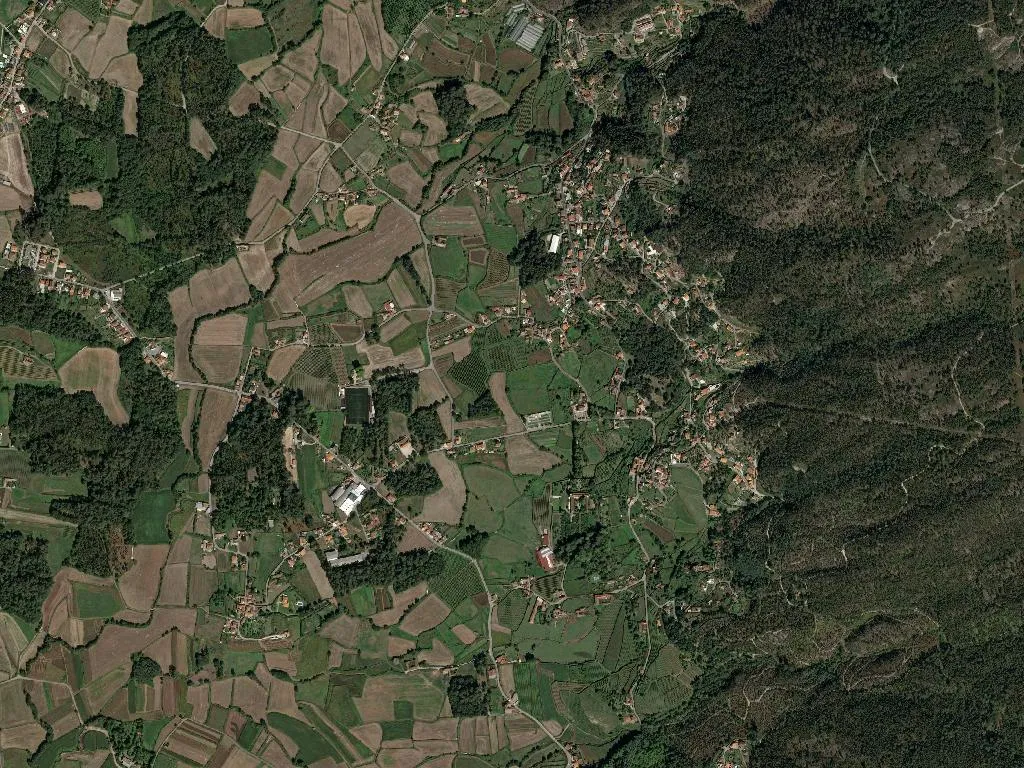
Full article about União das freguesias de Carreira e Refojos de Riba de Ave
Granite toll-posts, leaning church tower and warm bolas de chura in União Carreira e Refojos
Hide article Read full article
The Bell That Measures Time
On Sundays, when the Atlantic wind heels round to the east, the bell of Santiago church carries two parishes’ distance. In Parada, the oldest residents still distinguish the eight-o’clock toll from the nine without glancing at a clock – a party trick learned from decades of being woken by the half-seven mass.
Parada, Carreira, Refojos – the names feel like sepia family photographs. Parada remembers when travellers on the royal road paid their toll in chickens or cured leather and were guaranteed bed, bread and water, rain or shine. Carreira is exactly that: a drovers’ track that became a road, then nothing much at all once the national highway shifted to the far side of the Leça. What remains are low granite walls, stubby chimneys and the sweet reek of fermenting grapes each September. Refojos was a market town before petrol: it had a courthouse, a jail and a public fountain. Today it has Café “O Padrão”, where Zé Mário has pulled perfect espressos since 1987 and, if you arrive before eleven, you’ll find doughnut-style bolas de chuva still warm from the fryer.
The church, the manor and the forgotten pillar
Santiago’s tower leans – only a finger’s breadth, but enough for anyone who knows a spirit level to notice. Inside, the wooden ceiling is a jigsaw of more than three hundred interlocking pieces, not one spare. Beside it, Casa da Menguela looks like a schoolbook engraving: granite staircase, balustrade and a private chapel that opens only once a year, on 8 December, when the old families return to check the bells still ring.
Half a mile away, down a lane you will miss unless you are looking for Quinta do Outeiro, a granite pillar marks the spot where, in 1832, Miguelist troops camped without quite knowing where they were. Hunters now use it as a rendezvous to complain about the partridges they failed to shoot.
The pilgrims’ cut-through and the vineyard tractor
The modern Camino de Santiago cuts straight through the village. Backpackers appear with blistered feet and boots that broadcast their starting point – Rotterdam, Lyon, Bratislava. Most follow the yellow arrows, half of which were painted after closing time by Ti Armando, the barman, one Sunday when it seemed the neighbourly thing to do.
The same paths serve Ana driving her sheep to the hill and Carlos taking his tractor to prune the Loureiro vines. The earth is ochre and rust-coloured; after rain it smells of eucalyptus, and when the wind drops you hear stones shifting underfoot.
What appears on the table without asking
This is Vinho Verde country, but not the supermarket version. Sequeira, whose backyard is the corner plot opposite the church, distils bagaço that burns clear and still keeps a bottle from his son’s birth year. In the kitchen opposite, Dona Aurorinha marinates rojões with paprika she ground at her brother’s watermill. Her caldo verde uses potatoes no bigger than walnuts and a thread of olive oil pressed by her grandson from the same trees his grandfather planted: no television tricks, just chorizo made from local carne de porco alentejano.
August belongs to Nossa Senhora da Assunção. The space in front of the church becomes an open-air dining room where Ilda’s pão de ló is still mixed in a wooden trough and the cozido starts its countdown the previous night so the potatoes surrender at exactly the right moment. São João do Carvalhinho rounds off the month with accordion music, paper balloons and boys chasing the drifting fire as if it could tow their luck behind it.
The hour the walls turn gold
When the sun slips behind the Serra de Santa Cristina, the light lacquers the whitewash so that every house looks mid-goodbye. The air clarifies until you can tell whether the neighbour is grilling spare ribs or simply burning damp pine. In that moment between dog and wolf, you understand why no one forgets this place – not the daughter who left for Porto’s accounting firms, not the son wiring kitchens in Lyon. The main road may have diverted, but the bell keeps its own accounting, ringing out to remind anyone listening that some coordinates on the map don’t need signposts to show us where our stories began.