Full article about Monte Córdova: where the mountain bell rules Santo Tirso
Granite hamlets, leather-scented lanes and a 376 m sanctuary gaze over Porto’s skyline
Hide article Read full article
The bell that still keeps mountain time
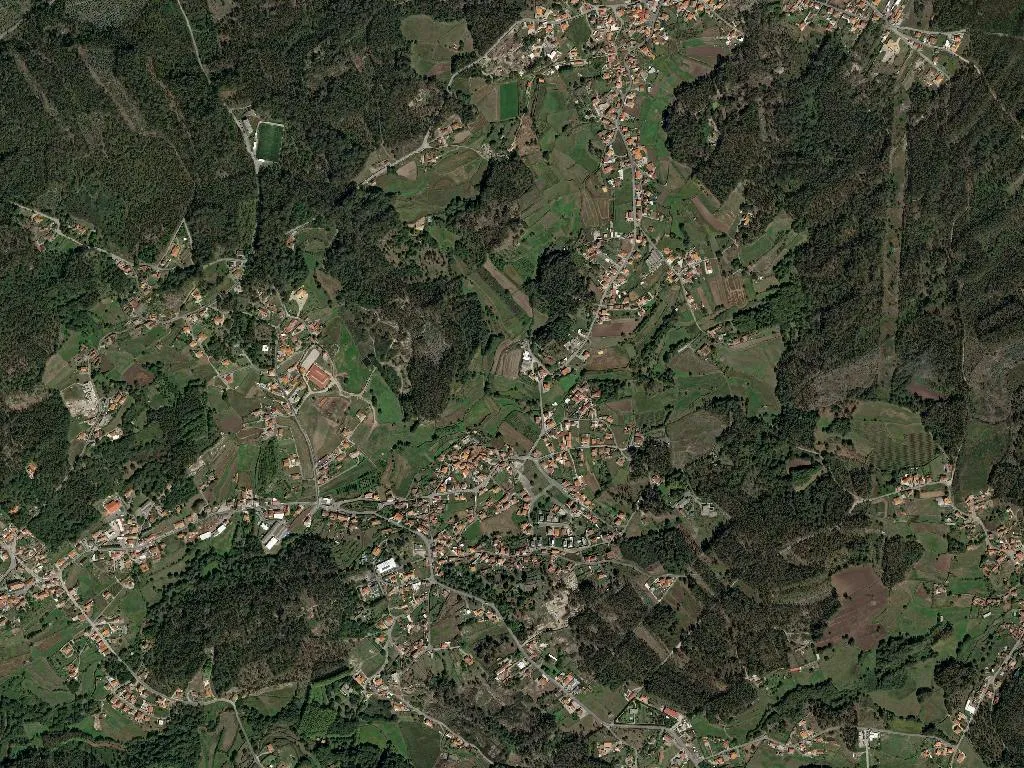
At 07.30 the bronze bell in the sanctuary tower fractures the morning air and rolls down the terraced slope. All 3,848 residents—whether they live in Vilaça’s granite row, Carvalhinho’s scattered smallholdings, Outeiro’s cow-lanes, Reguenga’s stone yards or any of the other six hamlets—set their watches to it. From 376 m above sea level Monte Córdova is more than the municipal summit; it is the natural belvedere from which, on clear winter days, you can pick out the Baroque lantern of Santo Tirso’s mother church and, beyond the Leça valley, the white factory chimneys of Lactogal in Vila do Conde.
Sanctuary on the skyline
Ernesto Korrodi’s neo-Baroque project replaced an overcrowded 1901 chapel in 1919, yet the building was not finished until 1946 when Fr António Alves da Silva finally secured post-war cement for the twin 28 m towers. Seventy-four steps lift you to a forecourt big enough for tractors as well as pilgrims. Inside, the polychrome Assumption is by João da Fonseca Lapa—the same sculptor who carved the Bom Jesus de Matosinhos crucifix. On 15 August the 11 o’clock mass packs every pew and slab: two offertories are needed to hold the notes of parishioners and the home-comers from France who have rented hatchbacks at Porto airport.
Granite villages, leather legacy
The 1155 charter issued by Afonso Henriques to Leonese knight Paio Soares da Cordova is the first written record of the settlement. The name has nothing to do with Spanish Córdoba; it derives from the Latin cordaria, a place of leather, a trade once fed by the fast waters of the Leça used for tanning. Until 1836 Monte Córdova belonged to the now-extinct municipality of Refojos de Riba de Ave; after the liberal reforms it was stitched into Santo Tirso. The parish church, dedicated to St Paio of Córdova, rose in 1758 over its thirteenth-century predecessor; the date is still chiselled on the cartouche: “S. PAI.DE CORDOVA – 1758”.
Way-marked to Santiago
The Central Portuguese Camino enters the parish beside the medieval Leça bridge, climbs the CM-535 and cuts through Carvalhinho. Before the sanctuary appears walkers pass seven granite water-troughs and two eighteenth-century calvaries. The municipal albergue, opened in 2019 inside Vilaça’s shuttered primary school, offers ten bunks; the guest-book already lists trekkers from Seoul to Oaxaca. Summer tallies run between forty and sixty pilgrims a day; Teresa’s café, stamping credentials since 1998, still serves a bica strong enough to power the next ascent.
Loureiro, wild boar and August fair
Small terraces at 250–350 m are stitched with loureiro vines. Santo Tirso’s cooperative buys grapes from 28 local growers and releases a lightly petillant white at €3.50 through the inter-municipal shop. Restaurant menus list rojão of wild boar shot in the nearby Serra da Cabreira; kid is slid into Bernardo’s wood oven in Reguenga at six in the morning, ready only for Sunday lunch. The Assumption novena begins on 13 August: a fair on the sanctuary terrace, a philharmonic blast, €1.50 bowls of caldo verde and cornmeal cake sliced tableside. Sunday’s procession counts twelve biers and the GNR band. In June São João do Carvalhinho stacks three bonfires; the tallest, built from resinous pine cut the previous week, tops 15 m.
What you only notice later
Take the signed Caminho do Rio to the hamlet of Foz and you will find the Leça’s official 1941 spring marker planted by the Geographical Commission of Portugal. At six the sanctuary bell rings again; cows grazing the Outeiro slopes lift their heads and walk, unprompted, to the byre. No viewpoint sign points the way, but climb the cemetery terrace at Vilaça and you can sight the Riopele textile plant at Pousada de Saramagos and, just right of it, Santo Tirso’s railway station, closed since 2009 and now a lesson in rust and tiles.