Full article about Roriz: Where the 12th-Century Door Still Opens Daily
São Pedro’s bell, Romanesque stone and Vinho Verde vines animate sleepy Roriz in Santo Tirso.
Hide article Read full article
A Church Bell Awakens Roriz
The granite still retains the chill of night when the bell of São Pedro’s Parish Church cuts through the morning silence. Roriz stirs slowly, at the pace of a place where time has no urgency.
At the heart of the parish, the Romanesque portal of São Pedro de Roriz Monastery has been rising since 1070. Its three weather-scored archivolts—carved with vegetal motifs now finger-smooth—frame a doorway that has admitted Benedictine monks, medieval pilgrims and, this morning, the parish postman. A National Monument since 1910, the building stands ungated and unguarded; you test the iron latch and step straight into the twelfth century.
The Way and the Water
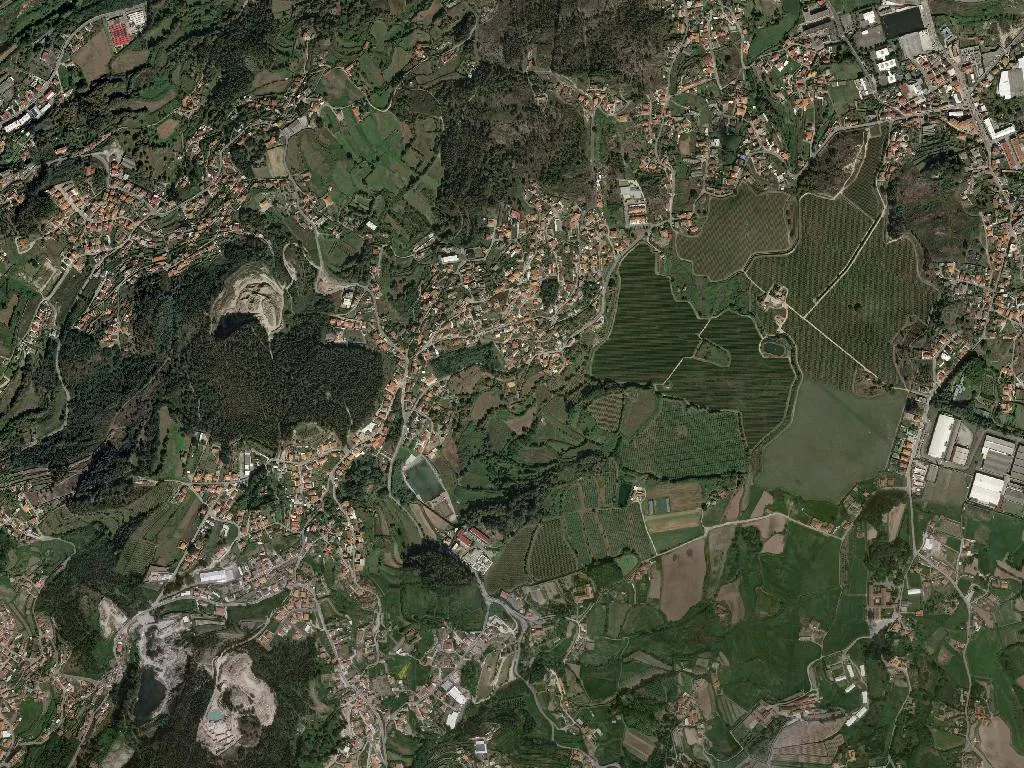
The Central Portuguese Camino cuts through the village. Travellers pause at the granite fountain to refill aluminium bottles, then sit beneath oak canopies to unlace boots. Beyond the road, vineyards stitched to granite posts mark the southern limit of the Vinho Verde region; the Atlantic influence at 201 m altitude keeps the Trajadura and Loureiro grapes bright and razor-edged. Follow the way-marked “Entre Mosteiros” trail and you drop into a corridor of eucalyptus whose resinous steam mingles with turned earth, before the path climbs toward the ridge that separates the Ave valley from the first slopes of the Serra da Cabreira.
An August Calendar of Fire
Fifteen August brings the Festa de Nossa Senhora da Assunção: a morning procession, brass band in attendance, and tables laid with caldo verde served from copper pots. Twenty-one days later the Romaria de São Bento fills the monastery forecourt with folding chairs for an open-air mass; by nightfall the cross-shaped bonfire of São João do Carvalhinho is lit on the hillside, its outline visible from the N105.
What the Kitchens Remember
In the single tavern on Rua da Igreja, papas de sarrabulho arrive smoking—pork blood enriched with cumin and lemon. The same stove turns out rojões, nuggets of shoulder fried in lard then braised with bay, and a stoneware bowl of feijoada thick enough to hold a spoon upright. Cornbread is sliced warm; the butter carries the salt of the Ave. Ask quietly and the owner produces a bottle of loureiro from a neighbour’s 200-litre talha—no label, just the year inked on wax.
Evening on the Granite
By late afternoon the monastery’s south wall drinks the sun. Place a palm against the stone: it returns the day’s heat slowly, nine centuries deferred. Swallows trace the apse cornice; the bell tolls once for Angelus, the note drifting over red-tiled roofs toward the vine terraces. In Roriz the past is not displayed—it is simply still here.