Full article about Granite Bells & Musket Scars in Santo Tirso’s Folded Valley
Walk where Ave mist lifts off bullet-dented monastery stone and blackbirds drown out suburbia.
Hide article Read full article
Granite that still carries bullet scars
At nine o’clock the bell of Igreja Matriz throws its bronze note across the valley, ricocheting off granite walls before it is swallowed by the alder gallery that hems the Ave. Santo Tirso wakes river-first: low mist skims the water, the smell of damp soil and moss rises, then the sun lays a warm palm on the grey ashlar of the Benedictine monastery. You hear the town before you see it.
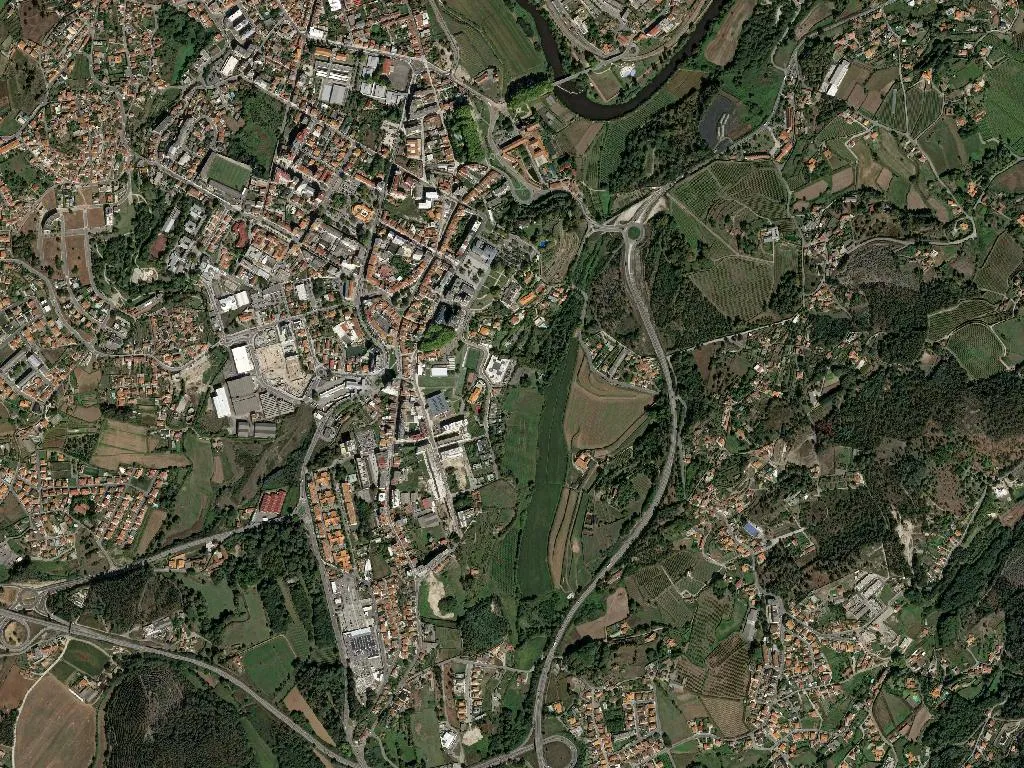
The 2013 merger that yoked Santo Tirso with the rural parishes of Couto (Santa Cristina and São Miguel) and Burgães created one of Portugal’s most densely populated corners—20,500 people in barely 25 km²—yet blackbird song and stream murmur still punctuate the day.
The monastery and its scars
Everything starts at the Mosteiro de Santo Tirso, a National Monument founded in the 10th century by monks who baptised a Roman landlord’s name—Titius—into sacred currency. The church and cloister, Romanesque in sober granite, have the squat columns and vegetable capitals worn smooth by a thousand winters; touch the stone in July and it still feels refrigerated. Climb the tower at the right hour and light picks out pock-marks—French musket balls from the 1809 sack during the Peninsular War, left unrepaired as a muted lesson.
Inside, the Abade Pedrosa Museum hoards medieval sculpture, linen vestments and agricultural tools that map centuries of Ave valley life. The mother church opposite shelters a gilt baroque altarpiece partly carved by José Joaquim, the 18th-century local master whose workshop dominated the valley’s devotional carpentry.
Watercourses and stone tracks
The Ave river runs south-west, defining the parish in both geography and mood. Alder and ash form green corridors where herons balance on mid-stream boulders and, if you are still, a kingfisher’s turquoise flare streaks past. The six-kilometre Trilho dos Moinhos hugs the left bank, passing water-mills built of stacked granite—wheels frozen mid-turn, ivy pouring through the spokes, the air inside still smelling of ancient flour and humidity.
For a longer circuit take the PR1 ST “Couto–São Bento”, a ten-kilometre climb to the hilltop hermitage inside the São Bento wood, the only protected landscape in the municipality. From the lookout the valley arranges itself in terraces: vegetable plots beside the water, rust-roofed town centre, and farther off the Tâmega ecopiste disappearing towards Arcos. The six-arched Ponte de São Miguel, rebuilt in the 16th century, is the crossing point for travellers on the Central Portuguese Way of Santiago; many doss down in the parish-hall dormitory before tackling the next stage north.
Winter blood and midsummer smoke
Minho cooking carries the weight of January fog. Papas de sarrabulho—steaming, cumin-darkened pork-blood porridge—arrive at table almost thick enough to stand a spoon in. January’s communal pig-kill turns streets into open-air charcuterie workshops: morcela, salpicão and wine-smoked chouriço hanging in rafters that smell of woodsmoke and paprika. In Burgães, wood-oven kid is the draw at tasca O Moinho, the skin blistered to crackling, the meat still rose. Corn-rye broa is baked in the village’s communal oven, while convent sweets—toucinho-do-céu, almond cigars—keep the Benedictine sugar-and-almond tradition alive. A lightly spritzy Ave sub-region Vinho Verde cuts cleanly through pork-fat like a cold breeze.
On 24 June the Festa de São João do Carvalhinho fills Couto with bonfires, basil pots and sardine smoke; the air tastes of charcoal and herb. August brings the procession of Nossa Senhora da Assunção down Burgães’ lanes to a tile-panelled rural chapel. Early July sees the Romaria de São Bento: faithful walk to the hill hermitage where an auction of farmhouse produce—goat cheese, honey, greens—renews an old contract between altar and soil. Easter Monday’s Compasso threads the main streets, bell paced, doors opened one by one in a slow, communal heartbeat.
Names chiselled deeper
António dos Santos Graça, born in Couto in 1882, founded the town museum and spent his life cataloguing rural rituals already slipping away. Burgães produced Padre Américo Monteiro, a Salesian who took the Ave farmers’ quiet stubbornness to Mozambique; Couto gave the church Dom José Dias, bishop of Timor. Narrow valley, wide horizons.
On the first Sunday of each month the craft fair in Largo Conde Ferreira brings potters and weavers who work in front of you. Buy a glass of Vinho Verde, tear open a wedge of broa, watch the slow drift of neighbours greeting each other. Somewhere behind the hum, the monastery bell tolls and the Ave keeps its own slow time. And up in the tower the bullet scars remain—because forgetting, too, is a kind of erasure.