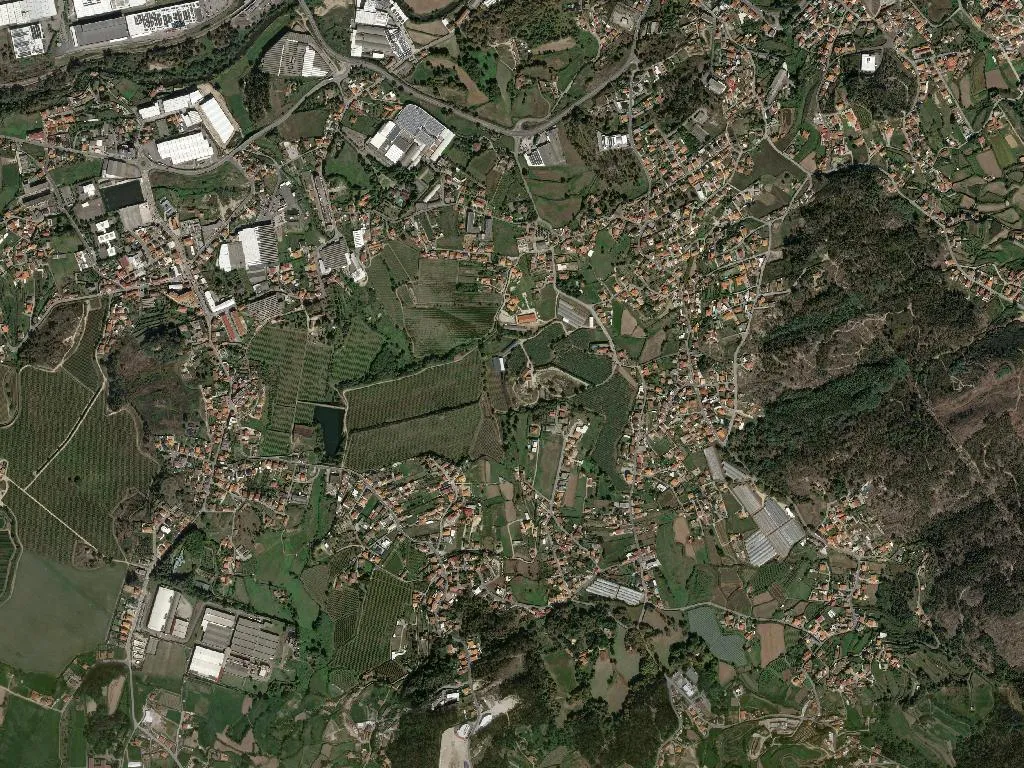
Full article about Vila Nova do Campo: Where River Vizela Sings
Granite hamlets, three saints & Roman bridge echo to mill wheels & cotton looms
Hide article Read full article
Vila Nova do Campo: Listening to the River Vizela
The river announces itself before you see it. A low, almost subterranean murmur rises through the alder canopy long before the granite hump of Ponte de Negrelos appears. It is the Vizela dictating the rhythm of this parish on the northern lip of the Ave valley, 20 km upstream from Porto’s outermost suburbs. By 7 a.m. the air is already damp, even in July, carrying the metallic scent of wet schist and moss that only the Minho’s river gorges seem to produce.
Three saints, one bank
Until the 2013 administrative shake-up, Vila Nova do Campo did not officially exist. What existed were three separate parishes—S. Martinho do Campo, S. Salvador do Campo and S. Mamede de Negrelos—each with its own church, patron saint and fiercely guarded identity. The merger glued them together on paper, yet walk the territory and the old borders remain legible. Three baroque bell towers still rise within a 3 km radius, each fronted by its linden-shaded churchyard where the same families occupy the same Sunday pews. Settlement is scattered in the Minho fashion: granite houses set back from narrow lanes, vines spilling over garden walls, lichens drawing slow-motion maps across stone.
Human time here is shallow compared with the river’s. The single-arched Ponte de Negrelos, on the parish’s northern edge, is Roman in spine—2,000 years of cartwheels have polished the parapet to a dull sheen. Stand on the bridge at 6 p.m. when the sun skims the water and the Vizela turns to molten copper; the stone beneath your trainers is the same that once carried legionaries from Bracara Augusta to Astorga.
A valley that still clocks in
Dismiss this as a sleepy agricultural wedge and you miss the point. Between the cornfields stand hangar-sized textile units, survivors of the Ave valley’s twentieth-century cotton boom. Their shift whistles cross-cut the cockerel’s cry at dawn, proof that the contemporary Minho is a hybrid creature: half pasture, half production line. With 658 inhabitants per km², Vila Nova do Campo is twice as dense as the Portuguese average, a statistic that translates into traffic lights outside knitting mills and refrigerated vans collecting lettuce from 2-hectare smallholdings.
Demography, though, tilts silver. Over-65s outnumber under-14s by more than two to one, and the evidence is visual: granite benches filled by 10 a.m., steel shutters on newly built houses that belong to Paris or Zurich mid-week, cafés where coffee arrives in thick terracotta cups and conversation moves at agricultural speed.
Fireworks, processions and scallop shells
The parish calendar is still moved by church bells. On 15 August the Festa de Nossa Senhora da Assunção turns the lanes around S. Martinho into an outdoor kitchen: caldo verde simmering in cauldrons, smoke from roast-suckling pig drifting across balconies hung with heirloom quilts. Mid-June brings São João do Carvalhinho, when villagers compete to craft the tallest bonfire without attracting the bombeiros, and late July delivers the Romaria de São Bento—simultaneously a devotional procession and an open-air reunion. Gunpowder crackle, brass-band marches and the sweet drag of accordions are the soundtrack.
A newer rhythm overlays the old: the Portuguese Central Way of St James cuts straight through the merged parish. Between Porto and Barcelos, walkers cross the Roman bridge and follow the Vizela’s willow-shaded towpath. Hostel beds are non-existent; what exists is a pair of signed rural houses where you sleep to the sound of water and wake to the smell of warm broa—cornbread—baking in the next-door kitchen.
Following the river instead of the road
The Quinta do Olival leisure park supplies picnic tables and a children’s pool, but the real corridor is the river itself. A narrow footpath threads the floodplain eastwards, screened by alders, ash and the occasional oleander. Kingfishers ratchet past; herons lift like grey umbrellas. On the lower terraces, small plots of dark alluvial soil still feed families—rows of kale, trellised tomatoes, pergola-trained vines dripping green-gold Loureiro grapes destined for the neighbouring Ponte de Lima sub-region. Higher up, eucalyptus and maritime pine take over, their resin sweetening the air after rain.
Accommodation is deliberately scarce. The two licensed dwellings—Casa do Rio and Quinta da Veiga—offer what the Algarve cannot: a bedroom that opens onto someone’s vegetable patch, silence broken only by the Vizela’s riffle and the church bell striking the hour you had forgotten existed.
Stone remembered in echo
The image that lingers is dawn on Ponte de Negrelos. Mist lifts off the water in slow coils, granite arches hover like a half-remembered dream, and your footfall reverberates as though the bridge were hollow, storing every crossing since the Pax Romana. The stone is cool, the colour of pre-dawn cloud, and the sound it returns—hollow, metronomic, solitary—feels older than the landscape itself. You leave Vila Nova do Campo carrying not panoramas or souvenirs, but that acoustics: the audible layer of 2,000 years, handed back to you by a river that refuses to hurry.