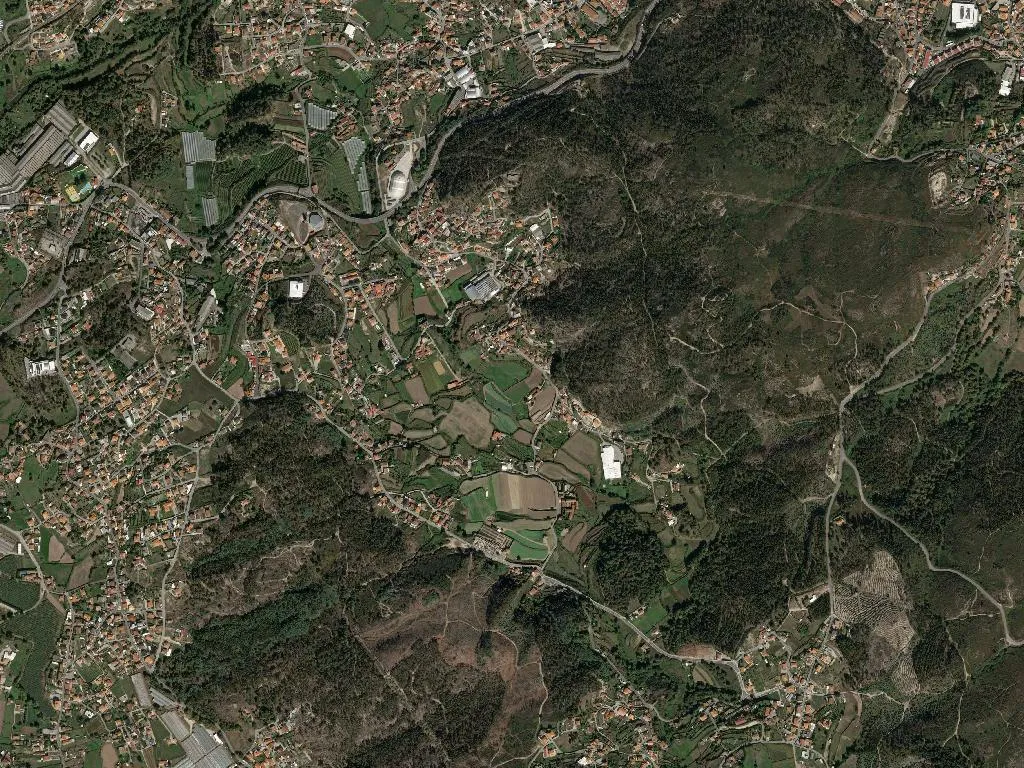
Full article about Vilarinho: Where the Bell Tolls Over Vine Terraces
Granite parish above the Ave valley, scented with beeswax and eucalyptus
Hide article Read full article
The bell that measures the day
The bronze of Nossa Senhora da Assunção strikes seven and the note rolls over the allotments of Vilarinho like a slow tide. It climbs the terraced slopes where Loureiro vines are trained on wires, slips between maize stalks, and finally reaches the dust of the Caminho Português Central. There, a German woman in zip-off trousers checks her altimeter: 183 m, the ridge that separates the Ave valley from the Serra da Cabreira. She tightens her hip-belt and walks on; the bell keeps measuring the parish’s 526 hectares of granite, soil and sky.
Stone, faith and right of way
The church, listed in 1977, sits in the geometrical centre of the settlement. Its walls are a metre thick, the stone hewn from the same seam that roofs the village houses. Inside, gilt carving explodes over the high altar – a baroque interruption in an otherwise sober northern Portuguese interior. Documented as early as 1258, the building has been enlarged, trimmed and earthquake-proofed, yet its social function never altered: it is the community’s clock, compass and confession box.
Two kilometres uphill, the solitary chapel of São Bento waits on a saddle of schist. On 11 July the faithful climb the stony track in single file, palms blistered from carrying candles, exchanging the Ave valley’s diesel fumes for beeswax and eucalyptus. The romaria is not re-enactment; it is parish maintenance, the annual retightening of invisible screws that hold 3,587 people together.
Pilgrims at the café
By 06:00 the lights are on in Café Avenida on Largo da Igreja. Koreans consult laminated maps, Frenchmen butter toast, and the barman pulls espressos with the gravity of someone serving communion. Vilarinho is a waypoint on the alternative route that leaves the coastal pilgrim trail at Porto and rejoins it at Rates; roughly one in ten Compostela-bound walkers passes through. They notice dark-granite houses whose wooden gates have warped just enough to reveal cloth-sealed lofts – the last traces of domestic textile workshops that died when the Lousado factory closed in 1985.
Two small guesthouses – Casa do Correio and Quartos da Fonte – offer rooms where the Wi-Fi password is written on the back of a scallop-shell coaster. Backpacks lean against walls like exhausted soldiers.
Calendar of gunpowder and cinnamon
Festivity here is not folkloric garnish; it is the operating system. On 24 June the parish ignores Porto’s flashy São João and lights its own modest fogueiras on the hill of Carvalhinho. Concertinas compete with crackling pine cones; children swing garlic-bulb censers to ward off imaginary witches. Two weeks later the Assunção procession leaves the church at 17:00 sharp, led by the local coral group singing hymns in tight Minho harmonies. Sardines blacken over laurel-fuelled grills; the smoke drifts across the fairground where teenage romances are negotiated between bumper-car rides.
The year’s final act is the São Bento romaria on 11 July. After mass, the priest hands out small bottles of água benta – holy water that doubles as a souvenir for the few foreigners who have timed their walk correctly.
Pans that never cool
Recipes are geological: layers of time condensed into cast-iron. Arroz de sarrabulho – pig’s blood, cumin, lemon – simmers for three hours while the cook judges viscosity by the way it coats the spoon. Rojões à Minhota are diced exactly two centimetres, fried in lard until the edges caramelise, then finished with chestnuts and cubes of fried potato. Desserts arrive as if from another economy: toucinho-do-céu, literally “bacon from heaven”, is a yolk-and-almond slab that makes the English custard tart feel underdressed. The wine poured is Quinta do Outeiro’s loureiro, 11 % and ideal for 200 ml measures – enough to wash down pork, not to slow the walker.
Walking the granite seam
A web of mule paths radiates from the church. One hour west drops you to the Ave river, its boulders upholstered in moss that stays emerald even in August. Eastward the trail climbs through gorse and dwarf oak to 400 m, where the view unwraps the Cabreira massif – a silhouette that Portuguese geologists liken to a sleeping bison. No nature reserve signs, no entrance fee, just the audible hush that begins once the last STCP bus has wheezed back to Santo Tirso at 22:07.
The population ledger
With 68 inhabitants per square kilometre, Vilarinho is half as dense as the English Lake District, yet its primary school still rings the morning bell for 63 pupils. Older residents remember when 400 workers clocked in at the Lousado spinning plant; now they follow grand-daughters on Instagram who sew fast-fashion seams in Matosinhos. Granite may outlast cotton, but both stories are etched into the same stone.
When the sun slips below the maize canopy, the façades ignite briefly – orange light on grey stone – and the bell tolls again. Inside, the priest prepares the host; outside, a pilgrim tightens a shoelace, consulting a guidebook that lists Vilarinho as a mere 2.3 km detour. The book fails to mention the echo that follows you down the road, a metallic aftertaste of somewhere that refuses to be only a passage.