Full article about Coronado Parish: River Ave’s murmur amid two saints’ fields
Where São Romão meets São Mamede, tractors hum, vines sag and elders guard the Ave’s misty banks.
Hide article Read full article
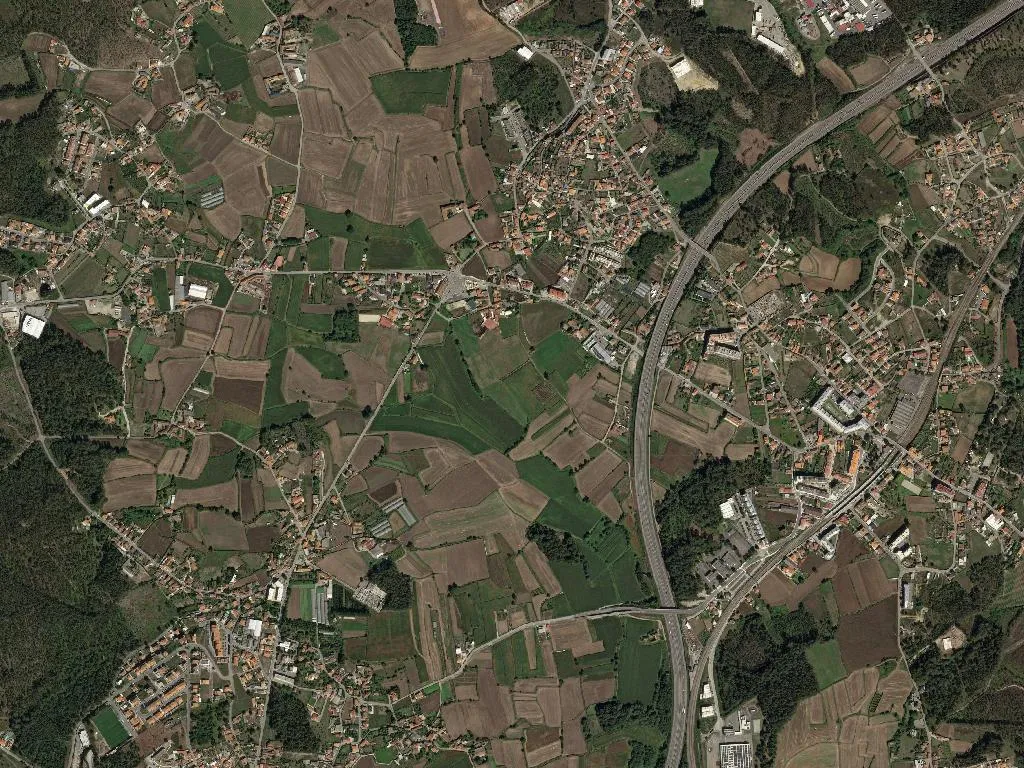
The sound reaches you before the scenery does. A tractor idles behind a granite wall, a dog argues with the dusk, and beneath both — a low, steady hush — the River Ave sliding over weirs. At barely 100 m above sea level, the parish of Coronado occupies a wrinkle of alluvial ground between Porto and Barcelos where the morning mist sticks to cotton and hair long after the sun has burned off the visible fog. Administratively it is a single parish, born in 2013 from the marriage of two medieval villages — São Romão and São Mamede — and home to 9,104 people packed into eleven square kilometres. Fertile, yes; but more importantly, lived-in in a way that is neither field nor city.
Two parishes, one territory
The merger never quite erased the border in people’s heads. There are still two churchyards, two patron saints, two memories that dictate which café you call “ours”. At 830 inhabitants per square kilometre, the land feels busy but not urban. Think coastal Minho in miniature: a two-storey house with a vegetable plot tight against the N13, vines trained over galvanised wire that sags under bunches of white Loureiro, a Pingo Doce supermarket sharing a junction with a cabbage patch.
The schools are full — 1,238 pupils at last count — and the playgrounds still rattle at break-time. Yet 1,686 residents are over 65, many of whom have never changed address. That is why Coronado feels tethered: the same ridge lines have framed entire lifetimes.
The weight of Nossa Senhora das Dores
Every mid-September the parish doubles in size. The Festa de Nossa Senhora das Dores is not a twee village fête; it is the liturgical calendar forcing the social one to bow. A procession winds downhill, rockets ricochet off gable ends, smoke from the doughnut stalls drifts across the church steps, and vinho verde is poured with the informality of tap water. The party marks the hinge between summer and the rest of the year, the excuse for expats to book flights and for dining tables to sprout into the lane. Without it, the annual cycle would simply stall.
Way-marked: Coronado on the Caminho
The Central Portuguese Route of the Camino de Santiago cuts straight through. There are no boutique hostels, no fridge-magnet shops — just two legal lodgings, both spare rooms in private houses. Pilgrims sleep under duvets chosen by the owner’s wife and wake to the squeak of a 1970s mattress. It is hospitality in the original sense: shelter offered because the road passes your door. For walkers it is a half-way breather before the climb to Barcelos; for locals it is a way of belonging to a wider geography without surrendering identity.
Between trellis and tarmac
Vines are everywhere, but they are not picture-postcard stuff. They climb telephone poles, colonise the triangle of wasteland between two roundabouts, curl above garage doors. The grapes go into family barrels, not auction catalogues; the wine is carried to Sunday lunch in plastic Coke bottles. At 107 m elevation, cooled by the Ave’s proximity, the climate is just humid enough to ripen Arinto without botrytis, modest enough to keep alcohol low and acidity bright.
The sound that lingers
At dusk, when the light turns the colour of old Seville marmalade and wall-shadows stretch across the tarmac, Coronado slips into a slower gear. Tractors are parked, children called in. What remains is a metronome of dog barks, the faint clink of a bell — São Romão or São Mamede, indistinguishable now — and that continuous water-sound underneath everything. You leave carrying neither photograph nor flavour, but the river’s patient baritone, a reminder that an entire parish built its life on the banks of something that never once needed to hurry.