Full article about Muro: Granite hush above Vinho Verde terraces
Trofa’s stone-roofed hamlet breathes Atlantic air, Caminho steps and septuagenarian calm
Hide article Read full article
Granite underfoot
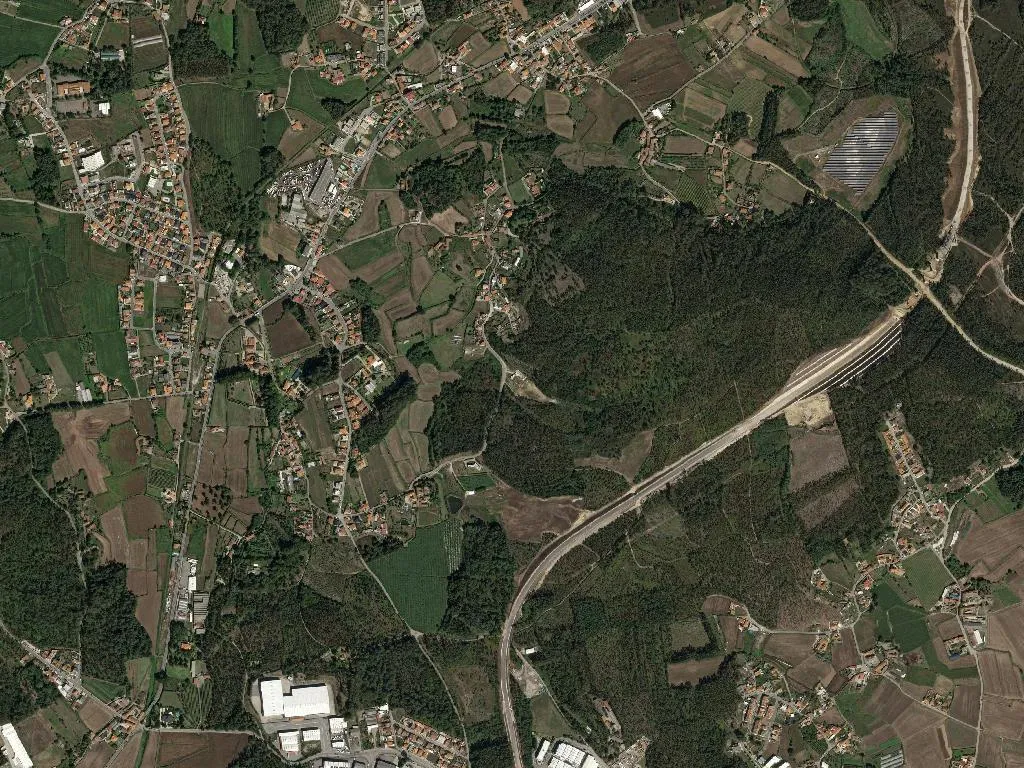
The granite setts ring like muted bells beneath your boots. At 160 m above sea-level, Muro sits where stone and woodland divide the terrain without haste. Single-track lanes thread between whitewashed houses whose eaves have turned the soft green of slow-growing moss. Beyond the terracotta roofs, vineyard terraces step quietly downhill—this is the outer edge of the Vinho Verde demarcation, close enough to the Atlantic for the air to carry a saline tang.
The pilgrims’ spine
The Caminho da Costa slips through Muro without ceremony. There are no neon arrows or backpacker cafés, only the discreet way-markers that stitch Santiago to the northern littoral. Hikers appear, rucksack-curved, looking for the shade of the plane trees and perhaps a stone bench on which to let the blisters breathe. The parish does not pose for postcards; it offers a pause, a place where heart-rates drop before the next stretch of grit.
One thousand eight hundred and thirty-eight people are spread across barely five square kilometres, a density so low that roosters feel no need to raise their voices. Properties keep polite distances, each with its chicken run and a regiment of cabbages. Four hundred and eighteen residents are over sixty-five; only two hundred and twenty-three under fourteen. By mid-afternoon the lanes empty, driven indoors by granite that hoards then radiates the sun. Silence becomes material, something you walk through rather than round.
Feast day mathematics
The Festa da Nossa Senhora das Dores still governs the year. On the Sunday after 15 September, the village band strikes up a minor-key march and six bearers shoulder the carved image down the slope. No fireworks, no thumping sound systems—just voices trained by decades of responding to the priest’s chant, the creak of varnished wood on collar-bones, and the drift of smoke-cured sausage from kitchen chimneys. Afterwards, neighbours swap lace napkins the way Londoners exchange business cards.
The surrounding plots are planted with low, cane-trained vines, sheltered from the north wind by waist-high walls of loose stone that warm the berries at dusk. Locals speak of azal and arinto, grape varieties that keep their bite in this damp micro-climate. There are no show-cellars; treading is still done barefoot in granite lagares, a concertina wheezing out “Mãe Querida” while someone repeats the same joke about the parish priest and a missing barrel. Drink the result with corn-fed roast pork or a bowl of caldo verde served in black clay—the soup’s kale sharpness tames the wine’s citrus snap.
Beds without booking apps
Accommodation is arithmetic: three private houses whose owners will answer the door if you knock loudly enough. Expect an early wake-up call from the cockerel, the iodine smell of wood-fired bread drifting through the shutters, and a breakfast of coffee in a chipped Majolica mug thick enough to survive civil war. There is no reception desk, only the question “Did the rooster let you sleep?” while a kettle is rattled onto the range for the tin bath.
When the light begins to slope, oak branches print long runes across the beaten-earth paths. The church bell strikes six—three metallic claps that cross the valley and subside into the hillside’s woollen hush. Walk on and you carry Atlantic humidity in your lungs, the squeal of a wrought-iron gate someone has just closed, and the chill that rises through granite when the sun slips behind the Serra de Rates, turning every west-facing window the colour of cooling embers.