Full article about Azurara: Where the Ave Meets Indigo Sky
Salt-laced granite parish, 12 monuments deep, cradled between pine-scented dunes and pewter estuary.
Hide article Read full article
The Atlantic exhales first. Long before you glimpse the surf, the air arrives heavy with brine and iodine, a fine saline film settling on forearms and sunglass lenses. From the iron lattice of the 19th-century railway bridge – still locally nicknamed the “new bridge” though it turned 140 last winter – the River Ave unrolls like polished pewter beneath your feet. On the far bank, Vila do Conde’s merchants’ houses rise in a terraced silhouette; on this side, Azurara keeps low, its 2.3 km² of sand, stone pine and granite almost grazing the horizon.
Blue in the etymology, blue in the water
The name is a Latin relic: azuraria, the colour of lapis. Stand mid-span at dawn and the estuary justifies it. The tide drags the sky down, flipping the palette so water becomes cloud and cloud becomes water, both shifting from pearl-grey to bruised indigo as the minutes pass. With only 2,367 residents, the parish is minuscule, yet every birth, emigration or return is still logged aloud in Café Central over espresso cups the size of thimbles.
Gothic ribs and Manueline knots
Azurara’s compass point is the thirteenth-century Igreja Matriz de Santa Maria. Early English settlers would recognise the lancet windows and ribbed vault, but King Manuel I stamped his own late-Gothic filigree here in 1518 when he granted the village charter – look for the armillary spheres and twisted ropes carved around the south doorway. Inside, July is no match for granite that has forgotten the sun; the stone is colder than skin, colder even than the air that smells of candle smoke and centuries-old beeswax. Twelve classified monuments crowd this diminutive parish – three National Monuments, nine Buildings of Public Interest – giving Azurara a cultural density you’d expect in a cathedral city rather than a seaside wedge.
A ten-minute shuffle down Rua da Igreja brings you to the chapel of São Bento de Vairão, better known as Nossa Senhora da Guia. Manorial houses flank the lane: granite darkened by Atlantic storms against whitewash so bright it makes your eyes water. Sparrows ricochet off terracotta roof tiles; the sea mutters beyond the pines, a constant bass line you only notice when it stops.
Estuary wings and tractor-drawn nets
At barely 20 m above sea level, Azurara is a stage for migratory theatre. The parish sits inside the North Littoral Natural Park and the Vila do Conde–Mindelo Ornithological Reserve, so the mudflats exposed each ebb are buffet tables for whimbrel, grey plover and the occasional glossy ibis. Borrow a bike from the kiosk beside the footbridge and the riverside boardwalk teaches discretion: brake when the heron lowers its landing gear, whisper when the greenshank probes for shrimp.
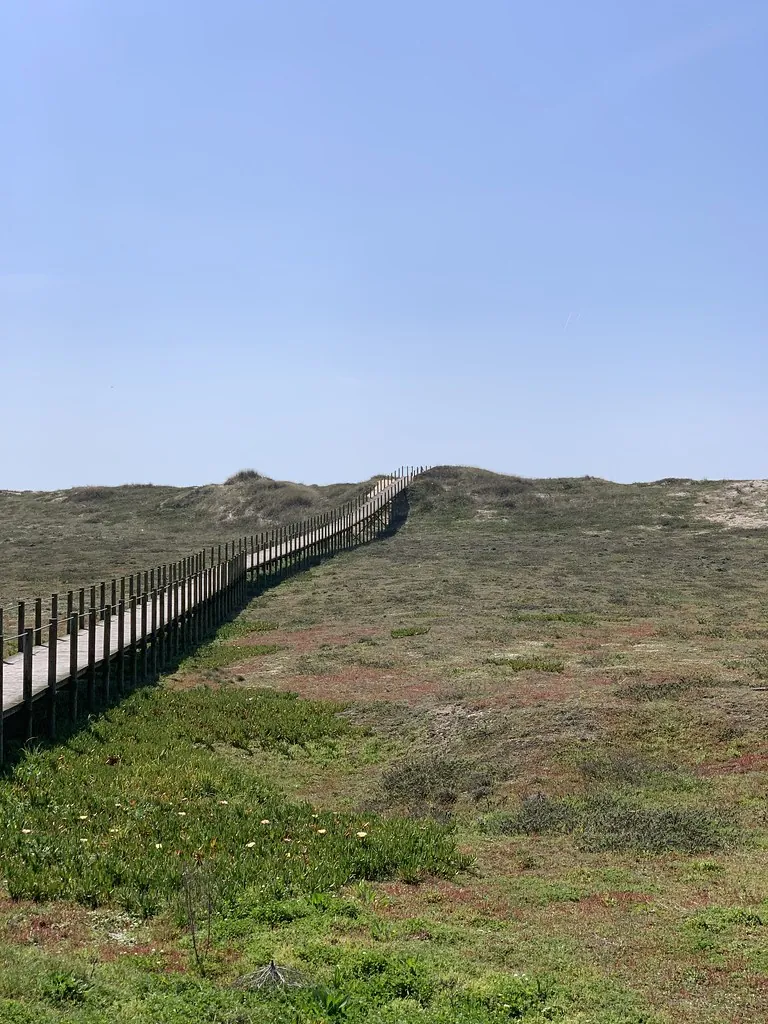
Behind the dunes, the Praia de Azurara arcs for nearly three kilometres, blond sand wide enough for a jumbo’s landing strip. When a north-westerly swell arrives, surfers and kitesurfers sprint across the wooden walkways; on flat August mornings, fishermen haul seine nets by tractor, diesel engines grumbling as they score deep arcs in the tideline. The scent alternates: first brine, then warm resin when the pine belt exhales under the midday sun, finally charcoal when sardines hit grills at dusk.
Caldeirada debates and Vinho Verde refills
Cooking here is a referendum on the correct ratio of tomato to coriander, the proper thickness of potato slice, the moment to add the monkfish. Every family swears by its own caldeirada, the fishermen’s stew that arrives at table in a shallow copper pan, saffron rising like sunset. Grilled sardines are non-negotiable on the night of São João, 23 June, when bonfires crackle along the beach and dancing lasts until the metro’s first train. If the son-in-law is invited, the household upgrades to arroz de tamboril – monkfish rice – its price whispered like a state secret.
Confectionery obeys the nearby convents: ovos moles shaped like scallop shells, almond cakes dense enough to stop a bullet. They are washed down with Vinho Verde from the demarcated region that begins just north of here, poured ice-cold into glasses that bead instantly; older locals top them up without asking, insisting city restaurants serve “carbonated tap water, not wine”.
Pilgrims, barges and a sixteenth-century fair
Azurara lies on the Coastal Camino to Santiago; scallop-shell way-markers guide today’s backpackers across the same bridge that once carried medieval cod-bound cargo to Braga. In September, the Festa de Nossa Senhora da Guia parades a seventeenth-century statue through streets carpeted with sawdust dyed the colours of the Portuguese flag. July brings the Festa do Senhor dos Navegantes: the image is floated down-river on a flower-decked trawler while brass bands play from accompanying punts, the service ending with communal sardines served on dented aluminium trays that could double as satellite dishes.
Book a room in one of the two-dozen guesthouses – most are converted fishermen’s cottages whose walls are thicker than a Ryanair baggage allowance – and you receive an invitation to the Feira de São Bento de Vairão, a country fair dating to 1518 where you can still buy hand-forged sickles beside indigo cotton towels. It is the sort of event at which the mayor makes a speech, someone wins a wheel of smoked cheese, and teenagers pretend they are not interested in the bumper cars.
Stay after the fireworks and you will understand why the place refuses the label “resort”. Nightfall empties the beach save for a few lamps on anchored punts blinking like low stars. The bridge thrums when the Atlantic breeze finds the right chord in its iron ribs. Somewhere a dog barks, then thinks better of it. What remains is the smell of wet sand beginning to cool, the faint sweetness of grilled fish still clinging to hair and clothes, and the sense that the river has, for a moment, forgotten the sea it is racing towards.