Full article about Labruge: Where River Onda Whispers to the Sea
Labruge blends salty beach air, granite mills, Santiago shell-markers and wood-fired broa on Porto's northern coast.
Hide article Read full article
The soundtrack arrives before the village does: Atlantic breakers colliding with the hushed slide of the River Onda. Labruge occupies the thin membrane between the two — a parish that never had to choose salt over fresh. Walk Rua da Igreja at dusk and you can still catch the phantom creak of timber water-wheels, though the mills fell silent decades ago.
The river that once fed the bread
A five-kilometre loop, the Mills Trail shadows the Onda past weirs padded with moss and curtains of willow. All ten granite mills are listed by Vila do Conde town hall — the only complete riverside set on Portugal’s northern coast. Moinho da Valéria keeps its stone roof intact; Moinho do Sol Posto faces due west and glows copper in the final hour of light. The last miller, Maria da Conceição “Tia Cotinha” Azevedo, died in 2020. Her knowledge surfaces only on Fridays inside O Forno da Aldeia, where a wood-fired oven turns fermented maize dough into crack-crusted broa.
Yellow scallop in the churchyard
Igreja Matriz de São Tiago rises beside the medieval coast road that once carried Portuguese kings between Porto and Vila do Conde. A sulphur-yellow cockleshell is painted on the churchyard flagstone: the marker for the coastal variant of the Caminho de Santiago. The adjoining albergue — a converted primary school — reopened in 2024 with 87 bunks and a credential stamp desk that operates from 10 a.m. to noon.
A mouth shared by two parishes
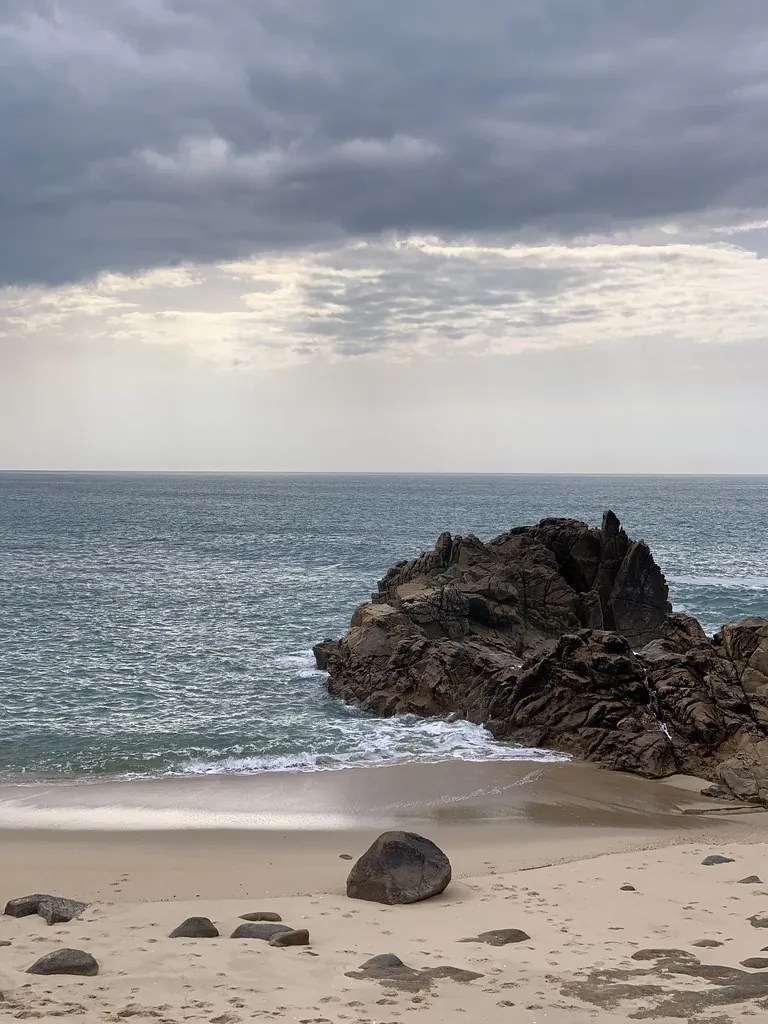
A timber footbridge arcs over the Onda’s mouth, splitting Angeiras (Matosinhos) from Labruge (Vila do Conde). Between October and March the North Littoral Natural Park interpretation centre lends out binoculars at weekends for grebe and turnstone spotting. Labruge beach itself is a 600-metre drift of pale sand, patrolled in summer. From the slipway a raised boardwalk runs south to Vila Chã — three flat kilometres that dawn joggers have claimed as their own.
Eel stew, whelks and tangerine firewater
Tasca do Gomes, set back from the bridge, ladles caldeirada de enguias — eel stew thickened with potato, mint and Minho white wine, always accompanied by toast-dark broa. In winter the menu shifts to feijoada de búzios (bean and whelk stew) and a looser, soupier sarrabulho than you will find inland. Pastry arrives in the shape of folhadinhos de São Tiago, flaky spirals stuffed with pumpkin jam, and toucinho-do-céu made only with sieved yolk. Loureiro-Arinto Vinho Verde from the Cávado sub-region is served in clay bowls; behind the kitchen a fishermen’s guild quietly macerates tangerine peel into aguardiente in five-litre brown demijohns.
When the church bell strikes six, salt rides the wind upstream and meets the darker scent of slow water. Labruge stays suspended between the two, a parish that measures time by tides and mill races rather than clocks.