Full article about Mindelo: Where Trains Skim Dunes & Wetlands Breathe
Mindelo, Vila do Conde, hides freshwater beneath its coastal dunes, pastel palheiros, rare plovers and age-old fisherfolk festivals just 25 min from Porto.
Hide article Read full article
The single-track railway nicks the edge of Mindelo’s beach like a blunt scalpel. When the Porto-bound train sighs into the 1875 timber halt, passengers on the seaward side are given a slanted, upside-down view of fishermens’ thatched palheiros—roofs the colour of dried kelp, walls the colour of salt. On the landward side, Atlantic pines flex in the wind and the dunes grip the continent as though the rent might suddenly go up.
Water beneath the sand
Those dunes are more than a backdrop. Beneath them lies a freshwater lens that keeps half the parish alive; the national environment agency patrols the fragile aquifer with the same vigilance a sous-chef reserves for truffle shavings. The duck-boarded paths are not picturesque whimsy—one careless footstep can snap the sand’s watertight seal and invite the sea into the groundwater. From the wooden hide beside the visitor centre, swivel-mounted binoculars pick out the Kentish plover, a dumpy shorebird whose eggs look exactly like speckled pebbles. Mindelo’s lagoons were Portugal’s first site to join the Ramsar list of wetlands—an honour secured in 1957, two years before the convention even existed.
Churches, surf-boats and processions that still turn out
The parish church of São João Batista squats in the middle of the settlement: stone portal left unpainted so the granite can breathe, bell tower clad in 1930s azulejos the shade of Wedgwood. In the forecourt, a granite cross leans 15° into the wind yet refuses to snap, like a mother-in-law who refuses to leave. Down the lane, Nossa Senhora da Guia houses ex-votos left by trawlermen—plastic limbs, silver-plated skippers, a child’s shoe bronzed after a safe return. Inside São Bento, in neighbouring Vairão, gilded angels carved by José de Almeida (Porto’s answer to Grinling Gibbons) clamber up columns as if angling for the sermon.
Every July the festa of Senhor dos Navegantes hauls the statue down to the tideline. Local surf-boats (saveiros) dress overall—yellow-striped sails, broom blooming from the masthead—and a concertina plays waltzes that sound older than the ocean. Sardines blacken over makeshift grills; the smell of charred skin drifts through incense and brine.
What you eat (and remember)
Eel stew is statutory at São Bento’s midsummer fair: river-caught eel, plum tomato, garden mint and cornmeal broa torn apart by hand. Sardine rice, stained gold with saffron grown twenty kilometres inland, tastes like someone else’s grandmother even if you never had one. In late June, street hawkers sell bolinhos de São João—fritters of sweet potato and cinnamon—so hot they blister your fingers. Wash them down with leveiro, a light red made from whatever the Atlantic-sprayed vines yield; it is bottled in spring and dead by Christmas, so procrastination is impossible.
Eight kilometres that earn their keep
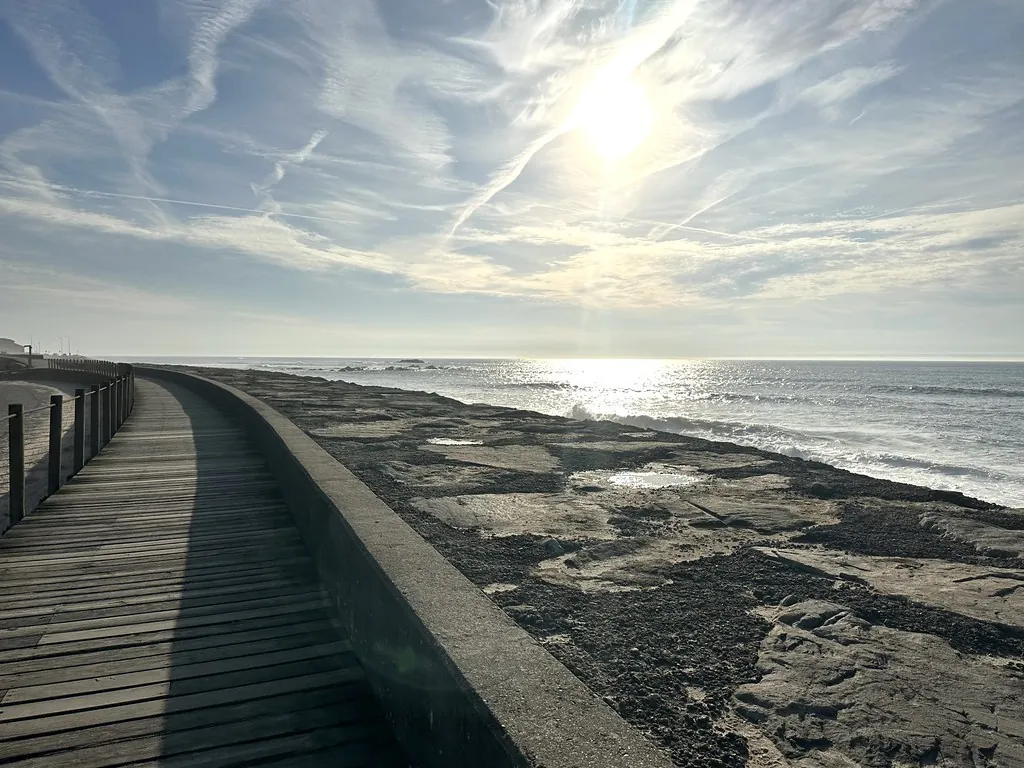
The Coastal Path strings together chapel, lagoon, pine ridge and beach in an eight-kilometre loop from the Capela da Guia to Praia de Árvore. Tarmac gives way to boardwalk, boardwalk to loose sand. Halfway along, an Artillery Corps bunker—built in 1942 to stare down U-boats—now serves as a picnic bench for walkers armed with ham-and-cheese sandwiches. Climb the final dune and the graceful iron curve of the Maria Pia bridge—Gustave Eiffel’s warm-up act for Paris—appears on the horizon, quietly photobombing every selfie.
When the evening train whistles its departure, you leave with salt freckling your lips, a smear of sardine ash on your thumb, and the certainty that Mindelo is still wedged between sea and pine, pretending the last century never happened.