Full article about Vila Chã: where Ave kisses the Atlantic
Salt tides, stone mills and flotillas of marigolds in Vila do Conde’s hidden parish
Hide article Read full article
The first thing you register is the gulls. Their steel-bright cries arrive before the ocean does, wheeling over the mouth of the River Ave where it unravels into the Atlantic. On the flood tide the air smells of iodine and warm silt; on the ebb you catch the darker note of peat from the saltmarsh that fringes Vila Chã. This is Portugal’s coastal limbo – a parish of 3,404 souls pressed between water and sky, where the land forgets to rise and time is measured by the slow breathing of the estuary.
Where the river meets the ocean
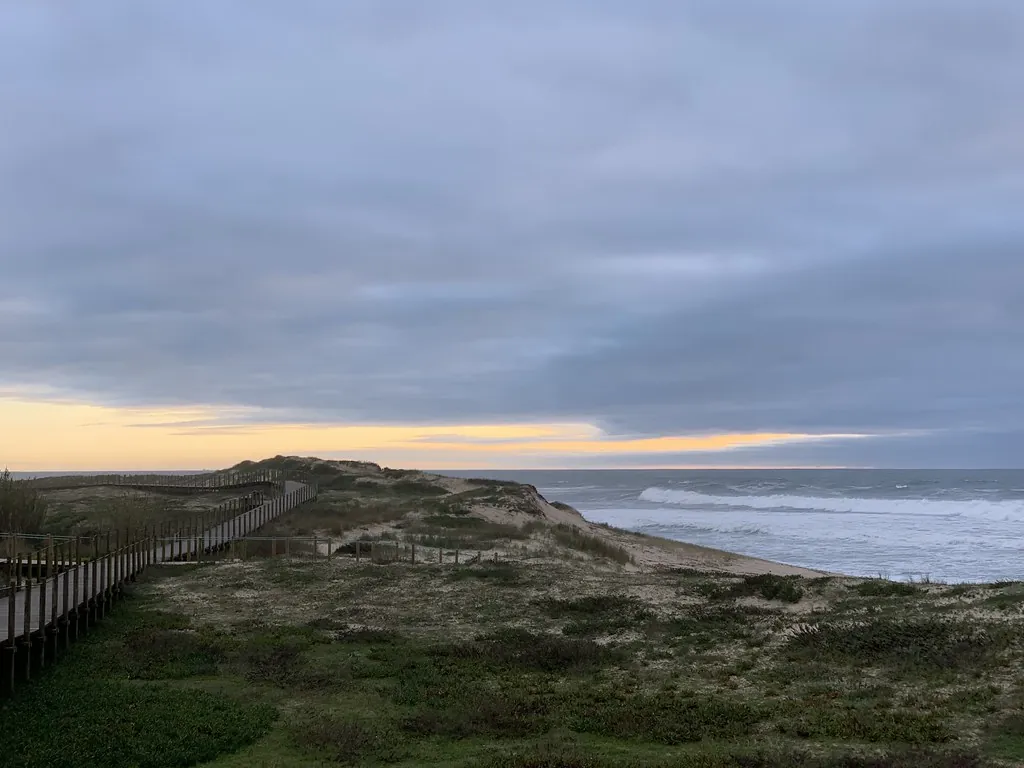
Board the timber walkway that stitches Vila Chã to Labruge beach and you walk above a world that is half-land, half-sea. Halophytes with silver leaves grip the boardwalk rails; glasswort glows jade-green at your feet. At spring tide the disused tidal mills stand clear like stone whales, wheels frozen mid-turn since the 1950s. The walk is 2.5 km; allow thirty unhurried minutes. Park free at the village end, then let the Atlantic wind do the pacing.
Back in the geometric centre of the parish, the 16th-century Igreja Matriz lifts its granite shoulders above lanes lined with manor houses whose coats of arms have been scoured featureless by salt. Beside the church a Roman immersion fountain – fed by the same aquifer that once supplied cod crews – still spills cold water into a square trough. Pilgrims on the Coastal Camino refill bottles here, unaware that medieval graves are set into the very flagstones they stand on.
The procession that floats
On the last Sunday of August the estuary itself becomes a nave. The Senhor dos Navegantes flotilla slips away from the ribeira quay at 4 p.m.: thirty fishing boats dressed with marigolds and signal flags, brass band balanced precariously in the lead vessel, hymns skimming across the water like skipped stones. Arrive half an hour early to claim a parking spot on Rua da Praia, or rent a kayak from the Clube Náutico (€20 for two hours) and join the aquatic choir. On the quay, plastic cups of vinho verde from the Cávado sub-region cost €1; a terracotta bowl of rojões (paprika-spiced pork) €2.
Xávega – the pre-Roman beach-seine – is still hauled here by human muscle. At dawn two or three times a week, depending on moon and tide, eight men in rubber boots chant in unison as they draw the 200-metre net through the surf. Be on the sand by 6.45 a.m. to watch; by 7 a.m. the catch is auctioned on the slip. Fried eel straight from the boat (€6 a dozen) is breakfast for those who know to ask the skipper of the Veleiro.
Where the Camino lingers
The Coastal Way of St James cuts a ruler-straight line through Vila Chã, flanked by cork oaks and tamarisk. Two albergues offer shelter: Casa do Pescador (€10) and the newer municipal hostel (€12). Cyclists can follow the waterfront cycle lane to Azurara – 4 km of level asphalt – picking up bikes at Loja do Gás for €15 a day.
Come nightfall, sign up at the parish council for Dunas à Noite (free, May–September, Fri–Sat). Guides lead you onto the fossilised dunes behind the village, extinguish every torch, and let the Milky Way pour across the sky. With no light pollution between here and Newfoundland, the constellations feel close enough to net. The Atlantic keeps its own rhythm, a low pulse under the wind – the sound of the planet breathing.