Full article about Arcozelo: sardine wharves & uncorrupt saint
Hear timber crates creak on Praia da Aguda, smell oak-smoke in Gaia’s barefoot Atlantic parish
Hide article Read full article
Salt and sawdust ride the same breeze. On Praia da Aguda, the last hand-built timber wharf between the Douro and the Ria de Aveiro creaks under crates of sea-bass and sardine, the men lifting with the unhurried choreography of those whose grandfathers did exactly this. Boards are split by July sun, swollen by January fog; their grain reads like tree rings for every season the boats came back. Behind them, the 1894 railway station—long, low and discreet—now houses the North’s only coastal aquarium; gilthead bream circle in illuminated tanks a biscuit-toss from the surf that first made them.
Arcozelo occupies 850 grassy hectares on Gaia’s southern lip, barely 30 m above sea level. Its Latin name, arcu celus—“little arch”—may refer to the soft fold of hills or to the stone bridge once thrown over the Granja stream, now corralled between concrete walls. Granted town status only in 1987, the parish has been inhabited since the early Middle Ages: dry-crop fields, vines that gave the world vinho verde, nets dried on wooden frames. When the coastal railway was electrified in the 1930s, ribbon development nudged the old fishing hamlets—Aguda, Mira, Pedra Alva—into commuter territory, yet the smell of oak-smoke and sun-warmed hemp still leaks from back-garden sheds on summer evenings.
Blue Tiles and an Uncorrupted Saint
Inside the sixteenth-century parish church, rebuilt after the 1755 earthquake, baroque gilding glints against azulejo panels the colour of a hazy Atlantic afternoon. Walk through the cemetery, however, and you reach the real devotional engine of Arcozelo: the Chapel of Nossa Senhora da Saúde, shrine to Santa Maria Adelaide. The young factory worker died in 1935, aged twenty-six; her body is said to have remained incorrupt. Candles gutter in front of the glass-topped coffin, the wax smell mixing with mums and eucalyptus from graveside jars. Roadside crosses—Manueline and rococo—punctuate the lanes beyond, relics of a sacred geography drawn long before Google Maps.
Gilded Boats and Beach Bonfires
June brings the Romaria of São Gonçalo and São Cristóvão: fishing boats strung with paper flowers and bunting process just outside the breakers, a floating pageant of faith and diesel. A week later the Festas de São Pedro pile bonfires on the sand and stage a mock maritime trial of the saint—verdict always forgiven, soundtrack always accordion. On the last Sunday of August the parish fête packs the main square with open-air mass, procession and a grilled-sardine cloud so thick it sugars the beer glasses. May Day, meanwhile, belongs to the Maios: children recite rhyming quatrains door-to-door, swapping home-made bouquets for sweets, the whole street turned dressing-less stage.
Eel Stew, Cornbread and a Wobbly Sponge
Arcozelo tastes of estuary silt and stone-milled maize. Caldeirada de enguias—a dark, oily eel stew—arrives with warm cornbread to mop until the bowl is a clean sunrise of saffron. Sardines grilled over pine cones need nothing more than brown paper and Atlantic ozone. At family-run O Pescador near the wharf, fried eels retain their seawater sweetness under glass-crisp skin; across the road, Arco Doce bakery turns out pão-de-ló so freshly tremulous it collapses into a spoonable custard centre. Communal ovens in Sá and Pedra Alva still fire corn broa and rye loaves; pass at dawn and you’ll feel the dry heat exhaling through cracked doors. Wednesday’s market in Sá brings down-country produce—soil-dusted turnips, wild asparagus that smells of wet pinewood.
Boardwalks, Sea Stacks and Two Saintly Ways
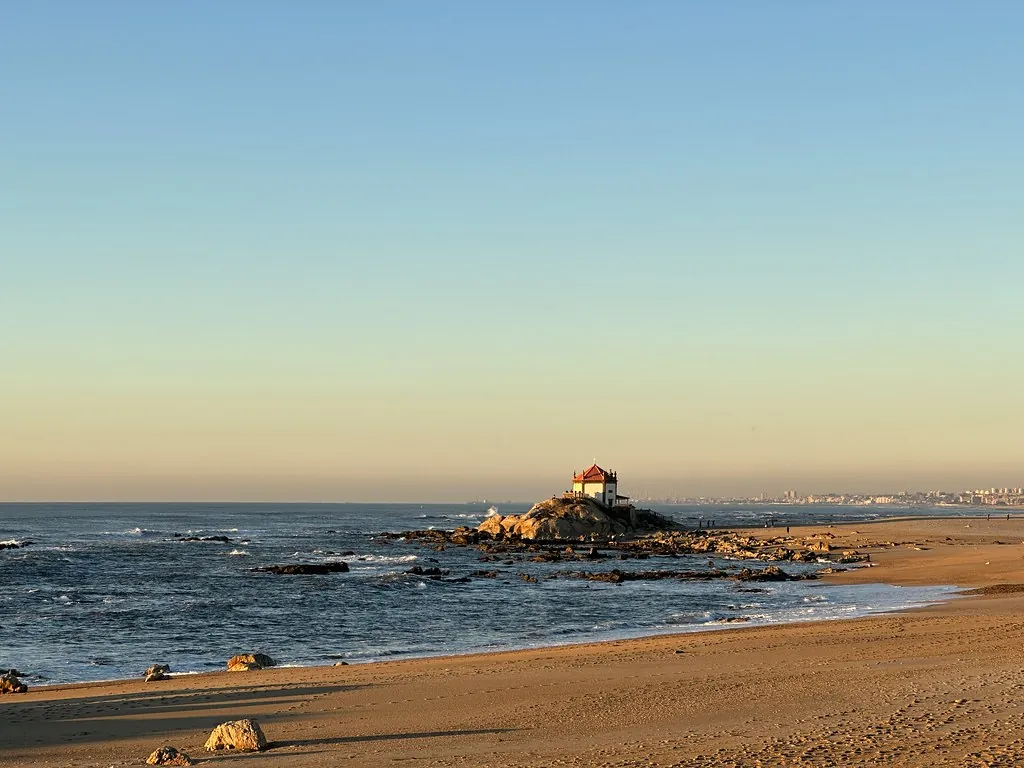
The Rio Ouro wooden walkway snakes two kilometres through dunes and stone-pine, sand trickling between planks, rock-rose scent thickening as the ocean fades behind. Praia da Aguda unrolls golden sand reachable only by boardwalk, its cordoned dune system a Natura 2000 refuge for sea-daffodil and sharp-leaved crowberry. Southwards, Miramar’s wave-lashed granite shelf supports the hexagonal Chapel of Senhor da Pedra, star of Edgar Pêra’s baroque-horror film O Barão. The Fishermen’s Trail stitches Aguda to Miramar along cliffs and boulder fields; here the Central and Coastal Portuguese Caminos converge, scallop-shell pilgrims crossing paths with men still mending nets by eye.
When the sun slips west, low light turns the timber wharf into a paper-cut silhouette against a blood-orange horizon. Gulls wheel overhead, but the sound that lingers is subtler: wooden keels grinding across damp sand, a slow rasp that stays in the inner ear long after the train back to Porto has pulled away.