Full article about Canidelo: Where Douro Meets Atlantic Salt
Neolithic tombs, reed-born name, Atlantic surf—Canidelo hides layers beneath Gaia’s coastal bustle.
Hide article Read full article
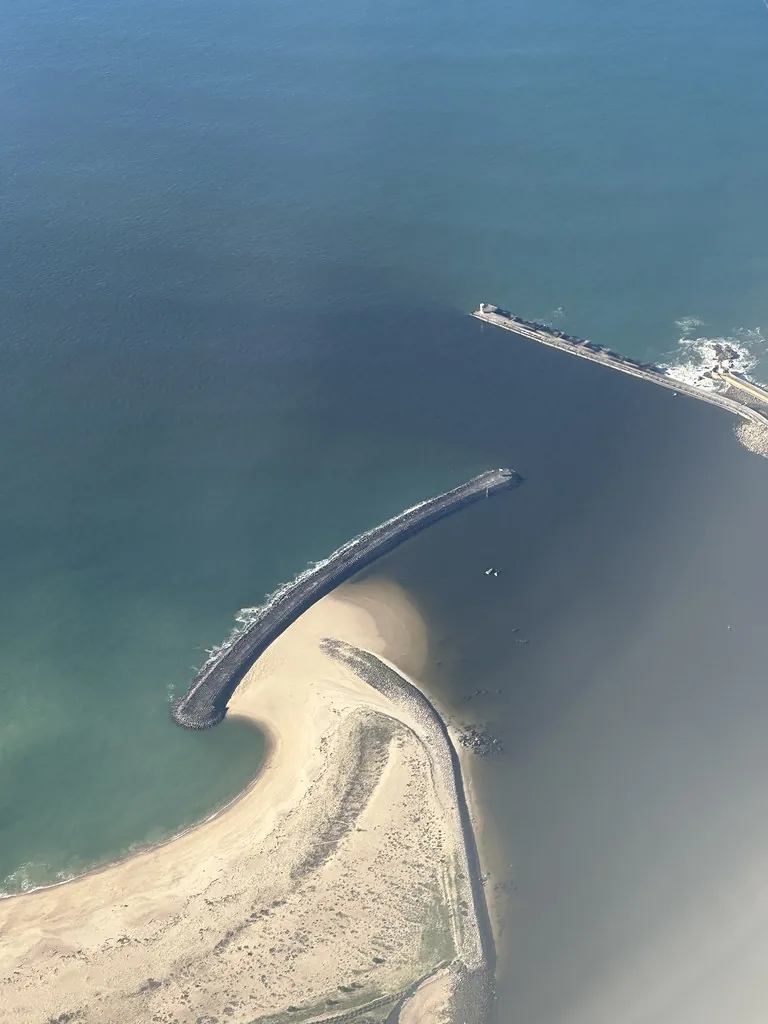
The salt wind finds you before the Atlantic does. It lifts the hair at your nape and dries the lip like a warning. Then the wooden boardwalk tilts gently upwards between the dunes and the river, and suddenly the ocean is simply there—gunmetal at dawn, bruised violet by late afternoon—while on your left the Douro slides into it without ceremony, surrendering its name to something larger.
This is Canidelo, a parish that occupies barely nine square kilometres of Vila Nova de Gaia’s coastline, pinned between estuary and open sea at an altitude of thirty-seven metres. Some 28,000 people live here, packed tight enough that mornings echo with buses, bicycle bells and the thud of footballs against asphalt. Yet most visitors cross the bridge from Porto, photograph the port-wine lodges further upstream and never realise they have already passed it.
A reed bank that became a place-name
The ear wants to translate “Canidelo” as “little dog”; the archives disagree. The first written form, Kanitello (1107), points to canebrakes—tall reeds that once rattled in the estuarine wind, their roots sunk in black mud. The reeds have retreated, replaced by cycle lanes, beach volleyball nets and a trim riverfront promenade, but the linguistic fossil remains.
Paper memory begins with King Afonso III’s national survey of 1258, which lists “S. Fins de Canidelo”. By 1527 the parish belonged to the Maia jurisdiction; only in 1836 did the liberal reforms of Mouzinho da Silveira attach it definitively to Gaia. Long bureaucratic pedigrees for such a slender strip of coast, yet the ground beneath is older still.
Flint beneath the flip-flops
In 1905 workmen digging foundations near the Capela do Padrão uncovered a Neolithic burial chamber—locals call it the Anta das Alminhas—together with quartz blades and pottery sherds. A casual stroll to the bakery therefore walks over at least five strata: asphalt, twentieth-century cobbles, medieval field walls, Roman fish-salting tanks, and a Mesolithic toolkit dropped by someone watching the same river-mouth eight millennia ago.
The parish church, dedicated to St Peter, has stood here since the thirteenth century; its granite blocks drink in winter damp and slowly bleach again in May sunshine. Closer to the water, the recently restored Capela do Senhor de Além catches the river’s bounced light, so that the interior shivers with moving shadow whenever the door stands ajar.
Two pilgrim routes, one horizon
Rarely does a suburb carry the scallop shell twice. Canidelo is crossed by both the Central and the Coastal Portuguese Caminhos de Santiago. Way-markers direct coast-bound walkers right along the dunes, Atlantic breakers drumming in their ears; the inland branch threads through residential streets where laundry flaps above toy cars and jacarandas. The two itineraries intersect at the parish boundary as if choosing between meditation and metabolism.
Between mudflat and beach break
The Douro estuary’s micro-reserve is the parish’s most sensorially concentrated address. At first light, low tide exposes glistening banks where pied avocets, bar-tailed godwits and the occasional glossy ibis stitch invisible seams. You do not need binoculars: the soundtrack is vivid enough—redshank alarms, the soft slap of a grey heron landing, sudden hush when a peregrine scissors overhead.
South of the river-mouth, Praia de Canidelo and Praia de Lavadores unroll 2 km of firm, brown-gold sand. A level timber walkway stitches them together, busy with weekend scientists brandishing shrimp nets and parents pushing running buggies. The 2021 census counted 1,675 under-15s here—explain the decibel level on a Saturday afternoon.
When the nortada wind stiffens, kitesurfers unzip neon wings and launch from the Douro’s sheltered side; surfers carry boards to the outer break where the tide has had 5,000 uninterrupted kilometres to organise itself.
Saints, sardines and loudspeakers
June belongs to São Pedro. Processions leave trails of petals along Avenida da República, grilled sardines carbonate the night air, and parish loudspeakers compete until the small hours. Mid-August adds Nossa Senhora da Saúde, whose candle-lit vigil spills from the church doors and turns the neighbouring arcade into an open-air pharmacy of whispered requests. Later still, romarias honour São Gonçalo and São Cristóvão, each with its own fairground ride and quota of caramel popcorn. During festival week population density becomes something you can bump into, smell, dance with.
The sound no phone can record
What you take away is acoustic: the precise metre where the Douro’s low bass note—almost a hum—folds under the Atlantic’s full-range roar. The two coexist for perhaps a hundred metres, a stereo overlap that cannot be captured by a microphone pressed to the back of a camera. Stand barefoot on Cabedelo at mid-tide, soles tingling with each wave’s aftershock, and the river’s surrender becomes something you feel in the marrow. Headphones off, screen dark, city lights beginning to prick the hill behind you.