Full article about Oliveira do Douro: River-Mist & Granite Arches
Hear Douro’s hush beneath Gaia’s shale slopes, sip history at Sardão’s 1690 aqueduct
Hide article Read full article
Oliveira do Douro: where the river still calls the cadence
The Douro announces itself before you see it: a low, steady exhale of water moving between stone banks, thick and the colour of chestnuts in November. From the promenade at Areínho the river’s breath rises as mist, settling on skin already filmed with Atlantic salt. Joggers overtake buggy-pushing fathers; someone brakes a bicycle simply to watch a rabelo cargo boat shear the reflected sky. We are 108 m above sea level, in Vila Nova de Gaia’s most densely packed civil parish—almost 3,000 residents per square kilometre—yet the traffic lights can’t compete with that liquid metronome.
Oliveira do Douro survives in the friction between apartment blocks that climb the shale slope and streams that still insist on finding the Douro’s level. The name itself is a contract: olives and water, the twin axes sketched in 14th-century charters and still legible beneath the tarmac.
Water that once ran above ground
Nothing in the parish speaks more softly, or more precisely, than the Aqueduto do Sardão. Built between 1690 and 1720 by José Bento Leitão—grandfather of Romantic writer Almeida Garrett—the two-tiered arcade of granite was never meant for show. Its job was to deliver spring water two kilometres to the Quinta do Sardão; today lichen maps the stone like a second, yellowing skin. The structure is modest compared with the Roman arches at nearby Vila do Conde, yet it is emblematic enough to share space with an olive branch on the parish coat of arms. Walk under it at dusk and you feel the pragmatism of a region that once solved thirst the way it now solves Wi-Fi dead spots—quietly, efficiently.
Close by, the parish church of São Miguel anchors the built heritage. Scattered through the grid of 1970s social housing you’ll find smaller chapels and stone fountains—punctuation marks in a long, run-on sentence of granite and whitewash. The 18th-century Quinta da Alegria, currently under municipal survey, adds another layer to a palimpsest that keeps being overwritten but never fully erased.
Two pilgrim routes, one riverbank
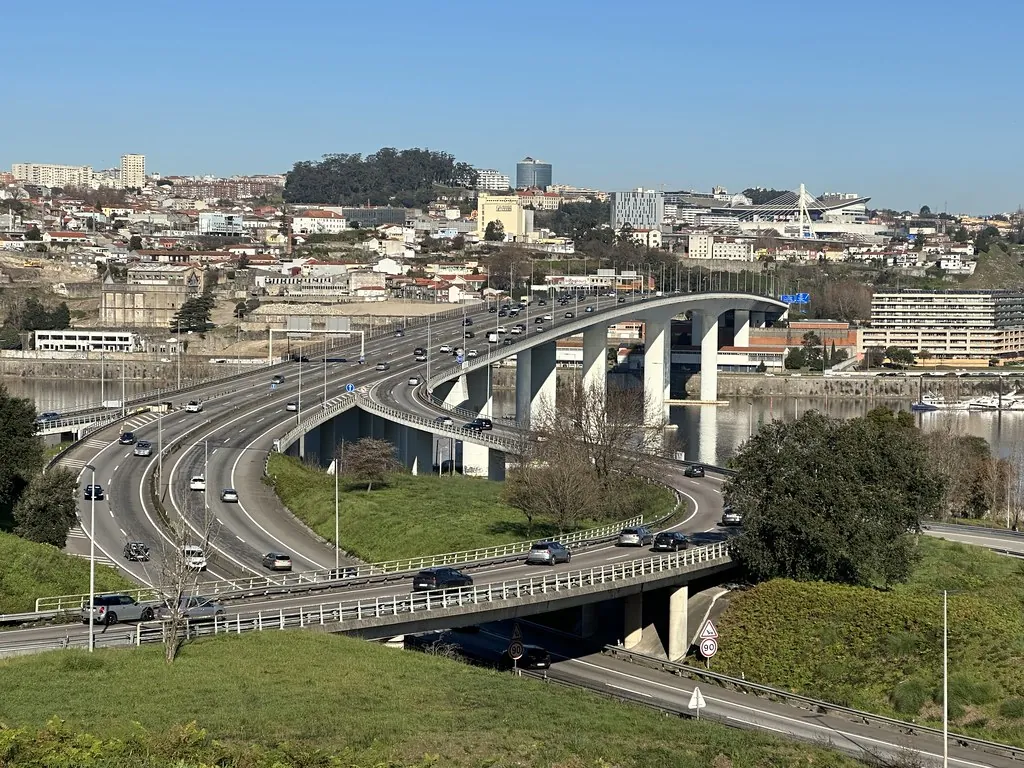
Few visitors realise that Oliveira do Douro is crossed by not one but two St James Ways: the Central Portuguese and the Coastal. Backpackers following the yellow arrows suddenly find themselves negotiating zebra crossings and café esplanades rather than cobbled lanes. It is perhaps the most urban 3 km of any Jacobean path in Portugal, a surreal interlude where the medieval merges with the Monday-momentum of 22,000 commuters. The new Ponte D. António Francisco dos Santos, scheduled to open in 2026, will throw a direct road deck across to Port’s Campanhã district, shortening the walk to Santiago but lengthening the list of commuters.
Sarrabulho on the plate, sardines on the grill
The parish sits far enough up-estuary for the Atlantic to muscle onto menus—grilled sardines, fish-head caldeirada—yet Minho and the Trás-os-Montes supply the interior grammar: pork liver papas de sarrabulho, cumin-scented rojões, winter cozido stacked with chorizo and cabbage. The acid tang of cabidela—chicken or kid finished with its own blood and a splash of red-wine vinegar—turns up in back-street tascas on Thursdays. Desserts obey the convent ledger: egg yolk, sugar, almond. Toucinho-do-céu (“bacon from heaven”) and the clam-shaped pastéis de Santa Clara demand a follow-up espresso bitter enough to reset the palate.
Saints, processions and summer dances
Festivity here is less Instagram backdrop than civic circulatory system. In late May the parish council stages the Festas em Honra de Nossa Senhora da Saúde, processions book-ended by fireworks and open-air concerts in the EcoParque. June belongs to São Pedro: patchwork banners sag between balconies, brass bands march, and the smell of charcoal-roasted beef drifts over improvised trestle tables. Mid-July’s Romaria de São Gonçalo e São Cristóvão sees folkloric ranchos twirling to concertina and drum, the dancers’ woollen socks improbable in 28 °C heat. During these nights population density becomes choreography—neighbours reserving the same plastic chair they occupied last year, children shouldering gilt saints’ statues learned by heart.
Green between the concrete
For all its brick-and-mortar density, Oliveira do Douro keeps fragments of its original topography. The EcoParque do Atlântico, a former quarry turned sports-and-events lawn, acts as the parish’s pressure valve. Smaller streams—Ribeiro do Castelo, Ribeira da Granja—slip between housing estates, their banks colonised by cane and giant reed that rattle like sabres in the north wind. The riverfront boardwalk from Areínho to Caldas de São Jorge is best taken at walking pace; cyclists politely ping bells while fishermen sink lines for barbel and nase. Morning joggers share the path with retired men carrying folding chairs and a bottle of mate tea, convinced the best bite coincides with the 10 o’clock ferry from Crestuma.
By late afternoon the lowering sun flattens the Douro into a sheet of beaten copper. The promenade empties, leaving only the river’s rumble, the caramelised smell of grilled sardines lingering above the water, and—if you listen past the hum of the IC23 flyover—the single bell of São Miguel marking the Angelus. Oliveira do Douro grew around olive roots and water; in that double reflection it still recognises itself.