Full article about Santa Marinha: Port vapours rise from granite quays
Santa Marinha Vila Nova de Gaia hides oak-scented Port lodges, 14th-century granite chapels and river-washed lanes beneath Porto’s mirrored skyline
Hide article Read full article
Santa Marinha: where the Douro exhales between granite and cask
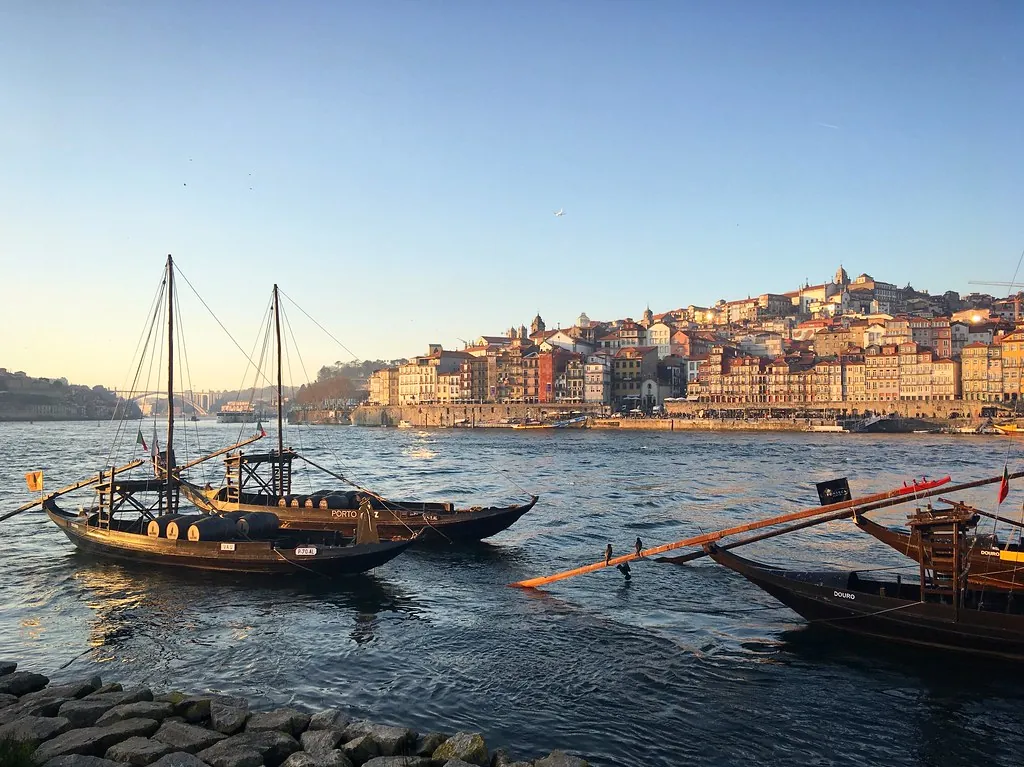
The smell reaches you before the view. A warm, bready sweetness of old oak and maturing Port drifts uphill from Gaia’s riverfront, carried by the same breeze that once filled the sails of the laden rabelo boats. It is the scent of slow time: decades condensed into a single inhalation. Within Santa Marinha’s six square kilometres the Douro is not postcard background; it is narrator, employer, landlord and mirror, bouncing Porto’s tiled façades back at themselves.
River first, everything else second
The parish takes its name from a 14th-century church whose square tower rises like a stone wardrobe against the hillside. Around it, fourteen classified monuments are stitched into the street grid—tiny granite chapels, baroque crosses, a fountain or two—so discreetly that you can turn a corner and find yourself inside the Middle Ages without noticing the threshold. Trade followed the water: stone quays, narrow flights of steps worn into gentle waves, warehouses the colour of weathered parchment. The river dictated the grammar of the streets; even now every slope is a sentence ending in water.
Underground cathedrals
Leave the sunlit promenade, push open an unmarked door and the temperature drops five degrees. Inside the lodges—Cálem, Kopke, Taylor’s, Sandeman—aisles of French-oak pipes recede into darkness like pews in a subterranean cathedral. The air is viscous with alcohol; the walls bead with moisture. A lodge man draws off a thimble of tawny with the gravity of a verger pouring communion wine. Above your head, Gaia carries on its afternoon business; down here the calendar is measured in angel’s shares and decades.
Festivals that refuse to move out
17,000 people still live in the parish, and they keep their calendar stubbornly local. In mid-August the Festas de Nossa Senhora da Saúde lace the steep lanes with paper garlands and artificial roses; the procession squeezes past front doors while residents lean from balconies as if greeting distant cousins. June belongs to São Pedro: brass bands, makeshift grills, sardine smoke that clings to cotton like proof of devotion. No one has thought to move the party to the conference centre; the streets are the ballroom.
Two Santiago trails cross here
Most walkers tramp the upper deck of Dom Luís I bridge, selfie the view and march on. Few realise that both the coastal and the central Portuguese pilgrim routes to Santiago thread through Santa Marinha. Dawn brings rucksacks through the parish before the cafés have finished stacking the pastéis de nata. Pilgrims share the pavement with commuters, briefcases versus walking poles, an accidental choreography that feels entirely Portuguese.
Atlantic salt, Douro depth
The menu is split between river and ocean. You can lunch on Gomes de Sá’s salt-cod—potatoes turned translucent with olive oil—then supper on a francesinha so drenched in spiced tomato-and-beer sauce that the china beneath disappears. In the tascas behind the church, tripe is still simmered in copper pots older than the EU. Nothing carries a DOP label; the only certification is the waiter’s assurance that his grandmother would eat it.
The light that pays back
Stay on the quay until late afternoon and you’ll witness a quiet transaction. The sun strikes Porto’s riverside first, bouncing off painted plaster and medieval brick, then ricochets across the water to ignite Gaia’s stone with an orange glow, as though the river were returning borrowed money with interest. A bell drifts down from Santa Marinha’s tower, half-drowned by café chatter and the slap of tide against hull. It is the sound of a parish that still keeps medieval time, tolling the hour even when no one is officially listening.