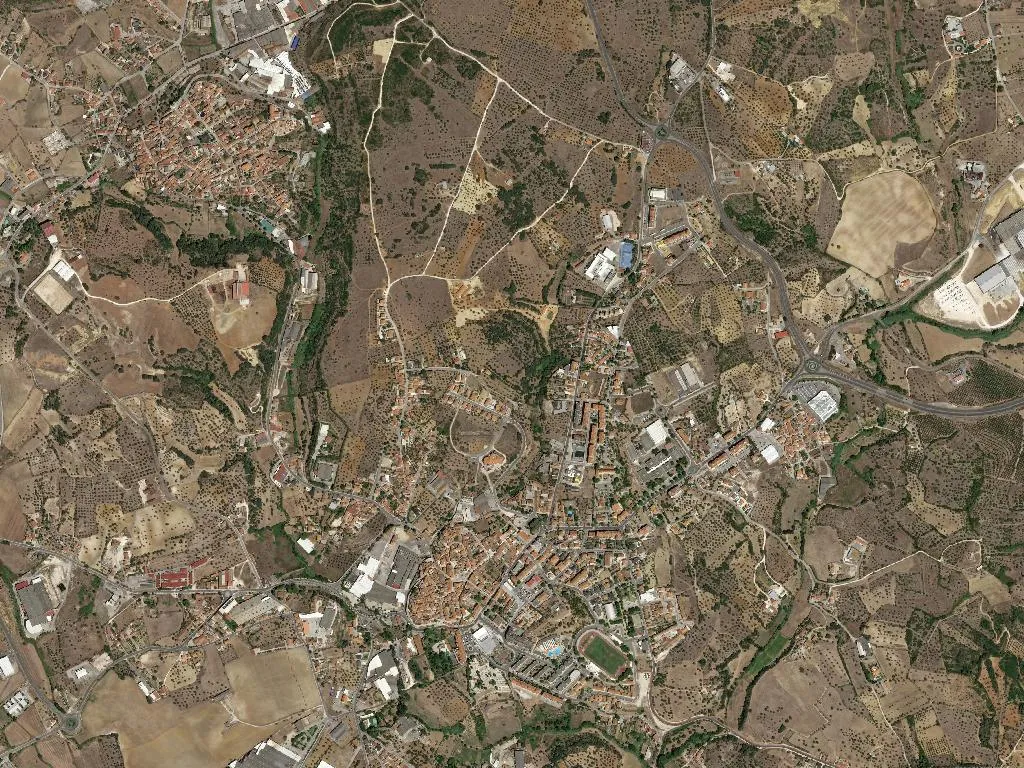
Full article about Alcanena & Vila Moreira: Echoes of Paper, Stone and River
Alcanena-Vila Moreira blends 1926 limestone quarries, a shuttered paper mill and the tree-shaded Alviela loop into a 15 km² Ribatejo tale.
Hide article Read full article
The late-afternoon light slips through the broken panes of the Casal dos Pretos paper mill, laying bars of gold dust across the cracked concrete. Alcanena’s heartbeat is still syncopated by the machines that stopped twenty-three years ago; in the Café Central they talk about Celbi the way Liverpudlians talk about the docks—1,200 jobs, 1963-2001, a whole town clocking in at the same gate. Yet the real skeleton of the place is limestone. Hacked from the Carrascal quarry since 1926, sliced on the saws of Olho do Bode ridge, burnished in the workshops of Mota & Companhia, it has left a chain of pale amphitheatres across the hills. The largest is 40 m deep and 12 ha wide—an inverted coliseum that catches the sun like moon rock.
Between River and Stone
The Alviela is too modest to boast, but every drop explains why people stayed. Its flow fed a mill mentioned in a 1336 charter, irrigated wheat fields until the 1970s, then cooled the paper vats that turned the village into an industrial knot. Today the river’s 5.3 km way-marked loop is a corridor of blackbird song and water-whisper where joggers share the path with men who once walked it to the night shift. Across the water, Vila Moreira has always been the other half of the same watershed; when the two parishes were merged in 2013 nobody felt the boundary disappear because it was never really there.
4,854 people occupy 15.84 km²—roughly the density of Bath in a space the size of Regent’s Park. Terraces cling so tightly along Rua Dr Joaquim Tomé Ribeiro that numbers 47 to 73 fit into fifty metres of pavement. Climb ninety-five metres above the centre, though, and the view unrolls: 180 ha of olive groves certified DOP Ribatejo yielding 450 t of oil a year, 25 orchards producing 800 t of Rocha pear, and beyond them the stepped white scars of eight still-working quarries—three inside the parish alone.
The Weight of Time
One in four residents is over sixty-five. That arithmetic sits on a bench in Jardim 1º de Maio every morning at nine-fifteen: Sr António, 78, retired fitter from the Sotér lock factory, brings the same boxwood dominoes he’s used since 1997. Younger families live in the Cruz da Pedra social quarter—ninety-six flats built 2008-10 where four-storey blocks replaced single-storey cottages with vegetable plots. On Saturdays grandparents wheel pushchairs to Praça Tomás Pinto; the metal slide warms in the sun and children shout in Portuguese peppered with “selfie”, “like” and “YouTube” picked up on the tablets of Escola Básica D Dinis (298 pupils, 2023-24).
Eating the Ground
Recipes are heirlooms, not trends. At O Popular the bean-and-kale soup still follows Dona Alice’s 500 g-butter-bean formula—leaves from her nephew’s back garden, bay from the tree outside the door. Three streets away, O Mengo’s wood-fired oven perfumes cod with the same carvalho oak Sr Luís’s grandfather bought from Sr Faustino, a woodcutter on Olho do Bode. November means the scent of new oil at Lagar do Casal dos Pretos: six granite presses squeeze twenty tonnes of olives a day. Finish at Café Central with D Lourdes’ pear preserve—three Rocha pears, 200 g sugar, one stick of canela from a 92-year-old neighbour’s travelling spice tin.
Where to Stay, How to Be
Only one place carries an official plaque: the 22-room Hotel Alcanena, opened 1991, refurbished 2019. The absence of boutique conversions is not oversight—it is honesty. Alcanena entertains 1,400 visitors a year, mostly geologists, cyclists on the Alcobertas–Minde greenway, and descendants of mill workers tracing family ledgers. Hospitality is measured in directions, not stars: in the grocer’s “turn left after the postbox, third gate painted blue”; in the bakery where a neighbour delivers sliced loaf at 7.30 because she knows the grandchildren are visiting; in the barber who keeps a 1965 photograph of the Corpus Christi procession when rain soaked the priest’s surplice and the brass band played barefoot.
At 17.30 the saws fall silent, the limestone dust resettles, and the town takes a mineral breath. The bell of the parish church—built 1706-23—strikes six, the note rolling along brick façades on Rua Luís de Camões until it reaches the whitewashed gable of Largo do Coreto. It is not silence; it is a pause. One by one the street-lights answer: Sr Joaquim’s corner lamp, D Albertina’s carriage lantern, until Rua da Amieira is fully lit at 20.15 and the evening shift of everyday life begins.