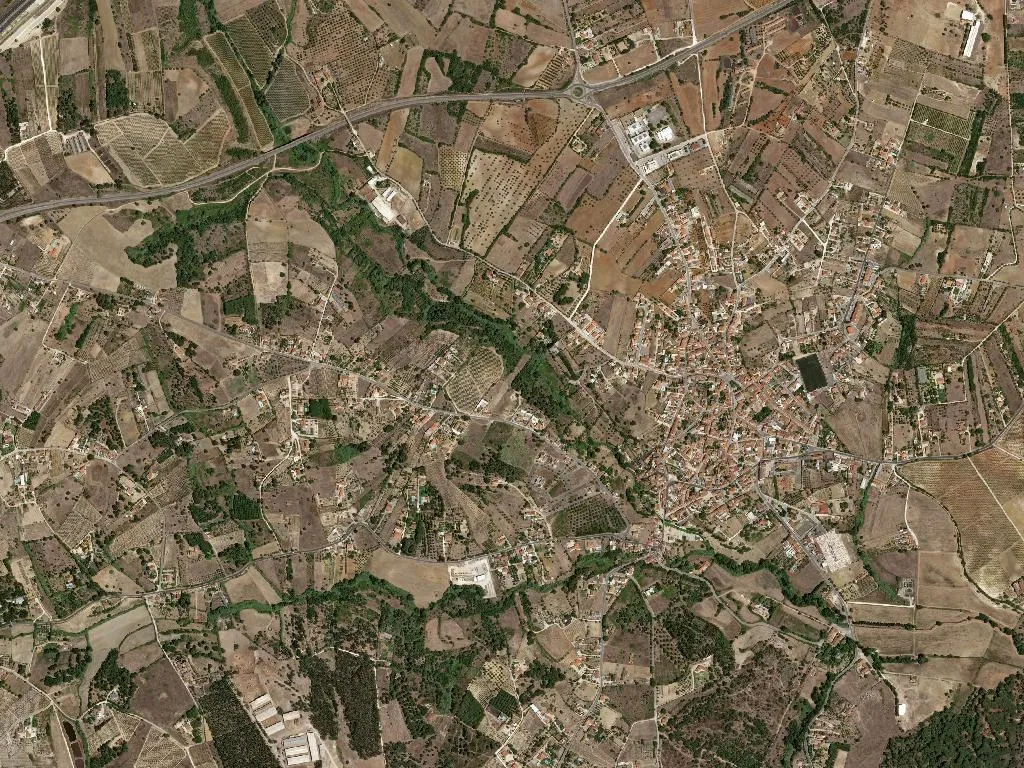
Full article about Pontével
In Cartaxo’s quiet parish, irrigation arms write crop colour across alluvial soil
Hide article Read full article
The scent of wet earth
The irrigation arms swing over the rectangles of alluvial soil and the smell of wet earth rises between Pontével and the Tagus. Poplars file along plot lines like quiet bailiffs; the only verticals are water towers and the occasional stork. At 58 m above sea level the view is a spreadsheet of colour values – January’s cabbages the deep green of a billiard cloth, July’s wheat the exact buff of dry straw you remember from Hockney’s "Mulholland Drive".
A parish that refuses to be a town
The N3 speeds through, carrying commuters from Cartaxo to Santarém who rarely brake. Houses sidle off the carriageway in no particular order: 1970s bungalows with satellite dishes, older smallholdings where a David-Brown tractor sits in the yard next to a pile of orange crates. Density is 156 people per km² yet you can walk ten minutes between letterboxes. The only listed building is the eighteenth-century parish church, but pilgrims don’t stop for Baroque altarpieces; they stop because the fields themselves – vines, olives, pears – are the attraction.
What the land dictates
This is the Tejo wine region, where vines share rows with olives entitled to the Ribatejo DOP seal and with Pêra Rocha orchards that locals insist taste better here than anywhere else in Portugal. The single café on the roundabout functions as de-facto town hall. Ask what’s for lunch and the cook replies with the day’s truth: bean soup thick enough to hold a spoon upright, bread baked at 5 a.m., on Friday whatever silver-sided fish Sr Joaquim brought back from the Lisbon market. Chickens enter the pot after their laying career; chickpeas are soaked the previous autumn. Nothing is written down, everything is seasonal, and the olive oil on the table was pressed last month from fruit grown across the lane.
Way-station, not destination
The Central Portuguese Route of the Camino slips through Pontével without fanfare. There is no albergue; instead walkers knock on the door marked “Albertina” where two spare rooms come with sheets smelling of sun-dried cotton and breakfast includes homemade tomato jam. Nine dwellings are registered for rural tourism, all private homes whose owners prefer silence to star ratings. Demography tells the usual story – 518 children under fourteen, 1,218 residents over sixty-five – yet GPS-guided tractors still crawl across the loam at dawn, sowing perfect furrows for a crew of three who manage what once took twenty. The school has two classes per year, the library opens Tuesdays, Thursdays and Saturdays, and the land keeps its own timetable.
When the low sun flattens the fields into a chessboard of indigo shade, Pontével smells of turned soil and new manure – an aroma that no travel poster can bottle. It is the fragrance of a place that keeps planting, keeps harvesting, and asks nothing more of visitors than that they leave before the water sprinklers start again.