Full article about Santa Margarida da Coutada
Follow the Trilho das Fontes past outlaw fonts, granite springs and schist echoes
Hide article Read full article
The hush of morning is shattered by the toll of a bell — three slow, resonant strokes that rise from the parish church and fade into the grove of cork oaks. A dog barks somewhere beyond the red earth. The air smells of dust and gum-cistus, the resinous shrub that cloaks the hills in a grey-green mantle. Santa Margarida da Coutada wakes reluctantly, at a tempo set by its own scarcity. With 1,601 souls spread across 62 km², solitude is measured in square metres rather than minutes; you can walk for an hour and meet only your own footfall echoing off schist walls.
A parish baptised by stealth
Local lore insists the settlement was born in 1618 when an outlaw font appeared overnight inside the existing chapel, forcing the bishop to recognise a new parish carved from Vila de Rei. Whether pious conspiracy or convenient legend, the name tells an older story: "Coutada" once denoted a royal hunting preserve where only the crown could chase boar and red deer. The right to hunt vanished with the liberal reforms of 1834, but the memory lingers in the 1867 church that still occupies the thirteenth-century footprint. Inside, gilded carving glints against tile panels that narrate the martyrdom of Saint Margaret, dragon and all, while late-afternoon light fractures through nineteenth-century stained glass onto stone worn smooth by centuries of knees.
Springs that saved lives
Water here was never ornamental. When typhoid swept the Tagus valley in the 1840s, the parish council erected the Fonte de São João (1849) above a reliable vein of granite-filtered water. Its adjoining wash-house, a long granite trough scarred by scrubbing, still carries the ghost-murmur of women who exchanged gossip while attacking shirts with wooden bats. Three kilometres south, the Fonte da Mina (1882) feeds a stone basin no wider than a cartwheel; the iron spout is rusted the colour of burnt umber, yet the water runs icy even in August. Linking the two, the Trilho das Fontes is an eight-kilometre ribbon of cobbled mule paths and dry-stone walls that drop into valleys where streams hurry toward the Tagus between ash and willow. Walk it early and you’ll startle a heron lifting from the mist.
Cork, carrion and quiet
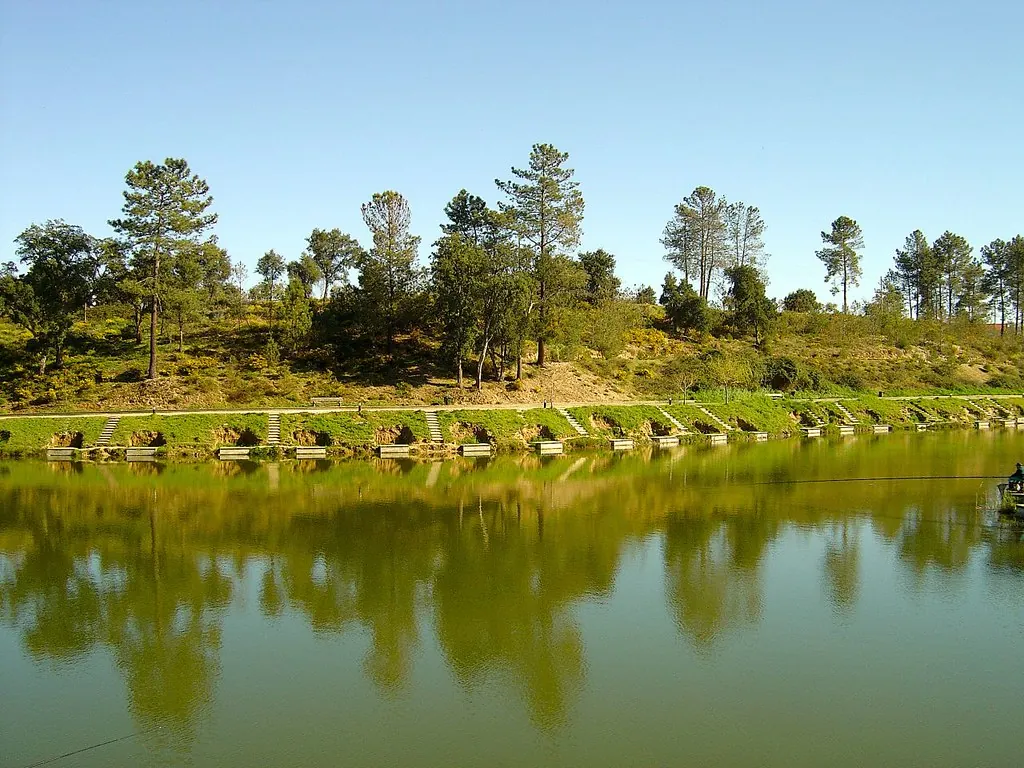
The horizon is a ruler-drawn line interrupted only by the occasional umbrella pine or holly oak. This is montado in its purest form: cork oak spaced wide enough for sheep to graze and pigs to root for acorns. At dusk the Santa Margarida dam, no larger than a farm pond, becomes a mirror for migrating gulls and the occasional spoonbill. Overhead, black vultures ride thermals in regal silence; lower, a booted eagle scans the scrub for oblivious rabbit. The loudest sound is the crack of a twig beneath wild-boar trotter.
Food that tastes of earth and river
Lamb stew arrives in a black clay pot, the meat slackened with nothing but garlic, white wine and coriander stalks. Sarrabulho rice, the colour of Burgundy, carries the metallic note of fresh pig’s blood bound with smoked chouriço and cubes of morcela. On winter mornings tomato soup is thickened with yesterday’s alentejano bread and topped with a poached egg that breaks into saffron threads. Sweet loaves called fogaceiros — enriched with egg yolk and perfumed with lemon zest — appear during the Festa de Santa Margarida, the fourth weekend of August, when the churchyard turns into an open-air canteen and the village brass band negotiates its way through vira dances. November brings the new olive oil: green-gold, peppery at the back of the throat, tasted on crusty bread with a pinch of flor de sal that catches the light like frost.
When the sun slips behind the Serra de Alvelos the cork trunks glow copper. Shadows lengthen across the red soil; somewhere a tractor coughs once and dies. The bell rings again — six, perhaps seven — the note hanging in the cooling air long after the clapper is still. You carry the smell of cistus home on your jacket, a reminder that some places keep time not by clocks but by the slow expansion of bark.