Full article about Nossa Senhora de Fátima: born of steam, steel and sidings
In Entroncamento, rails laid in 1861 still pulse as Portugal’s railway heart and parish soul.
Hide article Read full article
Where Iron Gave Birth to a Town
The whistle tears the air before the train appears. A low, almost visceral note, it ricochets off the concrete platform and settles behind the ribs. At Entroncamento station the ground trembles to the metronome of wheel on rail—tum-tum, tum-tum—while the air tastes of diesel and rust, a metallic film that lingers on the tongue. No other Portuguese town carries a birth certificate like this: in 1861 there was no village, no chapel, not even a crossroads—only Ribatejo flood-plain, flat and water-logged, forty-five metres above the sea. Then the Linha do Leste arrived, bringing with it rails, sleepers and men whose palms were already engrained with coal dust. Houses, streets, identity—everything else grew around the iron like moss on stone.
A town that began as a junction
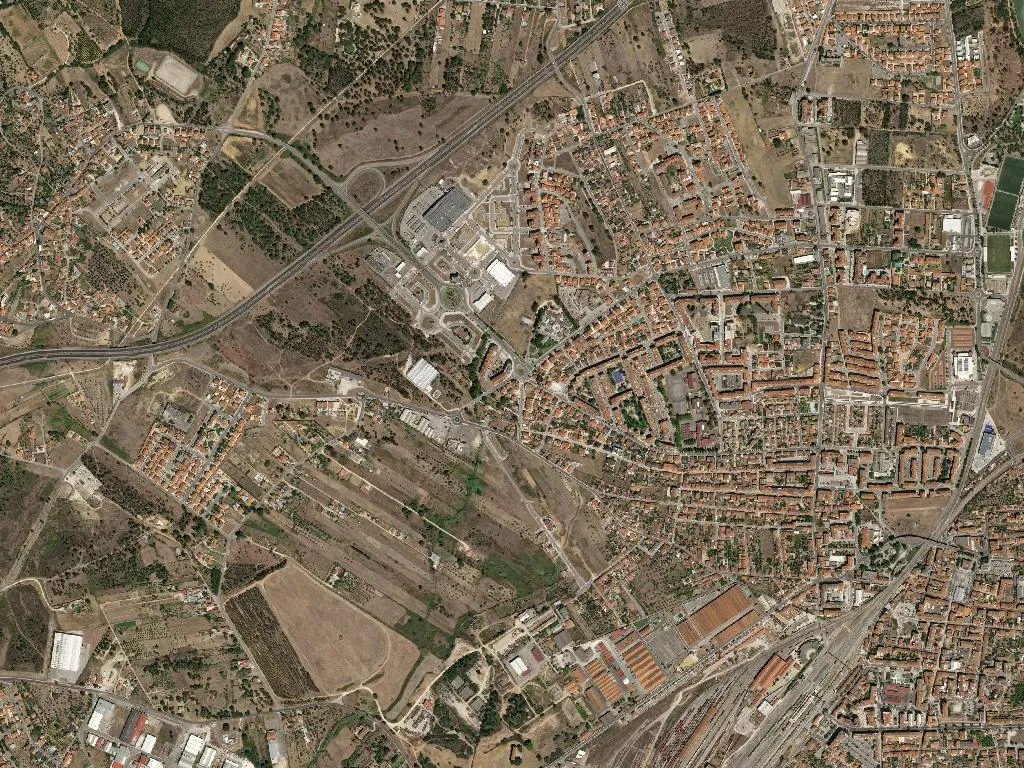
When the station opened on 18 October 1861, Entroncamento was not yet a dot on the map; it was a verb—to entroncar, to switch tracks. Locomotives were uncoupled, wagons shunted, freight rerouted. Thirty-seven parallel sidings—then the longest fan of track on the Iberian Peninsula—lay open like a steel hand. Boiler-fitters, drivers, mechanics followed. They threw up barracks first, then cottages, then entire neighbourhoods. In 1932 the settlement was promoted to vila (town); two years later the parish of Nossa Senhora de Fátima was carved from Santa Catarina da Sertã, its name chosen by ballot on 28 May 1934, beating São José Operário and São João Baptista—a reminder that Marian fervour still rippled out from the 1917 apparitions 25 km away. Today every Lisbon–Porto or Lisbon–Madrid service still stops to swap locomotives; Entroncamento is not on the line, it is the interchange.
Steel giants and Almada’s stained glass
The National Railway Museum occupies the old fitting shops; step inside and you walk into an industrial cathedral. Coal-fired giants stand in mute formation—black boilers polished by decades, pistons thick as oak trunks. Royal carriages, velvet seats balding to the weave, exhale the faint scent of varnished mahogany. Ninety minutes disappear among brass pressure gauges and connecting rods without a glance at a watch. Outside, in the public gardens, Portugal’s only surviving semaphore signal still lifts its crimson arm to the sky like a flagman greeting a ghost train.
Five minutes away, the parish church of Nossa Senhora de Fátima, inaugurated on 13 May 1956, startles with pure 1950s modernism. Almada Negreiros’ abstract stained-glass panels throw shifting pools of cobalt and amber across the nave, a kinetic calendar that drifts with the sun. The 1940s railway social club—once strictly for CP staff—now hosts concerts; inside, the original render is deliberately left rough, the texture of a time when leisure was timetabled with the same precision as the mail train to Badajoz.
Fireman’s calories
Entroncamento’s cooking was never meant for grazing tourists: it fuelled men who shovelled coal and spun spanners in the Ribatejo glare. Sopa de grão arrives in deep bowls—thick chickpea broth bobbing with slices of pork chouriço, shards of belly pork and a sprig of mint that releases its scent the moment the spoon dives in. Broa, corn-bread with a crust you could tap like a drum, is obligatory. Bacalhau à linha—grilled cod laced with olive oil, garlic and smoked-paprika, served over bread that drinks up the juices—tips its hat to the drivers. In pig-slaughter season, papas de sarrabulho (blood-enriched porridge with spare ribs) reminds you that asphalt hasn’t erased the countryside. The almond-rich toucinho-do-céu travelled here with crews on the Tomar branch, bringing conventual sweetness in their lunch tins. Throughout, Ribatejo DOP olive oil—galega and cobrançosa varieties—lends a peppery gloss that makes bread, chickpeas and cod taste immediately of this specific plain.
Where rails give way to water
Walk two kilometres down the Almonda Linear Park and the clatter of wagons dissolves into water murmuring over stone. A four-kilometre boardwalk leads to the 1925 riveted-lattice bridge built for the Tomar line; when the wind rises the trusses creak like breathing. Grey herons stand motionless among the reeds, kingfishers dart and reappear faster than a blink. Community allotments beside the Bairro da Estação wedge tomatoes, cabbages and fig trees between breeze-block walls; retired railwaymen irrigate them at dusk, reciting timetables from memory.
On Sundays a steam special huffs out of the main station towards the Carvalho viaduct; a joint ticket includes museum entry. Inside the carriage the whistle feels intimate, the vibration travelling straight through the bones. Through open windows the lezíria’s hot air arrives powdered with dust and the distant scent of rock-rose.
The echo that stays
With 12,849 souls packed into barely nine square kilometres, silence is always provisional. Somewhere a bogie squeals round a switch, a rail expands in the heat with a dull click. That is Entroncamento’s pulse—not the ticking of a clock but the slow heartbeat of a locomotive at idle. Sit on a bench beside the red semaphore in the public garden and, sooner or later, your own breathing falls in with it. You realise, without anyone spelling it out, that this town never put down roots in the earth; it anchored itself in steel.